 Anacortes Siding
 Fidalgo Island Sits Right in the Weather
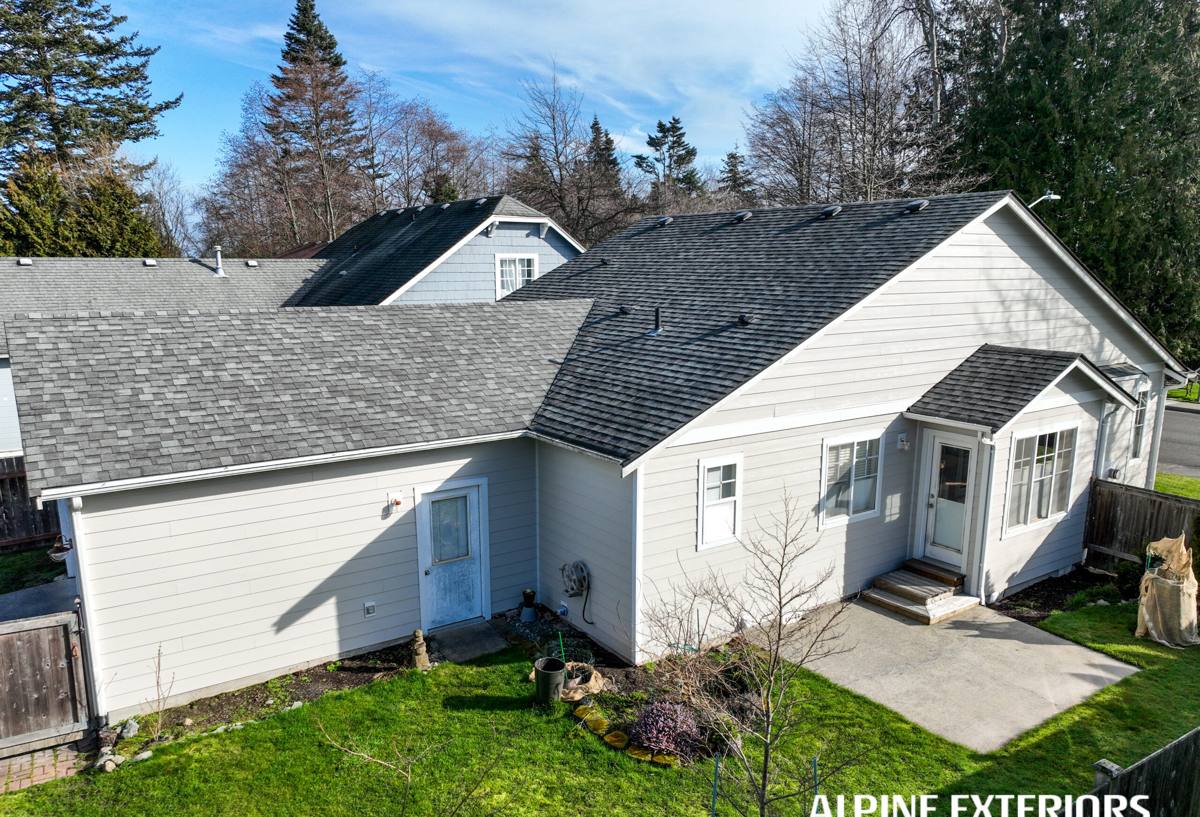
Fidalgo Island catches weather from three directions at once. There's the marine air coming off Rosario Strait and the Guemes Channel, the rain that piles up against the Anacortes hills and the Cascade foothills further east, and the shade and moisture that collect under the fir and cedar canopy on the island's wooded lots. A home a half-mile from saltwater deals with a different set of problems than a home tucked into a stand of trees, but on Fidalgo Island a lot of houses deal with both at the same time. That combination is hard on exterior building materials in ways that don't show up right away — it shows up five, ten, fifteen years in, as soft trim, peeling paint, swollen panel edges, and moss creeping up from the bottom courses of siding.
We've worked on homes across Anacortes and Skagit County long enough to know that "coastal Pacific Northwest" isn't one climate — it's several, layered on top of each other depending on exposure, tree cover, and elevation. Siding that's rated fine for a general Puget Sound climate can still struggle on a specific lot if it's not matched to what that lot actually experiences.
What Salt Air, Driving Rain, and Moss Actually Do
Salt Air
Airborne salt is corrosive to fasteners, flashing, and any metal trim components on a home's exterior, and it also accelerates the breakdown of some paint and coating systems faster than a purely inland climate would. Homes with unobstructed views toward the water or that sit up on higher ground exposed to wind off the strait see this more than homes tucked into a valley or behind a windbreak of trees.
Driving Rain
Wind-driven rain doesn't just wet a wall — it forces water sideways and upward into laps, seams, and butt joints that a straight-down rain would never reach. Over time, any siding material that isn't dimensionally stable when wet, or that relies on paint film alone to keep water out, is going to take on moisture at those joints. That's when you get swelling, delamination, and soft spots, especially at the bottom courses closest to grade and around window and door trim.
Moss and Sustained Damp
Skagit County's long wet season means siding, especially on north-facing walls or under tree cover, can stay damp for weeks at a stretch. Moss and algae take hold in that environment, and once established they hold moisture directly against the siding surface — which is worse for the material underneath than the moss itself. Wood-based and wood-fiber siding products are the most vulnerable to this kind of sustained damp because they can absorb and hold water; that's the mechanism behind a lot of the rot and paint failure we see on Fidalgo Island siding jobs.
Why We Only Install James Hardie Fiber Cement
We used to install a broader range of siding products, the same as most contractors in the area. Over time, watching how different materials actually held up on Fidalgo Island and around Anacortes — not in a lab, but on real houses exposed to real salt air and real wet winters — we narrowed our offering to James Hardie fiber cement exclusively. That wasn't a marketing decision. It was a maintenance-call decision.
Fiber cement is made from cement, sand, and cellulose fibers, which makes it non-combustible and dimensionally stable in a way wood-based products can't match. It doesn't absorb water the way engineered wood or wood-fiber siding does, so it isn't prone to the same swelling and softening at cut edges and joints that shows up on damp, shaded walls. James Hardie's ColorPlus finish is baked on in a factory-controlled process rather than field-applied, which means better adhesion and a more consistent, longer-lasting color than a job-site paint job — a real advantage in a climate that's hard on exterior coatings.
James Hardie also builds region-specific "HZ" product formulations engineered for different climate zones, including the wetter Pacific Northwest, rather than a single one-size-fits-all formula. Combined with a strong transferable warranty backed by a large, established manufacturer, it's the product we're comfortable putting our name behind on Fidalgo Island homes.
We don't install LP SmartSide, vinyl, Cemplank, Allura, or primed wood siding like spruce or cedar. Each of those has situations where it can perform reasonably well, and we're happy to talk through the honest trade-offs of each if you're weighing options. But for the specific mix of salt exposure, driving rain, and moss-prone shade that shows up across Fidalgo Island, fiber cement is what we've found holds up with the least maintenance burden over the longest stretch of time.
What a Siding Replacement Project Involves
Every Fidalgo Island home is different, but a proper siding replacement follows the same general sequence:
- Removal of existing siding and inspection of the sheathing underneath for any rot, soft spots, or prior water damage — this is often where hidden problems from the old siding get found and addressed.
- Repair or replacement of any damaged sheathing and framing before anything new goes on.
- Installation of a weather-resistive barrier and proper flashing at every window, door, and penetration — flashing details matter enormously in a driving-rain climate, and it's usually the first thing that fails when a siding job was done poorly.
- Installation of James Hardie panels or planks according to manufacturer specifications, including correct fastener spacing, clearances from grade and roofing, and joint treatment.
- Trim, caulking, and touch-up work to complete the weather seal.
The flashing and weather barrier work is where a lot of siding jobs succeed or fail long-term, and it's largely invisible once the siding is up. That's part of why the contractor doing the work matters as much as the product going on the wall.
Beyond Siding: The Whole Exterior Envelope
Siding doesn't work in isolation. Roofing, windows, and decks all interact with the same wind, rain, and moisture exposure that siding deals with, and problems in one area often show up as damage in another — a roof that's shedding water onto a wall, or a window that's not flashed correctly, can undermine even a well-installed siding job. We handle roofing, windows, and decks in addition to siding, which lets us look at a Fidalgo Island home's exterior as one connected system rather than a set of separate projects, and catch issues at the boundaries between them — roof-to-wall transitions, window flashing, deck ledger connections — that get missed when different trades never talk to each other.
Cost Factors for Fidalgo Island Homes
Every project is priced based on the specifics of the home, but the factors below generally drive the cost of a siding project on the island:
| Factor | Why It Matters |
|---|---|
| Home size and wall complexity | More square footage and more corners, gables, and trim details mean more material and labor |
| Condition of existing sheathing | Rot or water damage found during tear-off adds repair scope before new siding can go on |
| Exposure level | Waterfront or wind-exposed homes may warrant additional attention to flashing and fastening detail |
| Siding profile chosen | James Hardie offers lap, shingle, and panel styles at different price points |
| Access and site conditions | Steep lots, mature landscaping, or limited access can affect labor time |
Choosing a Contractor on Fidalgo Island
Anacortes and the surrounding island have a mix of local crews and contractors who travel in from elsewhere in Skagit or Whatcom County for larger jobs. There's nothing wrong with an out-of-area contractor doing good work, but a crew that regularly works on the island tends to have a better instinct for how a specific lot's wind exposure, shade, and drainage will affect a siding job — knowledge that only comes from having done the work here repeatedly.
- Ask whether they're a factory-certified installer for the specific siding product they're proposing.
- Ask to see their approach to flashing at windows, doors, and roof transitions — not just the siding brand.
- Get written scope that specifies sheathing inspection and repair, not just "install new siding."
- Check that they carry proper licensing and insurance for work in Washington State.
- Ask how they handle warranty claims if an issue shows up years down the road.
A Straightforward Estimate
If you're dealing with aging, moss-covered, or damaged siding on a Fidalgo Island home, or planning ahead before it becomes a problem, we're happy to take a look and give you an honest read on what you're working with. Reach out for a free, no-pressure estimate using the form below.