 Anacortes Siding
 Mount Vernon's Exterior Climate: What Homes Are Really Up Against
Mount Vernon sits in the Skagit Valley, a few miles inland from Anacortes and Fidalgo Bay, but the marine influence still reaches it. Homes here deal with a long wet season, heavy morning fog off the river and surrounding farmland, and enough humidity most of the year to keep moss and algae established on north-facing walls, fences, and rooflines from fall through spring. Add in wind-driven rain events that push moisture sideways into siding laps and window trim, and you have a climate that is genuinely hard on exterior building materials — not in a dramatic way, but in a slow, cumulative way that shows up as soft trim boards, streaked siding, and roof moss five or ten years before a homeowner expects it.
None of this is unique to any one house. It's the baseline condition for exteriors throughout this part of Skagit County, whether a property sits close to town or out toward the valley's farmland edges. The practical implication is that material choice and installation detail matter more here than they would in a drier climate. A siding product or installation method that performs fine in Eastern Washington can fail early in Mount Vernon simply because it's never given a real chance to dry out between weather events.
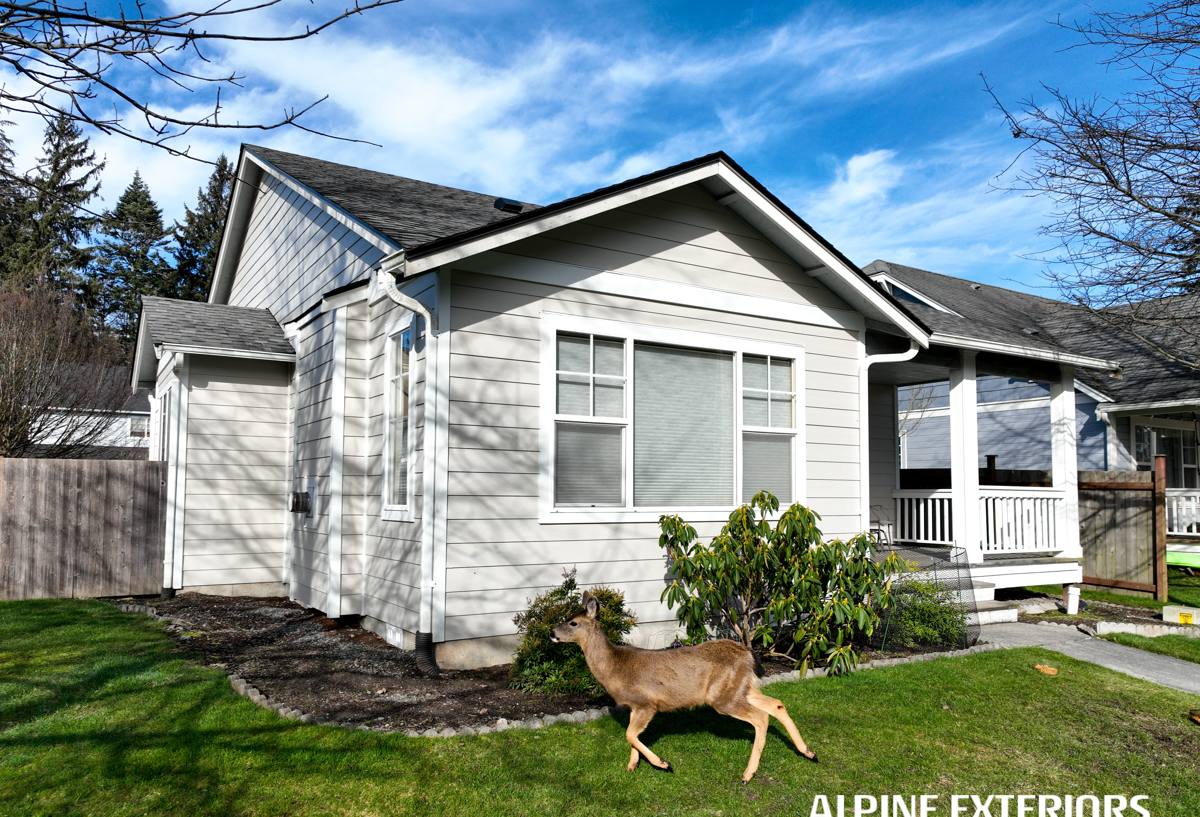
Signs Your Siding Is Losing the Fight
Siding failure in this region rarely announces itself with a dramatic crack or a sudden leak. It's usually a slow accumulation of small signals that homeowners notice individually but don't always connect.
Visual warning signs
- Persistent moss, algae, or dark streaking on siding that returns within a season of cleaning
- Paint that's chalking, peeling, or needing repainting more often than every 7-10 years
- Visible warping, bowing, or buckling in panel or lap siding
- Soft or spongy spots when pressed, especially near the bottom courses and around windows
- Gaps opening up at seams, corners, or trim joints
What's happening behind the siding
By the time any of the above is visible from the ground, moisture has usually been working on the sheathing and framing behind the siding for a while. Wood-based siding products absorb water at cut edges and fastener penetrations, and in a climate with this much sustained dampness, that moisture doesn't get many chances to fully dry out before the next rain arrives. That's the core problem we're solving for on every Mount Vernon exterior — not just picking a material that looks good, but one that behaves well when it's wet more often than it's dry.
Why We Install Only James Hardie Fiber Cement Siding
We made a deliberate decision as a company to install one siding system: James Hardie fiber cement. We don't install vinyl, LP SmartSide, Cemplank, Allura, primed spruce, or cedar. That's not a marketing position — it's a practical one, built around what actually holds up in Pacific Northwest weather over decades, not just years.
What makes fiber cement different
James Hardie siding is cement, sand, and cellulose fiber, not wood and not wood byproduct. It doesn't absorb water the way wood-based products do, it won't rot, and it's non-combustible. In a region where siding spends a large fraction of the year damp, that moisture indifference is the whole ballgame. Wood-based siding, even with good primer and paint, is fighting a losing battle against sustained humidity and driving rain — the material itself wants to swell, dry, and swell again, and that cycle eventually shows up as warping, delamination at seams, or soft spots.
HZ5 and climate-engineered product lines
James Hardie's HZ product lines are engineered for specific climate zones, and the HZ5 formulation used in the Pacific Northwest is built around moisture and freeze-thaw resistance for exactly this kind of weather. It's a meaningful difference from a one-size-fits-all siding product — the material is formulated for the conditions it's actually going on.
ColorPlus factory finish
Most Hardie siding we install uses the ColorPlus finishing process — a baked-on, factory-applied finish that's more consistent and more durable than field-applied paint, with a longer color warranty. In a climate that's hard on paint jobs, that matters. It means fewer repaint cycles and a more even, fade-resistant look over the life of the siding.
Warranty and longevity
Hardie backs its siding with a transferable limited warranty that's meaningful because the product has a long, verifiable track record in wet climates, not just marketing claims. Installed correctly, it's a 40-to-50-year exterior, not a 10-to-15-year one.
What "Installed Correctly" Actually Means
Fiber cement siding's long-term performance depends heavily on installation detail — this is a product that rewards a careful crew and punishes a sloppy one.
Flashing and water management
Every window, door, and horizontal trim transition needs proper flashing so water is directed out and away from the wall assembly rather than trapped behind the siding. This is the single most common place we see problems on homes we're asked to re-side — not the siding material itself, but flashing that was skipped or installed backwards.
Clearances and gaps
Hardie's installation specifications call for specific clearances from grade, roofing, and decking, and gaps at butt joints and trim to allow the material to move without cracking. Skipping these details voids the manufacturer's warranty and sets up the exact moisture problems fiber cement is supposed to prevent.
Fastening
Correct fastener type, spacing, and placement affect both wind performance and long-term panel integrity. We follow Hardie's published fastening schedules rather than shortcuts that speed up the install but compromise the wall.
Roofing, Windows, and Decks: The Full Exterior Picture
Siding doesn't work in isolation — it's one part of a building envelope that also includes the roof, the windows, and any decks or attached structures. We handle all four because they interact with each other constantly.
Roofing
A roof shedding water improperly, or holding moss and debris in valleys, sends extra moisture down onto the siding below it. Roof condition and siding condition are connected problems, and we look at both when we're on site.
Windows
Window flashing and trim are one of the most common failure points behind siding. When we replace siding around older windows, we make sure the flashing detail is right before the new siding goes on, rather than covering up a problem that will resurface in a few years.
Decks
Deck ledger boards attach directly to the house structure and are a frequent source of hidden water intrusion if flashed poorly. We treat deck work with the same moisture-management standard we apply to siding and roofing.
What Drives the Cost of a Siding Project
Every Mount Vernon home is different, so we don't quote off square footage alone. These are the factors that actually move a project's price:
| Factor | Why it matters |
|---|---|
| Existing siding removal | Tear-off and disposal of old siding, especially if there's hidden water damage to address first |
| Sheathing and framing repair | Rot found once old siding comes off has to be repaired before new siding can go on correctly |
| Home size and complexity | Dormers, multiple gables, and cut-up wall lines take more labor per square foot than a simple rectangular elevation |
| Siding profile and trim detail | Lap width, board-and-batten, and trim style all affect material and labor costs |
| ColorPlus vs. field paint | Factory-finished color adds cost up front but reduces repainting over the life of the siding |
| Access and site conditions | Multi-story sections, tight lot lines, and staging needs affect labor time |
Choosing a Contractor for Exterior Work in Mount Vernon
Siding, roofing, and window work all involve moisture management decisions that are hard to inspect once the project is buttoned up. That makes the contractor you choose as important as the material.
- Ask specifically whether they are a certified or experienced James Hardie installer, not just "we do siding"
- Get a written scope that names the flashing and water-management details, not just "install siding"
- Check that they carry proper licensing and insurance for exterior work in Washington
- Ask how they handle sheathing or framing damage discovered mid-project
- Look for a company based in the region, familiar with local weather patterns and permitting
- Get the warranty terms in writing — both manufacturer and workmanship
What to Expect When You Work With Us
We start with an on-site look at the whole exterior, not just the siding — roof condition, window flashing, and any decks or attached structures factor into what we recommend. If we find water damage once old siding comes off, we stop and show you before covering anything back up. Every Hardie installation we do follows the manufacturer's published specifications for flashing, clearance, and fastening, because that's what keeps the warranty valid and the wall dry for the next several decades.
If you're weighing a siding replacement, a roof that's holding onto moss, aging windows, or a deck that needs attention, we're happy to come take a look. The estimate is free, there's no pressure, and you'll get a straight answer about what your home actually needs — just fill out the form below to get started.