 Anacortes Siding
 Serving Oak Harbor From Our Anacortes Base
Oak Harbor sits on Whidbey Island, connected to Fidalgo Island and Anacortes by the Deception Pass Bridge. It's a short drive from our shop, and we treat it as core service territory rather than a stretch job we take when things are slow. That matters more than it sounds like it should. A contractor who only shows up in Oak Harbor once or twice a year doesn't build a feel for how the local weather actually behaves against a house over a full year of seasons. We do, because we're out here regularly.
Whidbey Island and the Anacortes area share the same basic weather pattern — a marine climate off the Salish Sea, with wet winters, a long shoulder season of drizzle and fog, and a short, dry summer. But Oak Harbor's exposure isn't identical to Anacortes proper. Homes closer to the water on Whidbey often catch more open wind off the Strait, and that combination of wind and moisture is exactly what drives most of the exterior problems we get called out for.
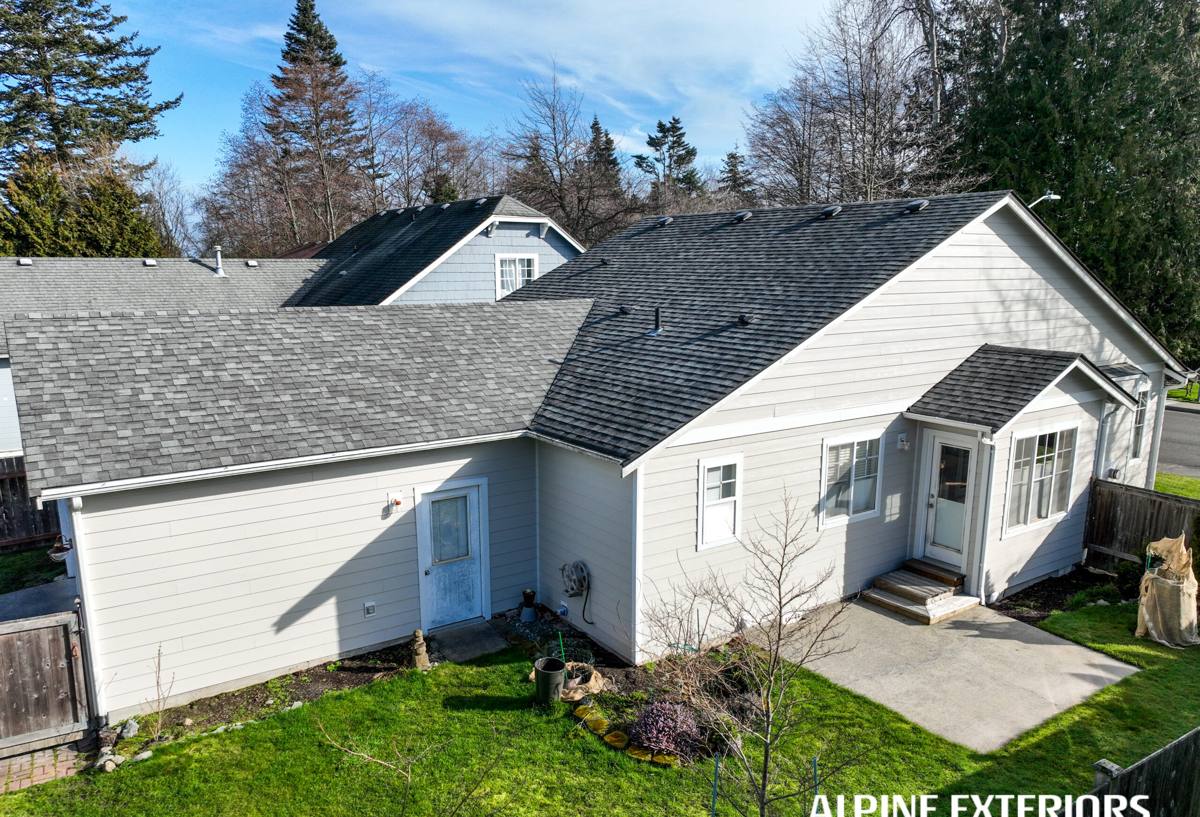
What the Local Climate Does to Siding
Salt Air and Marine Exposure
Any home within a few miles of Puget Sound or the Strait of Juan de Fuca is dealing with airborne salt, whether or not the ocean is visible from the yard. Salt-laden air accelerates corrosion on fasteners, flashing, and trim, and it degrades paint film faster than it would inland. Siding materials that rely on a factory finish or a field-applied coat behave very differently under this kind of exposure, and it's one of the first things we evaluate on an Oak Harbor estimate.
Driving Rain and Wind-Driven Moisture
Skagit and Island County both get plenty of rain, but the rain that does the damage isn't the gentle, straight-down kind — it's wind-driven rain that gets pushed sideways into wall assemblies, especially around window and door openings, at butt joints, and at inside corners. Over years, that pattern of wind-driven moisture finds every weak seam in a siding system. Houses on more exposed lots, or with west- and south-facing walls that catch the prevailing weather, take the brunt of it.
Moss, Mildew, and the Shade Problem
Between the tree cover common on Whidbey Island lots and the length of our wet season, moss and mildew growth on siding, trim, and roofing is a near-constant issue rather than an occasional one. Shaded north walls and anything under overhanging branches stay damp longer after a rain event, and organic growth follows. This isn't just cosmetic — sustained moisture against a wall surface is what eventually leads to rot, delamination, or paint failure, depending on what the siding is made of.
Why We Only Install James Hardie Fiber Cement
We standardized on James Hardie fiber cement siding for every home we side, including in Oak Harbor, and we don't install vinyl, LP SmartSide, or wood siding products. That's a deliberate professional decision, not a sales position, and it's rooted in exactly the climate conditions described above.
- Non-combustible core: Hardie's fiber cement won't ignite, warp, or melt from radiant heat the way vinyl siding can.
- Factory-applied ColorPlus finish: a baked-on finish that holds up to UV and salt air significantly better than field-applied paint, with a color warranty backing it.
- Engineered for wet marine climates: Hardie's HZ5 product line is formulated specifically for regions like ours — freeze-thaw cycles, sustained moisture, and coastal exposure.
- Dimensionally stable: fiber cement doesn't expand and contract with moisture the way wood-based products do, which matters when a house sits in a near-constant damp-dry cycle for eight months of the year.
- Strong transferable warranty: useful if an Oak Harbor home changes hands, which is common in a market with steady turnover near the base and the waterfront.
Vinyl siding is inexpensive and low-maintenance in the sense that it doesn't need repainting, but it's a petroleum-based product that can become brittle in cold snaps and deform under sustained heat or impact, and its seams and J-channels give wind-driven rain more paths to find. Wood and engineered-wood products can look excellent, but they demand a maintenance schedule — caulking, repainting, moisture checks — that most homeowners underestimate until the product starts showing its age faster than expected in a wet climate. We'd rather put a product on your house that's engineered for this specific environment than sell you something we know is going to need more attention than most people want to give it.
What We Install: Siding, Roofing, Windows, and Decks
Most of our Oak Harbor projects start as a siding conversation, but the exterior of a house is one connected system, and we handle the pieces that touch each other directly:
- Siding: full James Hardie replacement, plank and panel systems, trim, and soffit work.
- Roofing: roof replacement and repair, since a compromised roof edge or flashing detail will undermine even a well-installed siding job.
- Windows: replacement windows installed with proper flashing integration into the new siding, which is one of the most common failure points we see on older re-sides done without coordinating the two trades.
- Decks: exterior decks built to hold up to the same rain and moisture exposure as the walls above them.
Coordinating these trades under one crew matters most at the transitions — where a window meets siding, where a roof edge meets a wall, where a deck ledger attaches to the house. Those junctions are where most water intrusion problems actually start, and they're easiest to get right when one contractor is responsible for the whole envelope instead of three separate crews handing off liability at each boundary.
Comparing Siding Options for a Whidbey Island Home
| Factor | James Hardie Fiber Cement | Vinyl | Wood / Engineered Wood |
|---|---|---|---|
| Salt air resistance | Strong — factory finish holds up well | Moderate — can chalk and fade | Weak without ongoing maintenance |
| Wind-driven rain performance | Strong when installed to spec | Moderate — more seams and channels | Depends heavily on maintenance |
| Fire resistance | Non-combustible | Can deform/melt under heat | Combustible |
| Maintenance | Low — occasional wash and caulk check | Low, but limited repair options | High — regular repainting/sealing |
| Typical lifespan (installed to spec) | Multiple decades | Decades, with earlier fading/warping risk | Shorter without diligent upkeep |
| Warranty | Strong, transferable | Varies by manufacturer | Limited or product-dependent |
The Installation Process
A siding job on an Oak Harbor home generally moves through the same stages, though the order and emphasis shift depending on what we find once the old siding comes off:
- On-site evaluation: we walk the exterior, check for existing moisture damage, note shaded and wind-exposed walls, and evaluate the roof and window flashing while we're there.
- Tear-off and sheathing check: removing the old siding lets us inspect the sheathing underneath for rot or prior water intrusion before anything new goes on.
- Weather-resistive barrier and flashing: this layer is what actually manages wind-driven rain, and it's worth as much attention as the visible siding itself.
- Hardie installation: installed per manufacturer specification, with correct fastening, clearances, and joint treatment — details that directly affect the warranty and long-term performance.
- Trim, caulking, and final detail work: the finish work at corners, window returns, and transitions is where a careful crew separates itself from a fast one.
Signs an Oak Harbor Home May Need New Siding
- Visible cracking, warping, or bubbling on exterior wall surfaces
- Persistent moss or dark streaking that returns shortly after cleaning
- Soft or spongy spots when you press on siding near the bottom of walls or under windows
- Paint that's peeling or failing faster than a normal repaint cycle would suggest
- Rising heating bills that point to compromised insulation behind the siding
- Visible gaps or separation at seams, corners, or around window and door trim
Why a Local Crew Matters
A house on Whidbey Island doesn't need a generic siding job — it needs one installed by people who already understand how salt air, wind exposure, and a long moss season interact with a wall system over time. We install Hardie the same way on every job because we've seen what happens when flashing details or fastening specs get skipped in a climate like ours: problems don't show up in month one, they show up in year three or four, usually right after a rough winter. Being based nearby also means warranty support and follow-up don't require someone driving in from out of the area.
Get a Free Estimate
If you're weighing your options for siding, roofing, windows, or a deck on an Oak Harbor home, we're happy to come take a look and walk you through what we see, with no pressure to sign anything on the spot. Use the form below to request a free estimate.