 Anacortes Siding
 What Primed Spruce Siding Actually Is
Primed spruce siding is solid wood lap or panel siding milled from spruce lumber, coated at the factory with a primer coat before it ships to the jobsite. It's been a staple of Pacific Northwest building for generations, and there's a reason: it's real wood, it takes paint well, and it has a natural look that some homeowners want on a craftsman or farmhouse-style home. We understand the appeal, and we're not going to pretend otherwise.
But primer is not a finish. It's a base layer meant to help paint adhere — it is not a weatherproof barrier on its own. That distinction matters a lot once the siding leaves the shop and gets nailed to a house in Skagit County, where the wood will spend the next few decades absorbing salt-laden moisture off Fidalgo Bay, getting rained on sideways for months at a stretch, and growing moss in the shaded, damp corners that this climate specializes in.
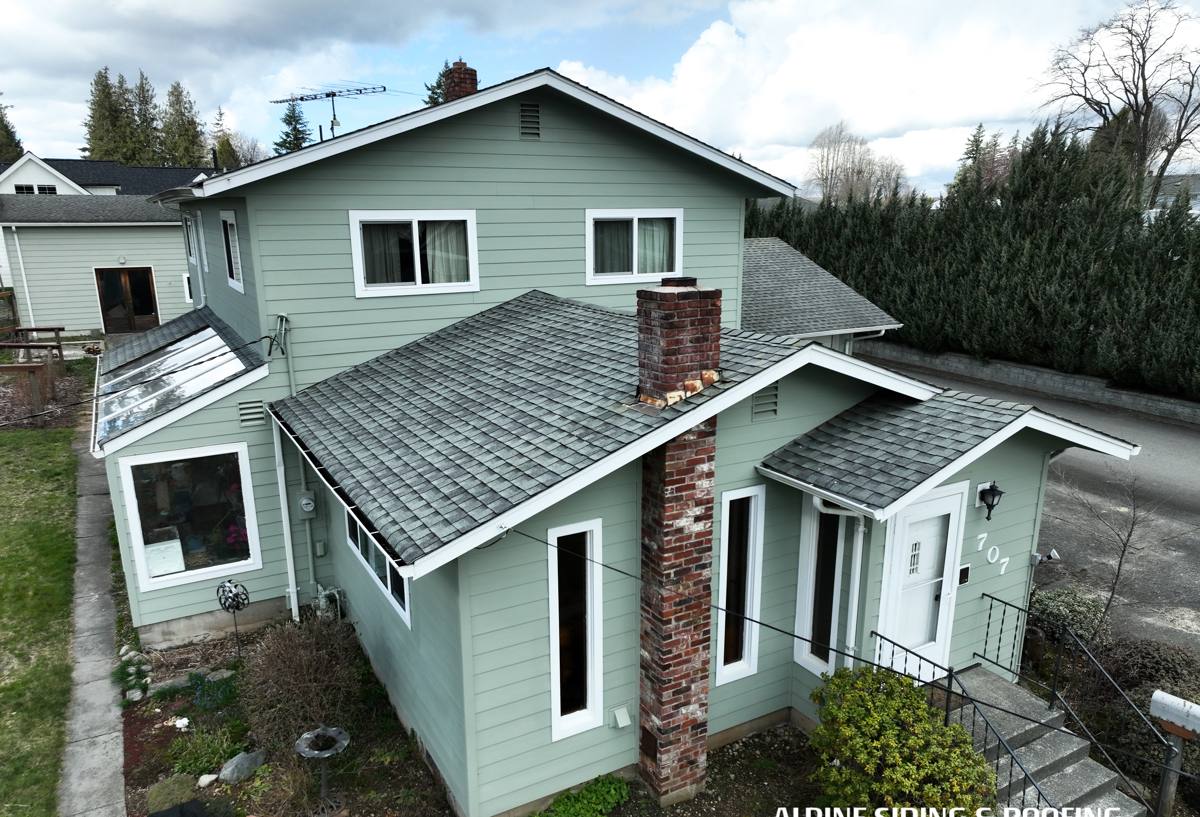
Why Anacortes' Climate Is Hard on Wood Siding
Anacortes sits right on the water, which means the air itself carries salt. Salt is hygroscopic — it pulls moisture out of the air and holds it against surfaces, including painted wood siding. Combine that with the driving rain that comes off Rosario Strait and Guemes Channel during fall and winter storms, and you have conditions that push water into every seam, nail hole, and end-grain cut in a wood siding installation.
Then there's moss. Skagit County's long, mild, wet season — often eight or nine months of the year with meaningful moisture — is close to ideal moss-growing weather. Moss and algae hold water against the siding surface far longer than the surface would otherwise stay wet, and that constant dampness is exactly what wood siding can't tolerate long-term without a strong, well-maintained paint film protecting it.
What Happens When Primer Alone Meets This Climate
Primed spruce siding is designed to be topcoated with quality exterior paint within a limited window after installation — typically 30 to 90 days, depending on the manufacturer's instructions. If that window is missed, or if the topcoat is thin, or if caulking at joints and penetrations isn't done meticulously, moisture gets a path into the wood fiber. Once wood siding takes on moisture repeatedly, you start to see:
- Paint failure — peeling, cracking, and alligatoring where the film can no longer flex with the wood underneath
- Cupping and warping of individual boards as one face absorbs more moisture than the other
- Soft or spongy spots at butt joints, corners, and anywhere end grain is exposed
- Moss and mildew staining on north-facing and shaded elevations
- Nail popping as the wood swells and shrinks with the seasons
None of this means primed spruce is a bad product. It means it's a product that demands an ongoing maintenance commitment most homeowners underestimate when they're comparing siding options up front.
The Maintenance Commitment Nobody Mentions at the Estimate
Wood siding — even good-quality, properly primed and installed wood siding — is a repainting project waiting to happen. In a marine climate like ours, most painted wood siding needs a fresh topcoat every 5 to 8 years to keep the moisture barrier intact, sooner on south- and west-facing walls that take the brunt of sun and wind-driven rain. Skip that cycle, or push it out a couple extra years because life gets busy, and you're not just touching up cosmetics — you're often replacing boards that have already started to rot underneath the failing paint.
That's the core issue with primed spruce as a long-term material for this region: the siding itself is only as durable as the maintenance schedule behind it, and that schedule doesn't bend for busy homeowners, rental properties, or anyone who wants to install siding once and not think about it again for 30 years.
How Primed Spruce Compares to Fiber Cement
| Factor | Primed Spruce Siding | James Hardie Fiber Cement |
|---|---|---|
| Repaint cycle in a marine climate | Every 5-8 years, sooner on exposed elevations | ColorPlus factory finish rated for 15 years against fading; field-painted Hardie holds paint far longer than wood |
| Moisture absorption | Wood fiber absorbs water directly; primer/paint is the only barrier | Cement-based composition doesn't absorb and swell like wood |
| Moss and algae resistance | No inherent resistance; relies entirely on paint film | Engineered surface resists moss and mildew better than bare or painted wood |
| Combustibility | Combustible, like any solid wood product | Non-combustible fiber cement |
| Warranty structure | Typically limited to material defects, not paint failure or rot | Long, transferable manufacturer warranty covering the product itself |
| Installation sensitivity | High — caulking, priming edges, and rapid topcoating are all critical | Lower moisture sensitivity, but still requires correct fastening and clearances |
Where Primed Spruce Still Has a Case
If a homeowner is restoring a historic home where matching original wood profiles matters, or if they genuinely want the look and feel of real wood and are prepared to commit to the repainting cycle, primed spruce isn't an irrational choice. It's a legitimate material with a long track record. What we've found, though, is that most homeowners who ask us to quote it haven't budgeted — in time or money — for what owning it actually costs over 20 years. That gap is why we made the call not to install it.
Why We Standardized on James Hardie Instead
We install James Hardie fiber cement siding exclusively, and it's not because we're chasing a brand name. It's because after years of doing tear-offs and repairs on wood siding around Skagit County — including plenty of primed spruce that failed well before a homeowner expected it to — we decided we didn't want to keep installing a product whose success depends on a maintenance schedule we can't control after we leave the jobsite.
Hardie's fiber cement composition is engineered specifically to resist the moisture, temperature swings, and biological growth (moss, mildew, fungus) that define our climate. The company makes climate-specific "HZ" formulations, and while the Pacific Northwest doesn't get the freeze-thaw extremes of colder regions, the wet-and-mild profile here is exactly the kind of moisture exposure fiber cement was built to outlast.
ColorPlus Factory Finish
Most Hardie installations we do use the ColorPlus finish system — color baked on at the factory under controlled conditions, rather than field-painted after installation. That finish is warrantied against fading and is simply more consistent than a paint job applied on a scaffold in variable weather, which is exactly the condition primed spruce depends on to perform.
Non-Combustible Construction
Fiber cement doesn't burn. In a region where wildfire smoke and dry-season fire risk have become a bigger part of the conversation even west of the Cascades, that's a real, practical advantage over any wood-based siding product, primed or not.
What Correct Hardie Installation Looks Like
Fiber cement isn't foolproof either — it has to be installed to Hardie's published specifications to deliver on its warranty and performance. That means:
- Proper starter strips, flashing, and weather-resistive barrier behind the siding
- Correct fastener type, spacing, and penetration depth — not just what happens to be on the nail gun
- Manufacturer-specified clearances from grade, roofing, and decking to keep the bottom edge out of standing moisture
- Caulked and sealed joints at trim, windows, and penetrations, matched to Hardie's approved sealants
- Correct panel and lap orientation for our prevailing wind-driven rain direction
We follow Hardie's installation manual to the letter because a warranty is only as good as the installation behind it — that's true of every siding product, wood or fiber cement.
Questions to Ask Before Choosing Any Siding Material
Whatever material a homeowner in Anacortes is weighing, a few questions cut through most of the marketing:
- What does the manufacturer's warranty actually cover, and does it cover labor or just materials?
- What's the realistic maintenance interval for this climate, not the national average?
- What happens at the seams, corners, and penetrations — where almost all siding failures actually start?
- Is the installer following the manufacturer's written specification, or just "how we've always done it"?
- How does this material perform specifically in salt air and prolonged damp, not just rain in general?
Those five questions will tell a homeowner more about long-term performance than any brochure will.
Our Bottom Line on Primed Spruce
Primed spruce siding isn't a scam or a low-quality product — it's a real wood siding option that performs the way real wood performs: well, as long as the paint film is maintained without fail, and less well the moment that maintenance slips in a climate this consistently wet. We've simply chosen not to put our name on installations where the long-term outcome depends so heavily on a repainting schedule outside our control. Fiber cement lets us install something once and stand behind how it performs for decades, not just until the next repaint is due.
If you're weighing siding options for a home in Anacortes or elsewhere in Skagit County, we're happy to walk through what we install and why, take a look at your current siding, and give you a straightforward, no-pressure estimate for James Hardie fiber cement — no obligation, just an honest read on what your home actually needs.