 Anacortes Siding
 March Point's Exterior Challenge
March Point sits out on the water, and that location cuts both ways. The views and the access to Fidalgo Bay and the surrounding shoreline are part of why people live there, but that same exposure means homes take a harder hit from the weather than a house tucked into town. Wind off the water carries salt and moisture further inland than most homeowners expect, and it does so year-round, not just during winter storms. If your siding, trim, or deck boards have started looking tired faster than you think they should, the location is usually the reason, not poor luck or a bad paint job.
We work throughout Anacortes and Skagit County, and March Point is one of the areas where we see exterior wear patterns that are noticeably different from siding failures we find in more sheltered neighborhoods. Salt-laden air accelerates corrosion on fasteners and metal flashing. Driving rain, pushed sideways by wind instead of falling straight down, finds gaps in siding laps and trim joints that would stay dry in a calmer setting. And the long, damp Pacific Northwest season gives moss and algae months at a time to take hold on north-facing walls and shaded roof slopes. None of this means March Point is a bad place to own a home — it means the exterior has to be built for the conditions it actually faces, not the conditions on a spec sheet from a milder climate.
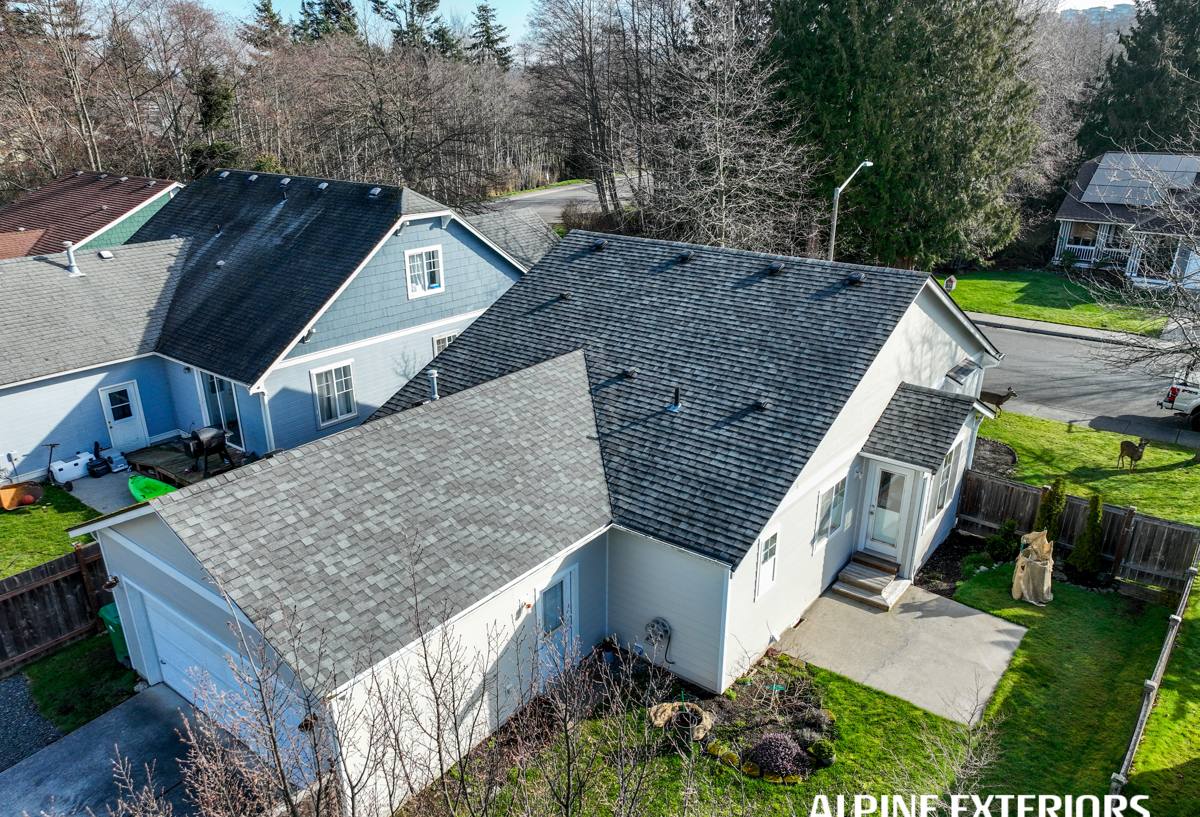
What Salt Air Actually Does to a House
Salt air is corrosive to metal and it's absorbent — salt particles pull moisture out of the air and hold it against whatever surface they land on. On a home near the water, that means fasteners, hinges, and any exposed metal trim age faster than the same materials would a few miles inland. It also means paint and coatings on some siding products break down sooner, because the surface is dealing with a near-constant low-grade chemical and moisture load, not just occasional rain.
This is one of the practical reasons we standardized on James Hardie fiber cement siding with a factory-applied ColorPlus finish rather than field-applied paint. A factory finish is baked on under controlled conditions and backed by its own finish warranty, which matters more in a marine environment than in a drier inland town where a paint job might reasonably last a decade or more without complaint.
Where We Look First on a March Point Home
- Corner boards and trim joints facing the water, where wind-driven rain hits hardest
- Fastener heads and any exposed metal flashing, checked for corrosion or staining
- Butt joints and lap seams on the weather-facing walls
- North and east-facing siding and roof sections, where moss and algae establish first
- Deck ledger boards and fasteners, which take on both moisture and salt exposure
Moss, Algae, and the Long Wet Season
Skagit County doesn't get a short rainy season — it gets a long one, and shaded or north-facing surfaces can stay damp for weeks at a stretch through fall, winter, and much of spring. That's exactly the environment moss and algae need. On some siding materials, this isn't just cosmetic. Moisture trapped under a moss mat can sit against the siding surface for extended periods, and on products that aren't engineered to handle sustained damp contact, that leads to swelling, softening, or coating failure over time.
Fiber cement doesn't feed mold or moss the way wood-based products can, and it doesn't swell or rot from sustained moisture contact the way engineered wood siding can if water gets past the surface. That doesn't mean moss won't grow on it at all — moss will grow on nearly any exterior surface in this climate given enough shade and dampness — but it means a moss problem on Hardie siding is a cleaning issue, not a structural one.
Why We Install James Hardie and Nothing Else
We get asked fairly often why we don't offer vinyl, LP SmartSide, or one of the other fiber cement brands on the market. The honest answer is that we made a call, based on what holds up in this specific climate, to install one product system and install it correctly rather than offer a menu of options with different risk profiles.
| Material | How it handles our climate | Long-term consideration |
|---|---|---|
| James Hardie fiber cement | Non-combustible, holds paint/factory finish well, doesn't rot or swell from moisture | Higher upfront cost, correct installation matters |
| Engineered wood (LP SmartSide, similar) | Wood-based core; vulnerable at cut edges and joints if moisture gets in | Depends heavily on maintaining sealed edges over decades |
| Vinyl | Won't rot, but can warp, fade, or crack in wind and temperature swings | Not repairable in sections; color is baked in and fades over time |
| Cedar / primed spruce | Natural look, but organic material in a wet marine climate | Ongoing maintenance burden: refinishing, sealing, moss control |
Every one of those alternatives has legitimate uses and a real fan base. Our decision isn't a claim that they're defective products — it's that in a salt-air, high-moisture, moss-prone location like March Point, we don't want to hand a homeowner a material that requires near-perfect maintenance discipline to avoid problems. James Hardie's HZ5 and HZ10 product lines are engineered specifically for climates like ours, and Hardie backs its ColorPlus finish and substrate with a strong transferable warranty, which matters to homeowners who plan to sell at some point.
How Our Process Works for a March Point Home
Assessment
We start by walking the exterior and identifying which walls take the worst of the wind and rain, where moss or algae has established, and what condition the sheathing and trim are in underneath the current siding. On a water-exposed property, we pay particular attention to any areas where past water intrusion may have gone unnoticed, since siding can look fine on the surface while the substrate underneath has already taken damage.
Installation Detailing
Correct installation matters more in a marine climate than in a calmer one, because the margin for error is smaller. That means proper flashing at every window and door, correct fastener placement and spacing per Hardie's specifications, appropriate house wrap and water-resistive barrier detailing, and lap and joint work that accounts for wind-driven rain rather than assuming water always falls straight down. A crew that's used to installing in sheltered inland neighborhoods can get sloppy in ways that don't show up for a few years on a water-facing home — we build every March Point job assuming the worst weather the site will actually see.
Beyond Siding
We also handle roofing, windows, and decks, and on a home near the water these systems don't operate independently. A roof with poor ventilation traps moisture that eventually shows up as staining or rot at the top of the siding. Windows with failed flashing let water track down behind the siding from above. Decks exposed to the same salt air and rain corrode fasteners and connectors faster than an inland deck would. When we're on site for one exterior project, we'll flag anything we notice on the others so small issues don't turn into bigger ones.
What a March Point Homeowner Should Ask Before Hiring
- Does the crew have documented experience installing in coastal or marine-exposed conditions, not just general siding experience?
- What flashing and water-resistive barrier details will be used at windows, doors, and trim joints?
- Is the fastener schedule and material spec matched to Hardie's requirements for our exposure category?
- What does the warranty actually cover — material only, or installation workmanship too?
- Will the crew inspect the sheathing underneath the old siding before installing new material?
- Who is doing the physical installation — the company's own crew, or a subcontractor you haven't vetted?
Cost Factors on a Water-Exposed Property
| Factor | Why it affects cost |
|---|---|
| Extent of substrate damage | Hidden moisture damage from years of exposure may require sheathing or framing repair before new siding goes on |
| Wall complexity and access | Waterfront lots and homes with multiple stories or limited access take more time and equipment |
| Trim and flashing scope | Doing flashing correctly on a wind-exposed home takes more material and labor than a sheltered lot |
| Product line and color | HZ5 vs. HZ10 panel selection and ColorPlus color choice affect material cost |
| Scope beyond siding | Bundling roofing, window, or deck work with siding can reduce overall disruption and sometimes total cost |
We give straightforward, written estimates based on what we actually find on your property — not a generic per-square-foot number pulled from an average job somewhere else in the county.
Why a Local Crew Matters
A contractor based elsewhere in the region can install siding, but they may not have spent years learning exactly how March Point's wind patterns, water exposure, and moss season behave differently from a job twenty minutes inland. We're an Anacortes company working in Skagit County day in and day out, which means we've seen how homes in this specific area age, what fails first, and what holds up. That local knowledge shows up in the details — where we add extra flashing attention, which walls we recommend a slightly heavier product line for, and how we sequence a job around our actual weather rather than a textbook installation schedule.
We also handle warranty and service calls locally. If a question comes up two or five years after installation, you're calling a company that's still working in your neighborhood, not chasing down a crew that moved on to other regions.
Let's Look at Your Home
If your siding, roof, windows, or deck are showing wear from March Point's salt air, wind-driven rain, or moss season, we're happy to come take a look. We'll give you an honest read on what's going on and a straightforward, no-pressure estimate — use the form below to get started.