 Anacortes Siding
 Cedar Has a Real Reputation — And It's Earned
Cedar siding didn't become a Pacific Northwest staple by accident. It's a genuinely good-looking material, it's local (a lot of it is milled right here in Washington), and when it's new, nothing quite matches the warmth of clear-grain cedar on a home. We're not going to pretend otherwise. If a homeowner in Anacortes tells us they love the look of cedar, we agree with them.
The problem isn't how cedar looks going up. It's how cedar behaves over the next 15 to 25 years on a home that sits a few miles from saltwater, gets battered by driving rain off Rosario Strait, and spends a good chunk of the year under a low, damp marine layer that keeps everything green and growing. That combination is exactly what cedar struggles with, and it's why we stopped installing it.
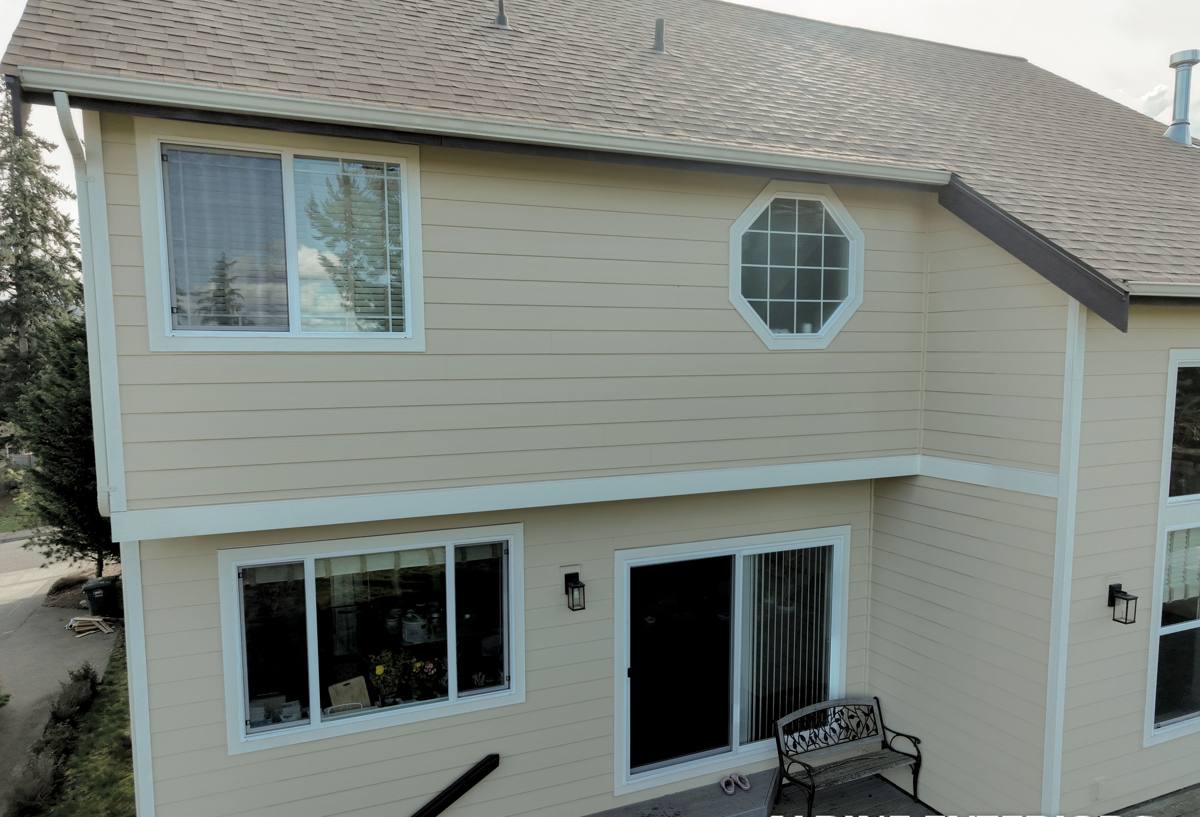
What Cedar Actually Requires to Last
Cedar is a natural wood product, and wood needs maintenance to hold up outdoors. That's true everywhere, but it's especially true in Skagit County. To get a normal lifespan out of cedar siding, a homeowner needs to commit to an ongoing schedule:
- Re-staining or re-sealing every 3 to 7 years depending on exposure, sun, and finish quality
- Regular washing to knock back moss, algae, and mildew before it takes hold
- Prompt caulking and touch-up wherever the finish cracks or wears thin
- Careful attention to any spot where siding meets trim, flashing, or grade — cedar that stays wet rots
- Replacing individual boards as they split, cup, or rot, which means keeping matching stock on hand
None of that is unreasonable to ask of a wood product. But it's a real, recurring cost — in money and in time — and it doesn't stop. Skip a cycle or two, and cedar starts losing the fight to moisture faster than most homeowners expect.
Why the Anacortes Climate Makes This Harder
Anacortes sits right on the water, which means salt-laden air is a constant. Salt air accelerates the breakdown of wood finishes and speeds up weathering on any exposed grain. Add in the driving, wind-blown rain that comes through in fall and winter storms — rain that hits siding at an angle instead of falling straight down — and cedar takes on moisture in ways that a more sheltered inland home wouldn't. Then there's the moss and algae season, which in this part of Skagit County can run from late fall through spring. Damp, shaded north- and west-facing walls stay wet for days at a time, and that's exactly the environment moss needs to establish itself in the wood grain.
We're not saying cedar can't survive here. It can, and plenty of older homes in Anacortes still wear it. But surviving and looking good with minimal upkeep are two different things, and the second one is what most homeowners actually want when they call a siding contractor.
Where Cedar Problems Actually Start
When we've looked at aging cedar siding on homes in this area, the failures tend to show up in predictable places, not randomly across the whole wall.
| Failure Point | Why It Happens |
|---|---|
| Butt joints and board ends | End grain soaks up moisture far faster than the face of the board |
| Lower courses near grade | Splashback and ground moisture keep the bottom rows wet longer |
| North-facing and shaded walls | Slow drying time lets moss and mildew take hold |
| Behind gutters or downspout splash zones | Concentrated water exposure well beyond normal rainfall |
| Nail heads and fastener lines | Rust staining and localized wood breakdown around ferrous fasteners |
Once rot or moss gets a foothold in one of these spots, it's not usually a quick fix. Rotten boards need to be cut out and replaced, matched for grain and grade, then refinished to blend — and that's assuming the substrate underneath hasn't also taken on damage.
The Cost Conversation Nobody Skips
Cedar's material cost up front is often comparable to, or sometimes even higher than, quality fiber cement. The real cost gap shows up over time, in maintenance. Here's the honest way to think about it:
| Cost Factor | Cedar | James Hardie Fiber Cement |
|---|---|---|
| Refinishing cycle | Every 3-7 years | ColorPlus finish holds color for years longer between repaints; factory finish, not field-applied |
| Moss/algae cleaning | Regular washing needed to protect the finish | Cleans without the same finish-damage risk |
| Board replacement | Common over a 20-year span in wet zones | Rare when installed to spec |
| Fire exposure | Combustible | Non-combustible core material |
| Warranty structure | Typically no manufacturer warranty on a natural wood product | Strong transferable manufacturer warranty |
We show homeowners this comparison because it's the whole reason we made the switch away from cedar as a standard offering. It's not that cedar is a bad material — it's that the total cost of ownership, in this specific climate, tends to run higher than people expect when they're only comparing install-day pricing.
Insurance and Fire Considerations
Wood siding is combustible, and that matters more each year as insurers in Washington reassess wildfire and general fire risk across the state. Some homeowners are already seeing it reflected in premiums or underwriting questions. Fiber cement's non-combustible composition doesn't make a home fireproof, but it removes siding from the list of things an insurer or an inspector flags as a combustible exterior material. For homeowners weighing long-term costs, that's worth factoring in alongside the maintenance math.
Why We Standardized on James Hardie Instead
After years of doing exterior work throughout Skagit County, we made a deliberate choice to install one product system — James Hardie fiber cement — rather than offering cedar, vinyl, LP SmartSide, or other alternatives as options. A few reasons drove that:
Engineered for This Exact Climate
Hardie's HZ10 product line is specifically formulated for regions with heavy moisture exposure and freeze-thaw cycling — which describes Anacortes well. It resists moisture intrusion and the kind of cracking and warping that wood and some composite products are prone to in wet, salt-air conditions.
ColorPlus Finish
Instead of a field-applied stain or paint that starts degrading the moment it's exposed to weather, Hardie's ColorPlus finish is baked on in a factory-controlled process. It holds color and resists fading, chipping, and moss staining far longer than what we can achieve painting or staining a wall on-site.
Non-Combustible
Fiber cement doesn't burn. That's a straightforward, meaningful difference from any wood-based siding product, cedar included.
A Warranty That Actually Backs the Product
James Hardie backs its siding with a strong, transferable warranty — the kind of coverage that reflects confidence in how the product performs over decades, not just at installation.
Proven Longevity When Installed Correctly
Fiber cement isn't magic — it still depends on correct installation: proper clearances, flashing, fastening, and joint treatment. We install to Hardie's published specifications on every job, because a product engineered this well only delivers on its longevity promise when it goes on right.
What This Means If You Already Have Cedar
If your Anacortes home currently has cedar siding, that's not an emergency by itself. Cedar in reasonable condition, on a maintenance schedule, can keep going for a while. What we look for during an inspection is whether the finish is still doing its job, whether moisture has gotten behind the boards anywhere, and whether the maintenance cost going forward still makes sense compared to a full replacement. Sometimes the right answer is targeted repair and refinishing. Sometimes, especially when rot has spread past a few boards, a full re-side with a lower-maintenance material is the more honest recommendation.
Questions Worth Asking Before You Decide
- How many years has it been since the cedar was last refinished, and what condition is the finish in now?
- Is there visible moss or algae buildup on shaded or north-facing walls?
- Are there soft spots, cupped boards, or visible rot near the bottom courses or around trim?
- What's the realistic maintenance budget over the next 10-15 years if the cedar stays?
- Does the home's insurance situation factor combustible siding into premiums?
Our Bottom Line
We don't install cedar siding because we don't want to sell a homeowner in Anacortes a product that requires that level of ongoing upkeep to fight off salt air, driving rain, and a long moss season — not when there's a fiber cement system engineered specifically for this kind of climate, backed by a real warranty, and finished in a way that doesn't need a maintenance calendar taped to the garage wall. That's a judgment call on our part, and we think it's the right one for homes out here on the water.
If you're weighing cedar against fiber cement, or your current cedar siding needs an honest look, we're happy to walk the exterior with you and give you a straight assessment. Reach out for a free, no-pressure estimate using the form below.