 Anacortes Siding
 Two Very Different Materials, Not Two Versions of the Same Thing
Vinyl and James Hardie fiber cement get lumped together in a lot of "siding options" articles, but they're not really competing products in the way that comparison suggests. Vinyl is an extruded PVC plastic panel. James Hardie is a cement-based composite made of sand, cellulose fiber, and Portland cement, engineered and baked to hold paint and shrug off weather in a way plastic can't. Both can look decent on a house. Only one of them is what we put on homes here in Anacortes.
This page isn't about scaring anyone off vinyl — it's a reasonable, inexpensive product and millions of houses wear it fine. It's about explaining, honestly, why a contractor working in Skagit County's specific climate has standardized on fiber cement instead, and where the trade-offs actually show up over the life of a house.
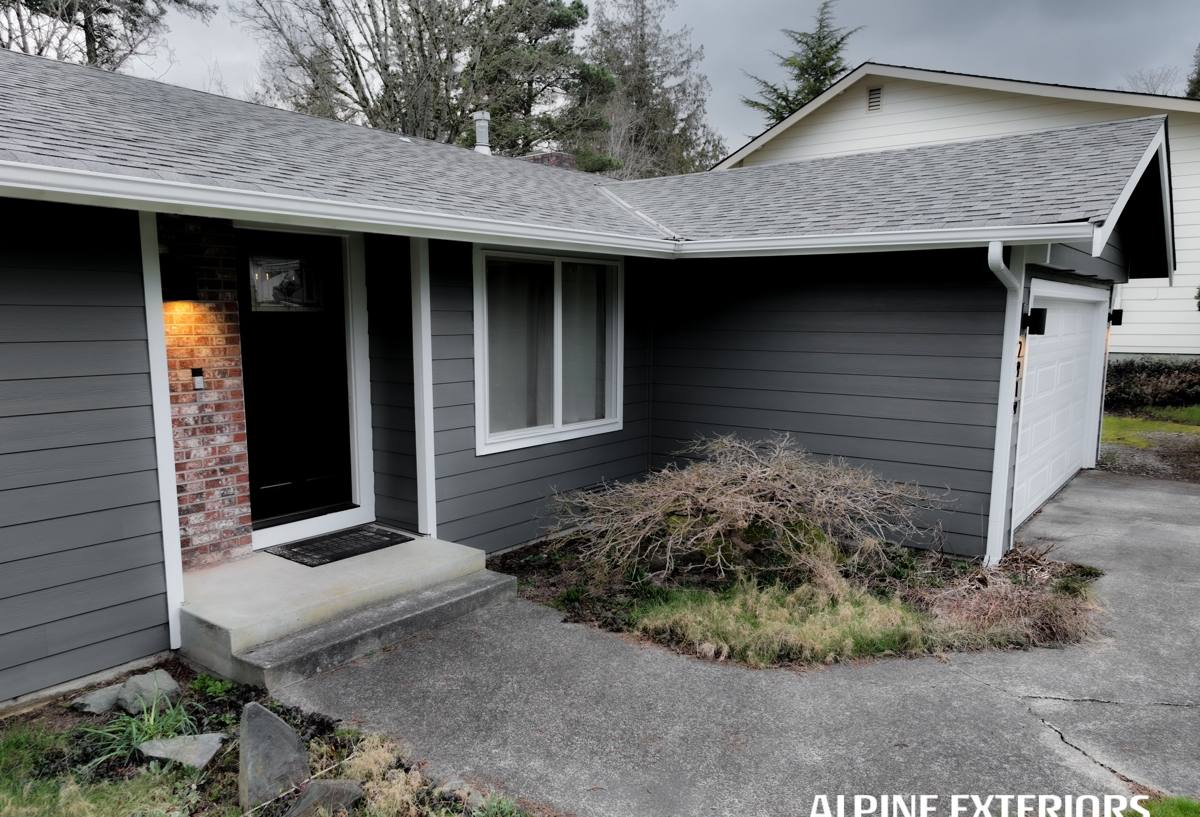
What Anacortes Weather Actually Does to Siding
Anacortes sits right on the water, which means siding here deals with a combination most inland Washington towns don't see all at once: salt-laden air off Rosario Strait and Guemes Channel, driving rain that comes in sideways during winter storms, and a long, damp moss-and-mildew season that can stretch from October into May. Any siding material has to handle all three, not just one.
How Vinyl Responds
Vinyl sheds bulk water reasonably well as long as it's installed with proper overlap and drainage behind it, but it's a thin material that expands and contracts significantly with temperature swings — more than most homeowners realize. In salt air environments, the fasteners and trim accessories (J-channel, starter strip, corner posts) are often the first things to show wear, and the panels themselves can become brittle over years of UV and temperature cycling, which matters when a winter windstorm is throwing debris at your walls.
How James Hardie Responds
Fiber cement doesn't expand and contract at anywhere near the rate vinyl does, and it isn't affected by salt air the way plastic or bare wood trim is. It's also dense enough to resist the kind of wind-driven rain intrusion that becomes a real issue on west- and south-facing walls near the water. Hardie's HZ5 product line was specifically engineered for climates with these conditions — freeze-thaw cycling, sustained moisture, and coastal exposure — which is exactly the profile of a house on Fidalgo Island.
Fire, Impact, and Physical Durability
This is the category with the clearest, least debatable difference between the two materials. Vinyl is a petroleum-based plastic — it softens, warps, or melts at fairly moderate heat, including from a barbecue grill too close to the wall or a neighbor's burn pile. James Hardie fiber cement is non-combustible; it won't ignite or contribute fuel to a fire. It's also considerably more resistant to impact damage — hail, thrown gravel from a mower, a ladder bump — without cracking or denting the way thin vinyl panels can.
| Factor | Vinyl Siding | James Hardie Fiber Cement |
|---|---|---|
| Combustibility | Combustible, can melt or warp from nearby heat | Non-combustible |
| Expansion/contraction | High — needs room to move at every panel | Minimal — dimensionally stable |
| Impact resistance | Can crack or dent | Resists impact well when installed to spec |
| Salt air exposure | Trim and fasteners degrade faster | Engineered HZ5 line for coastal/marine climates |
| Finish | Color molded into plastic, fades over time | Factory-baked ColorPlus finish, UV-cured |
| Typical repaint interval | Doesn't repaint well; usually replaced when faded | 15+ years before repaint typically needed |
| Manufacturer warranty | Varies widely by brand and grade | 30-year non-prorated limited warranty, transferable |
Appearance: What the Wall Actually Looks Like Up Close
From the street, mid-grade vinyl can pass. Up close, it reads as plastic — the panel lines are shallow, the color sits on the surface rather than in it, and reflected light shows the extrusion pattern. James Hardie's lap siding, shingle-style panels, and board-and-batten profiles are cast from real wood grain, and the ColorPlus factory finish has actual depth and a low-sheen, painted look because it is, in fact, baked-on paint rather than pigmented plastic. On a lot of Anacortes homes — especially craftsman, farmhouse, and traditional Pacific Northwest styles — that difference in texture is the difference between "the house has vinyl on it" and "the house is well-built."
Color is the other half of this. Vinyl color is locked in at the extrusion stage and, because it's integral to the plastic, dark colors absorb heat and can warp panels over time — which is why vinyl selections skew toward lighter shades. James Hardie's ColorPlus palette includes deep, saturated colors with a consistent factory finish across every piece, and because it's a separate coating over cement board, it doesn't carry the same heat-warping restriction.
Moss, Mildew, and the Long Wet Season
Skagit County's shoulder seasons are damp for months at a time, and anything on the north or shaded side of a house is going to see moss and mildew pressure eventually — that part isn't unique to either material. The difference is what happens underneath. Vinyl's overlapping panel system, especially at seams and J-channel, can trap moisture behind it if it isn't installed with correct drainage gaps, and once moisture is behind vinyl it has nowhere to go but to sit against the sheathing. James Hardie, installed with proper flashing, starter strips, and clearances per Hardie's fastening specs, sheds water at the face of the panel and is far more forgiving if a small amount of moisture does get behind it, since the board itself won't rot, swell, or delaminate the way OSB sheathing or wood trim can.
Installation Is Where Both Materials Succeed or Fail
Vinyl's Sensitivity
Vinyl looks simple to install and that's part of the problem — it's easy to install badly. Nail it too tight and it can't expand with heat, leading to buckling. Nail it too loose and it rattles or blows off in a windstorm. Corner and trim details are frequently where amateur or rushed vinyl jobs show their weakness first.
Hardie's Sensitivity
Fiber cement has its own installation requirements, and they matter just as much. James Hardie specifies exact fastener types and spacing, minimum clearances from grade, decks, and roof lines, correct caulking at joints, and proper flashing at every penetration. Skipping these steps doesn't just void the manufacturer's warranty — it's the single biggest reason a Hardie installation underperforms. This is why we treat installation to spec as non-negotiable, not a formality.
Maintenance and Long-Term Ownership
Vinyl is marketed as low-maintenance, and day to day that's roughly true — no painting required. But "low maintenance" isn't "no lifespan concern." Faded, chalky, or brittle vinyl generally can't be refreshed with paint the way fiber cement can, so the end-of-life path for vinyl is usually full replacement, not touch-up. James Hardie with a ColorPlus finish is engineered to go 15 years or more before it needs attention, and because it's a real painted substrate, it can be repainted down the road if a homeowner wants to change color, extending the usable life of the siding well beyond the original install.
- Rinse siding annually to clear salt residue and organic buildup, regardless of material
- Keep gutters and downspouts clear so runoff doesn't sheet directly down the wall
- Trim back vegetation and keep mulch/soil below the bottom edge of the siding
- Re-caulk joints and trim as needed — this matters more for longevity than most homeowners assume
- Inspect after major windstorms for loose panels, popped fasteners, or impact damage
Warranty Structure
Vinyl warranties vary enormously by manufacturer and product grade, and many are prorated — meaning the payout shrinks the longer you've owned the siding, which matters if a problem shows up in year 12 instead of year 2. James Hardie backs its fiber cement siding with a 30-year non-prorated limited warranty on the substrate and a separate finish warranty on ColorPlus color, and both are transferable to a new owner if the home is sold, which is a real selling point in a market like Anacortes where buyers are paying close attention to exterior condition.
Cost: What Actually Drives the Price Gap
Vinyl carries a lower material and labor cost up front, and that's a legitimate reason some homeowners choose it — there's no honest way to argue otherwise. Where the comparison gets more complicated is total cost of ownership: replacement cycle, repaint needs, and resale impact all factor in over a 20-30 year horizon. The real cost drivers on any siding project, regardless of material, are the same:
- How much of the existing siding, sheathing, or trim needs to be removed and replaced
- House size, wall complexity, and the number of corners, windows, and penetrations
- Whether housewrap, flashing, or moisture barrier needs to be added or repaired
- Siding profile chosen — lap, shingle-style, and board-and-batten price differently
- Color and finish selection, including custom trim work
Why We Only Install James Hardie
We don't install vinyl, and we're upfront about why: in a marine climate with salt air, driving rain, and a long moss season, we've seen where the trade-offs land over time, and we'd rather build a business on a material we can stand behind for 30 years than one that's cheaper to quote today. James Hardie's HZ5 line was built for exactly this kind of coastal Pacific Northwest exposure, the ColorPlus finish holds up without repainting for well over a decade, and the warranty is structured to actually mean something if a problem shows up down the road. That's the standard we hold every job to, and it's the only standard we're willing to put our name on.
If you're weighing siding options for a home in Anacortes or elsewhere in Skagit County, we're happy to walk your property, look at your specific exposure and trim details, and put together a free, no-pressure estimate — just fill out the form below.