 Anacortes Siding
 An Older Neighborhood With Its Own Climate Problems
Old Town Anacortes carries a different feel than the newer subdivisions spreading out toward the edges of the city. Many of the homes here are older, built in decades when siding choices were simpler and exterior products weren't engineered for what this stretch of Skagit County actually throws at a house year after year. That matters, because a home's age and its proximity to the water both push its siding harder than most homeowners realize until they're standing in front of a wall that's cupping, staining, or soaking up moisture it can't shed.
Being this close to the water means salt-laden air moves through the neighborhood constantly. It settles on painted wood, works into seams and fastener holes, and accelerates corrosion on anything metal - trim nails, flashing, hose bibs, light fixtures. Combine that with the long stretches of driving rain common to the Anacortes area and the extended damp season that lets moss and algae get a foothold on north-facing walls and anything shaded by mature trees, and you've got three separate stresses working on the same siding at the same time. Most siding products were not designed with all three in mind simultaneously.
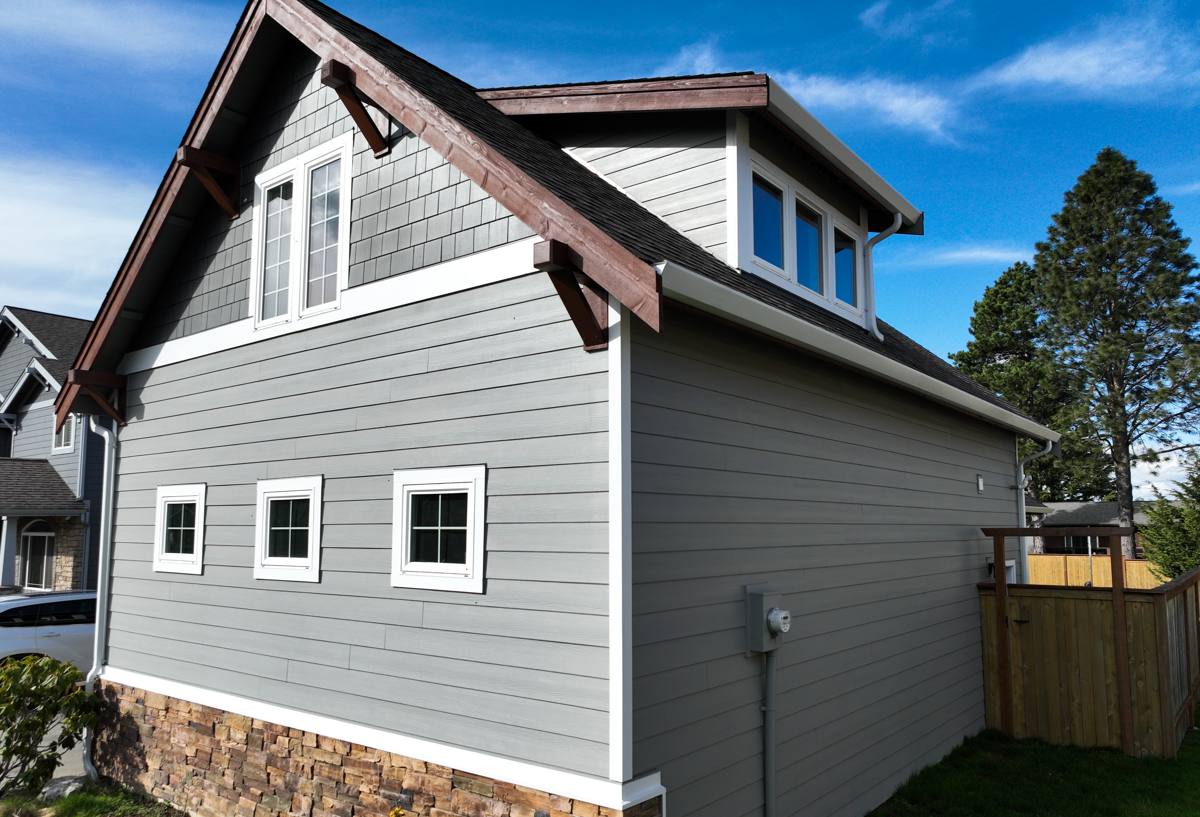
What This Actually Looks Like On a House
Walk a few blocks in Old Town Anacortes and you'll see the same handful of failure patterns repeating themselves on older siding:
- Peeling or alligatored paint on the sides of the house that catch the most weather off the water
- Soft or delaminating spots near the bottom courses of siding, where splash-back and standing moisture do their damage over time
- Green-black streaking and moss buildup on shaded walls and under overhangs that never fully dry out
- Gaps opening up at butt joints and around window trim as wood siding swells and shrinks through repeated wet-dry cycles
- Rust bleed streaking down from fastener heads or old metal trim pieces
None of this means the house is falling apart. It means the siding is doing exactly what untreated or poorly-matched exterior material does when it sits a few blocks from saltwater for enough winters in a row. The fix isn't a fresh coat of paint every few years - it's a siding system built to handle moisture, salt, and biological growth without requiring constant upkeep.
Why Age Compounds the Problem
An older home in this neighborhood has usually been through several siding-related repairs already: a repaint here, a section of trim replaced there, maybe a patch where a leak was found and fixed. Each of those repairs is a seam, and every seam is a place where water can eventually find its way behind the cladding. On an older house, we're not just replacing tired siding - we're often correcting years of small fixes that never solved the underlying moisture problem.
Why We Only Install James Hardie Fiber Cement
We made a deliberate call as a company to install James Hardie fiber cement siding exclusively - not vinyl, not LP SmartSide, not Cemplank, not Allura, not primed spruce or cedar. In a climate like this one, that decision isn't about brand loyalty. It's about which product actually holds up to salt air, sustained rain, and a moss season that doesn't really end.
Fiber cement is non-combustible and dimensionally stable, meaning it doesn't expand and contract with moisture the way wood-based products do. That stability is exactly what prevents the joint-gapping and cupping we see on older wood siding around Old Town Anacortes. Hardie's factory-applied ColorPlus finish is baked on under controlled conditions, which gives it far better resistance to fading and peeling than field-applied paint - a real advantage when your walls are absorbing salt spray on top of normal UV exposure. And because Hardie manufactures HZ5 product specifically engineered for wetter, harsher climates, we're not installing a generic siding and hoping it holds up here - we're installing the version built for exactly this kind of weather.
Wood siding products, even well-treated ones, stay vulnerable to moisture absorption at cut edges and fastener penetrations. Vinyl can warp and doesn't offer the same fire performance. Other fiber cement competitors may look similar on a spec sheet, but the finish quality, warranty structure, and manufacturing consistency are what separate them in practice - and after years of installing exterior products in this region, Hardie is the one we're willing to stand behind with a strong transferable warranty.
How We Approach a Siding Job in This Neighborhood
1. Assessment Before Anything Gets Touched
We start by identifying where moisture has actually gotten in - not just where the siding looks bad. That means checking behind trim, around window and door penetrations, and at any point where the old siding meets a roofline, deck, or lower-level transition. Old Town Anacortes homes often have additions or modifications over the years, and those transition points are where problems hide.
2. Fixing the Water Management, Not Just the Surface
Proper weather-resistive barrier and flashing detail work happens before a single piece of Hardie board goes up. This is the step that gets skipped on rushed jobs and is the reason some siding "fails" within a few years even when the product itself is good. We treat this as the most important part of the install, not a formality.
3. Installing to Manufacturer Spec
Fiber cement performs the way it's rated to perform only when it's installed correctly - proper fastener placement, correct clearances at grade and roof lines, and sealed or capped cut edges where the factory finish has been exposed. We follow Hardie's installation requirements because that's what keeps the warranty valid and the siding performing for decades, not just years.
Roofing, Windows, and Decks Face the Same Conditions
Siding isn't the only exterior surface under stress in this neighborhood. Roofs here deal with the same moss growth and driving rain, and a roof that's shedding granules or holding onto moss is sending water toward the same wall systems we're trying to protect with new siding - so the two jobs are connected. Windows on older Old Town Anacortes homes are frequently original or early-generation replacements, and failing seals around them are a direct path for the moisture we're talking about to get behind new siding, undoing the work before it's even finished. Decks facing the water take the same salt air and rain exposure and often show fastener corrosion and moisture damage well before the rest of the house does.
Because we handle siding, roofing, windows, and decks, we can look at a house as one connected exterior system rather than treating each surface as a separate problem. That matters most on older homes where one component's failure is often the reason another one is struggling.
Comparing Siding Options for This Climate
| Factor | James Hardie Fiber Cement | Vinyl Siding | Wood / Primed Spruce |
|---|---|---|---|
| Salt air resistance | Strong - non-corrosive material, factory finish holds up | Moderate - can become brittle and discolor over time | Weak - absorbs moisture at seams and cut edges |
| Moss / algae resistance | Good - dense material resists penetration, cleans without damage | Moderate - surface growth common in shaded areas | Poor - moss holds moisture against the wood |
| Fire performance | Non-combustible | Combustible, can melt or deform | Combustible |
| Finish longevity | Factory-baked ColorPlus finish, long fade resistance | Color molded in, but can chalk and fade | Field-applied paint, needs repainting every few years |
| Typical warranty | Strong, transferable manufacturer warranty | Varies widely by manufacturer | Limited to paint/product warranty, not the whole system |
What to Check Before Hiring Anyone for Exterior Work Here
- Do they carry current Washington contractor licensing and insurance, and will they show you proof without being asked twice
- Do they have documented experience with fiber cement installation specifically, not just general siding work
- Will they explain the weather-resistive barrier and flashing plan for your specific house, not just the finish product
- Do they follow manufacturer installation specs closely enough to keep the product warranty intact
- Can they speak specifically to salt air and moss conditions in this part of Skagit County, or are they giving you generic answers
- Are they willing to walk the property with you and point out exactly where the current siding is failing and why
Why a Local Crew Matters Here
Exterior work in Old Town Anacortes isn't the same job as exterior work forty miles inland. A crew that works this area regularly already knows which walls take the worst of the weather off the water, how aggressively moss establishes itself on shaded north sides, and how quickly driving rain finds its way into an older home's weak points. That local familiarity shows up in small decisions during the job - where extra flashing attention goes, which transitions get double-checked - that a crew unfamiliar with this specific climate might not think to prioritize.
If your Old Town Anacortes home is showing the wear this stretch of coastline puts on siding, roofing, windows, or decks, we're glad to take a look and talk through what we're actually seeing - no pressure, no upsell script, just a straight assessment. Reach out for a free estimate using the form below.