 Anacortes Siding
 Why Cap Sante Windows Wear Differently
Homes around Cap Sante sit close to the water, and that proximity shapes everything about how windows age here. Salt-laden air off Fidalgo Bay works into hardware, weep systems, and exposed fasteners faster than it would a few miles inland. Add the wind that funnels across the marina and up the bluff, and you get driving rain hitting window assemblies at angles they were never designed for. Skagit County's long, wet fall-through-spring stretch means those conditions aren't occasional — they're the default state for months at a time.
Then there's moss and algae. The same moisture and shade that keep this area green also colonize window sills, cladding, and the caulk lines around frames. Once organic growth gets a foothold in a failing sealant joint, it holds water against the frame and accelerates whatever rot or corrosion has already started. A window that would last three decades in a drier, calmer climate can start showing real trouble in Cap Sante well before that, especially on the sides of a house that face open water or prevailing weather.
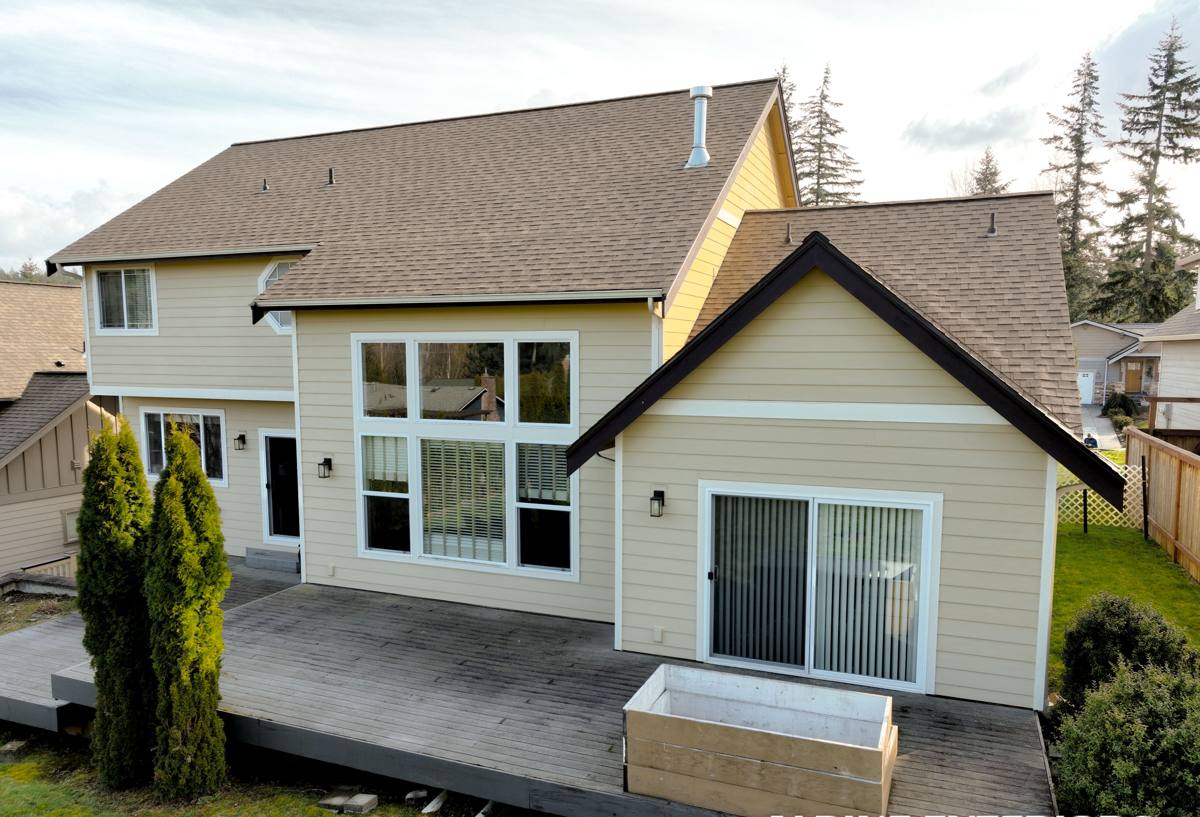
Signs Your Windows Are Losing the Battle
Most window failures in this area don't show up as a dramatic leak. They show up as small, easy-to-dismiss symptoms that add up over a season or two:
- Fogging or a permanent haze between panes, meaning the insulated glass seal has failed
- Soft or spongy wood at the sill or lower corners of the frame
- Windows that stick, won't latch fully, or have started to sag in the opening
- Visible moss, black streaking, or persistent green film on the sill or exterior trim
- A cold draft near the frame even when the sash is fully closed
- Paint or finish that's bubbling or peeling specifically around the window, not the wider wall
Any one of these on its own might just need maintenance. Two or three together, especially on a water-facing elevation, usually means the window assembly itself is past the point where caulk and touch-up paint will hold.
Why "It Still Opens" Isn't the Right Test
A window can operate fine and still be failing. Insulated glass seals go quietly — you lose the argon fill and the thermal performance long before you notice fog. Flashing behind the trim can be compromised for a year or more before water finds its way to framing lumber. We look past whether a window functions and check what's happening at the connection between the window and the wall, because that's where the real damage accumulates.
What a Correct Window Replacement Involves
Removal and Inspection
Pulling the old window is also our best chance to see what's actually going on behind the trim. We check the sill and jack studs for soft or discolored wood, look for signs of past water intrusion, and confirm the rough opening is square and sound before anything new goes in. If there's rot, it gets addressed here — installing a new window over damaged framing just resets the clock on the same problem.
Flashing and Water Management
This is the step that matters most in a climate like ours and the one that's easiest to shortcut. Proper flashing means a sill pan that directs any water that gets past the window back outside the wall assembly, correctly lapped house wrap or building paper, and head flashing that sheds water down and away rather than trapping it against the frame. Given how much wind-driven rain this area sees, we treat flashing detail as non-negotiable, not an upsell.
Installation and Sealing
The window gets set plumb, level, and square, shimmed correctly so it isn't relying on fasteners to hold its shape, and fastened per the manufacturer's schedule so the warranty stays intact. Sealing happens in the right order — backer rod and sealant at the right joints, not just a bead of caulk around the visible trim — so the assembly can handle both bulk water and the pressure differences that come with strong wind gusts off the water.
Choosing the Right Window for a Marine Environment
Frame material matters more here than in a typical inland install, because salt air and constant moisture cycling are harder on some materials than others. There's no single "correct" answer for every home — it depends on your home's exposure, existing trim details, and budget — but the trade-offs are worth understanding upfront.
| Frame Material | Behavior Near Salt Air & Moisture | Maintenance Burden |
|---|---|---|
| Vinyl | Won't corrode or rot; performs consistently in wet, salty conditions | Low — occasional cleaning |
| Fiberglass | Very stable dimensionally, resists moisture and salt well | Low — durable finish, minimal upkeep |
| Aluminum | Can corrode over time in salt-heavy air without a quality finish | Moderate — finish and hardware need monitoring |
| Wood / wood-clad | Attractive but vulnerable where cladding or seals are compromised | Higher — periodic finish and joint maintenance |
We don't push one brand or material as universally "best." What we do is size the choice to the exposure: a window on an open, water-facing wall in Cap Sante needs to be evaluated differently than one tucked under a covered porch on the leeward side of the same house. We'll walk your specific openings with you and explain the honest trade-offs — moisture behavior, upkeep, warranty terms, and appearance — rather than steering you toward whatever's easiest to install.
Glass, Gas Fill, and Coatings Worth Understanding
Most replacement windows sold today use dual-pane insulated glass, and many offer a triple-pane upgrade. In a climate with our temperature swings — cool, damp winters and increasingly warm summer stretches — a low-E coating that's tuned for both heat retention and solar control tends to perform better year-round than a coating optimized for one extreme. Argon or krypton gas fill improves the insulating value of the airspace between panes, but that only matters if the seal holds; it's another reason seal quality and installation care outweigh spec sheet numbers.
Condensation resistance is also worth asking about directly. Homes near open water often run slightly higher ambient humidity, and a window with poor condensation resistance will show it on the interior glass and sill first. It's a smaller detail than frame material, but it affects daily livability more than most homeowners expect.
Our Process, Start to Finish
We keep the process straightforward and try to minimize disruption to your home, especially during the wetter months when an open wall can't sit exposed for long.
- On-site assessment of each window, checking framing, flashing, and current condition — not just measuring for a quote
- Written estimate that spells out frame material, glass package, and scope, with no vague allowances
- Scheduling built around weather windows, since we don't leave openings exposed during an active system off the water
- Removal, framing repair if needed, and correct flashing and sill pan installation before the new window goes in
- Final air-seal, insulation, and interior/exterior trim work to match your home's existing finish
- Walkthrough so you can operate every window and see the completed work before we consider the job done
- Cleanup of the work area, including removal of old windows and packaging
Cost Factors to Expect
Every home is different, but the line items that actually move the price on a Cap Sante project tend to be consistent. Knowing them upfront makes it easier to compare estimates apples-to-apples.
| Factor | Why It Affects Price |
|---|---|
| Frame material | Vinyl is typically the most economical; fiberglass and wood-clad cost more upfront |
| Window size and configuration | Larger units, bays, and custom shapes require more material and labor |
| Condition of the existing framing | Rot repair or resizing an opening adds time and material beyond a standard swap |
| Number of openings on exposed elevations | Water-facing walls often warrant extra flashing detail, which adds labor |
| Access and site conditions | Second-story or hard-to-reach openings take longer and may need staging |
We'll always walk through where your project falls on these factors before you commit to anything, so the number on the estimate reflects your actual home rather than a generic average.
Permits and Local Code Considerations
Window replacement in Anacortes and unincorporated Skagit County can trigger permit requirements depending on the scope — particularly if an opening is being resized, structural framing is altered, or the work is part of a larger exterior project. Egress requirements also matter for bedroom windows if you're changing size or configuration. We handle this conversation as part of scoping the job so there are no surprises mid-project, and we won't cut a corner on code just to save a step.
Why Local Experience in Cap Sante Matters
A crew that only occasionally works this close to the water can miss details that are second nature to someone who does it regularly — how far wind-driven rain actually travels up a wall, which elevations in this specific pocket of Anacortes take the worst of it, how quickly moss reestablishes itself on a sill that isn't detailed to shed water cleanly. That knowledge shows up in small decisions: where we put extra flashing, how we sequence the sealant, which material we'll actually recommend for a given exposure instead of whatever's cheapest to stock.
It also matters for accountability. A local crew is still around next season if a question comes up, and has a reputation in Skagit County worth protecting. That's a meaningful difference from a crew passing through on a broader regional route.
Get a Straightforward Estimate
If your windows in Cap Sante are showing any of the signs above, or you're simply planning ahead for a home this close to the water, we're happy to take a look and give you an honest read on what's needed and what it'll cost. The estimate is free, there's no pressure attached to it, and you can use the form below to get started.