 Anacortes Siding
 Bow sits along the Skagit County coastline near Samish Bay, a mix of farmhouses, waterfront lots, and homes tucked into the tree line between open fields and forested hillside. It's a beautiful place to own a roof and a genuinely tough place to keep one performing. Salt-laden air off the bay, driving rain that hits roof slopes at an angle instead of falling straight down, and a moss season that runs most of the year all put real, sustained load on asphalt shingle roofing here. We install and replace asphalt shingle roofs throughout Bow, and this page covers what actually matters for a roof in this specific setting — not generic roofing advice, but what a correct installation looks like on a home dealing with this exact combination of weather.
What Bow's Climate Actually Does to an Asphalt Shingle Roof
Asphalt shingles are one of the most widely used roofing materials in the country for good reason — they're cost-effective, come in a wide range of styles and colors, and perform well when installed correctly. But "installed correctly" carries more weight in a place like Bow than it does in a drier, more sheltered climate.
Salt Air and Corrosion
Bow's proximity to Samish Bay means salt-laden air travels further inland here than most homeowners expect, especially during winter storms with sustained onshore wind. That air doesn't damage the shingles themselves much, but it accelerates corrosion at every metal component on the roof — nail heads, drip edge, valley flashing, vent boots with metal collars, and any exposed fastener. A roof that skimps on corrosion-resistant hardware in a coastal-adjacent setting like this one tends to develop rust streaks and failing flashing years before the shingles themselves are due for replacement.
Driving Rain and Wind-Driven Water
Rain in Bow rarely just falls straight down. Wind off the open water pushes it sideways into valleys, up under shingle tabs, and around penetrations like chimneys and vent pipes. That's a fundamentally different moisture challenge than a still, straight-down rain event, and it's exactly the scenario that exposes weak flashing, thin underlayment, or shingles that weren't sealed and nailed to spec. A roof built for a calmer climate, or installed without this in mind, tends to leak first at these directional-water points rather than across the open field of the roof.
Moss and the Long Wet Season
Between the marine-influenced climate and the tree cover common on many Bow properties, roofs here spend a large part of the year damp rather than fully dry. Shaded and north-facing slopes are the first to hold moss, and moss does more than look unsightly — it holds moisture against the shingle surface, works into the granule layer, and can lift shingle edges over time if it's left unchecked for multiple seasons. A roof in Bow needs to be thought of as living with moss pressure, not as something that occasionally gets a little green.
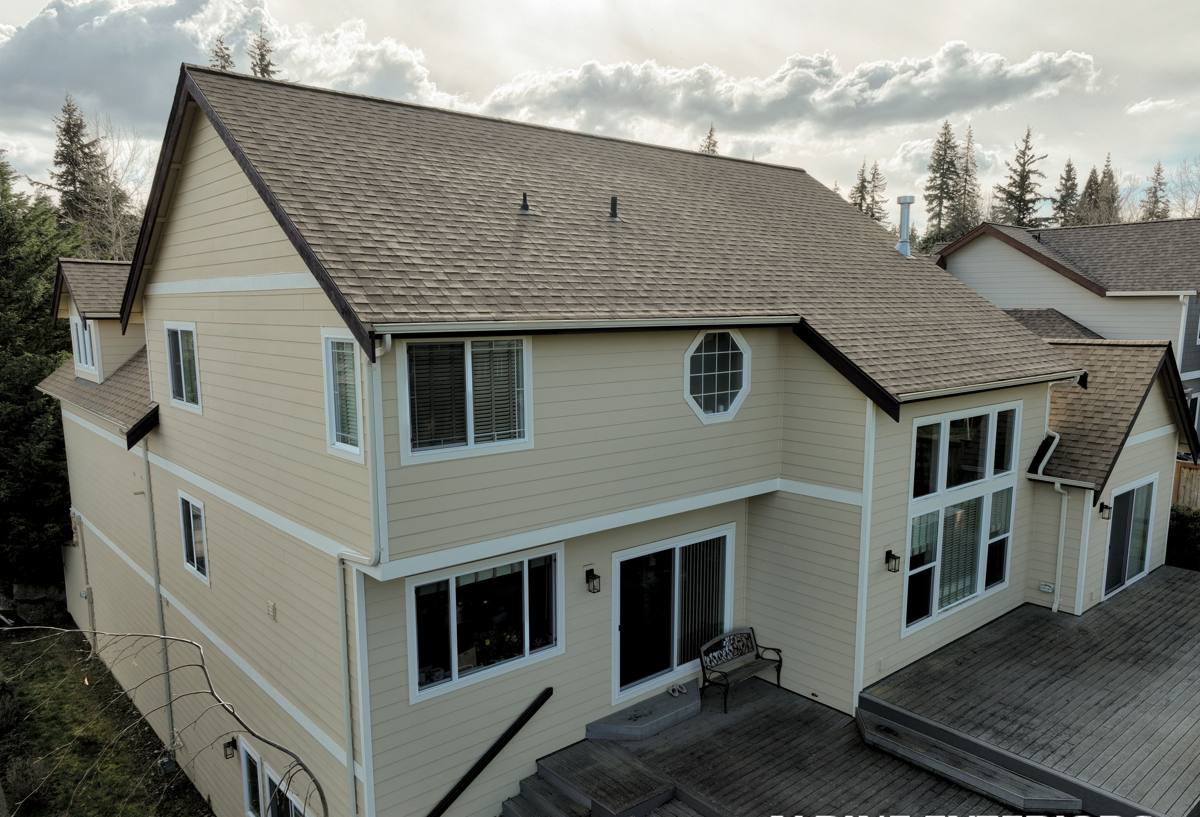
What a Correct Asphalt Shingle Installation Involves
A lot of what determines whether an asphalt shingle roof lasts 15 years or 30 years in a climate like this has nothing to do with the shingle brand printed on the wrapper. It comes down to what's underneath and around the shingles — the parts a homeowner rarely sees during the sales pitch but that do most of the actual work keeping water out.
- Synthetic or felt underlayment rated for sustained moisture exposure, installed with proper overlap, not a minimum-code product chosen purely on price
- Ice-and-water shield at eaves, valleys, and other water-concentration points where wind-driven rain and ice dams (on the rare cold snap) tend to collect
- Properly lapped and sealed step flashing and counter-flashing at every wall intersection, chimney, and roof-to-roof transition
- Correctly sized and sealed flashing at every penetration — vent pipes, skylights, exhaust fans — since these are common leak origins in wind-driven rain
- Balanced attic and roof deck ventilation so moisture from inside the home can escape instead of condensing against the underside of the deck
- Shingles fastened with the correct nail pattern and count for the local wind exposure, not just the manufacturer's bare minimum
- Corrosion-resistant flashing, drip edge, and fasteners suited to a salt-air-influenced coastal environment
None of these items add much to the overall cost of a roofing job relative to the shingles themselves, but skipping any of them is what turns a roof rated for 25-30 years into one that's leaking and needs attention at year 12 or 15.
Choosing the Right Asphalt Shingle for a Bow Roof
Not all asphalt shingles are built the same, and the differences matter more here than they would in a milder climate. The two broad categories homeowners choose between are three-tab and architectural (laminate) shingles.
| Factor | 3-Tab Shingles | Architectural (Laminate) Shingles |
|---|---|---|
| Construction | Single layer, flat profile | Multiple laminated layers, dimensional profile |
| Wind resistance | Lower rated wind speeds | Higher rated wind speeds, better suited to exposed lots |
| Moss and moisture behavior | Holds moisture in flat seams; shows moss buildup sooner | Sheds water more effectively; algae-resistant granule options available |
| Typical lifespan in this climate | 12-18 years realistic, shorter with sustained moss exposure | 20-25 years realistic with proper installation and moss upkeep |
| Upfront cost | Lower | Moderate |
For most Bow homes, architectural shingles are the better long-term value once you factor in realistic lifespan and wind performance on a more exposed, open lot. We'll also point out algae-resistant granule technology where it's available in a given product line — it doesn't eliminate moss, but it does slow how quickly it takes hold on shaded slopes, which matters on a property with real tree cover or north-facing roof planes.
Signs a Bow Roof Needs Attention
Because roofs here carry a heavier moisture and moss load than a sheltered inland home, problems tend to show up in predictable places first. Worth checking, or having a professional check, on a regular basis:
- Moss buildup in valleys or on shaded slopes that returns quickly after cleaning
- Granules collecting in gutters or at the base of downspouts, a sign shingles are wearing down
- Curling, cupping, or lifted shingle edges, especially after a windstorm
- Rust streaking near flashing, vent boots, or exposed fasteners
- Water staining on interior ceilings near exterior walls, chimneys, or skylights
- Soft or spongy spots when the roof is walked, indicating deck moisture damage underneath
- Daylight visible through the roof deck when viewed from inside the attic
Any single item on that list is worth a professional look. Caught early, most of these are a straightforward repair. Left through another wet season, several of them compound into a full tear-off.
Repair or Full Replacement? How We Help You Decide
Not every roofing problem in Bow calls for a full replacement, and we don't default to recommending one. We look at the age of the existing roof, how much of the surface is affected, whether the decking underneath has moisture damage, and how many prior repairs the roof has already had. A localized leak on an otherwise sound, reasonably young roof is usually a straightforward repair. A roof nearing the end of its rated life, with moss-related wear spread across multiple slopes or soft decking from long-term moisture intrusion, is more honestly addressed with a replacement than another round of patchwork that just delays the same conversation a year or two. We'll walk the roof, explain what we find, and give you the real trade-offs rather than pushing toward whichever option happens to be more profitable for us.
Our Process for a Bow Roofing Project
1. On-Site Inspection and Honest Assessment
We start by walking the roof and the attic, not just looking from the ground. That means checking valleys, flashing, vent penetrations, and the underside of the deck for existing moisture damage before we talk about products or pricing.
2. Clear, Written Scope
You get a written scope that spells out the shingle product, underlayment, ice-and-water shield placement, flashing details, and ventilation plan — not a vague line-item that just says "reroof."
3. Tear-Off and Deck Inspection
Washington building code generally limits roofs to two layers of asphalt shingles, so depending on the existing roof's history, this may mean a full tear-off to bare decking. That's also when any hidden deck damage from prior leaks gets identified and addressed before new roofing goes down over it.
4. Installation to the Details That Matter Here
Underlayment, ice-and-water shield, flashing, ventilation, and correct fastening — installed to hold up against wind-driven rain and salt air, not just to meet code minimums.
5. Final Walkthrough
We walk the finished roof with you, cover what was done, and explain what ongoing maintenance — mainly moss management — looks like going forward.
Why a Crew That Already Works Bow Matters
Bow isn't a dense subdivision with rows of identical rooflines — it's a spread of farmhouses, waterfront properties, and homes set back into tree cover, each sitting differently relative to wind, sun, and water exposure off Samish Bay. A crew that works this specific stretch of Skagit County regularly develops a feel for which roof orientations take the worst of the weather, which slopes hold moss longest, and which flashing details are worth the extra time versus which are just code minimum. That judgment doesn't come from a contractor who occasionally drives out from somewhere else for a one-off job — it comes from doing this work, on roofs like these, on a recurring basis.
What to Check Before Hiring a Roofing Contractor in Bow
- Ask specifically how they handle flashing at valleys, chimneys, and wall transitions — not just which shingle brand they carry
- Confirm fasteners and flashing are corrosion-resistant and appropriate for a salt-air-influenced coastal setting
- Get a clear, written scope that names the underlayment, ice-and-water shield placement, and ventilation plan
- Ask how they handle moss-affected or shaded slopes differently from sun-exposed ones
- Confirm both the manufacturer's material warranty and the contractor's separate workmanship warranty in writing
- Verify the contractor is licensed, bonded, and insured to perform roofing work in Washington State
A contractor who can speak concretely to wind-driven rain, salt exposure, and moss management is usually one who's actually dealt with those conditions before, not one reciting a general sales script.
Get a Free, No-Pressure Estimate
If your Bow home needs a roof inspection, a repair, or you're weighing a full asphalt shingle replacement, we're glad to take a look and give you a straightforward, honest read on what it actually needs. Reach out using the form below to schedule a free estimate — no pressure, no upsell script.