 Anacortes Siding
 Building a Deck That Actually Holds Up in Bow
Bow sits in a corner of Skagit County where saltwater air off Samish Bay, heavy tree cover, and a long wet season all work against outdoor wood structures at the same time. A deck built the way it would be in a drier inland town doesn't last here. The fasteners corrode faster, the shaded boards stay damp longer, and moss gets a foothold in gaps and seams within a season or two if the deck wasn't built to shed water and dry out quickly.
We build custom decks for homeowners throughout the Anacortes and Bow area, and the design decisions that matter most aren't cosmetic — they're about material choice, fastener selection, framing details, and drainage. Get those right and a deck can go decades with just routine cleaning. Get them wrong and you're looking at soft boards, rust streaks, and slick, moss-covered surfaces well before the structure should be showing its age.
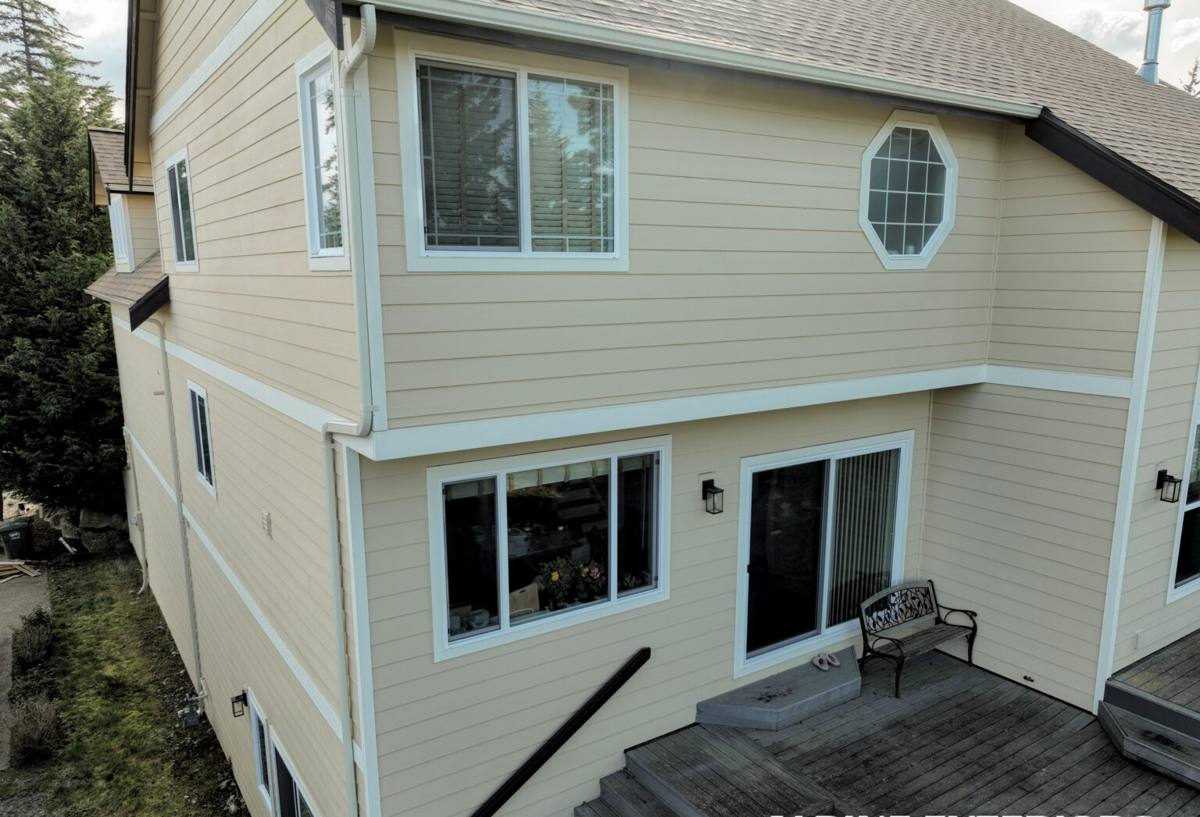
What Makes a Bow Property Different
Homes in and around Bow tend to sit on a mix of open farmland, wooded lots, and properties close enough to Samish Bay to catch salt-laden air on windy days. That mix matters for deck design in a few specific ways:
- Salt exposure: properties nearer the water deal with airborne salt that accelerates corrosion on screws, joist hangers, and railing hardware — even on structures that never get rained on directly.
- Tree cover and shade: many Bow lots have mature evergreens or sit close to tree lines, which keeps deck surfaces damp longer after rain and creates the shaded, humid conditions moss and algae need to establish.
- Open, wind-exposed sites: on cleared or farmland-adjacent lots, decks take driving rain from more angles, so flashing and water-shedding details at the house connection carry more weight.
- Mixed soil and drainage conditions: footing depth and drainage around posts need to account for the wetter ground common across low-lying parts of the county.
A custom deck means the design actually responds to which of these your specific lot deals with, rather than defaulting to a generic layout.
Choosing Decking Material for This Climate
Material choice is the single biggest factor in how a deck ages in Skagit County's climate. There's no universally "best" decking — the right choice depends on your budget, how much maintenance you're willing to do, and how shaded or salt-exposed your site is.
| Material | How it handles salt air & rain | Moss/algae resistance | Maintenance | Relative cost |
|---|---|---|---|---|
| Pressure-treated fir/hem-fir | Good if properly sealed; hardware must be corrosion-rated | Low — needs regular cleaning to stay ahead of it | Annual cleaning, re-sealing every 1-2 years | Lowest upfront |
| Western red cedar | Naturally moisture- and rot-resistant, ages gracefully | Moderate — still needs periodic cleaning in shaded spots | Occasional cleaning, optional staining | Mid-range |
| Capped composite | Excellent — won't absorb moisture or corrode | Good, but surface film can still grow on it in deep shade | Occasional wash, no sealing or staining | Higher upfront, lowest lifetime |
| PVC decking | Excellent — fully synthetic, unaffected by salt or rot | Good, smooth surfaces shed algae more easily than wood-grain composites | Occasional wash | Highest upfront |
For most Bow homeowners, the decision comes down to whether they want to actively maintain a wood deck's appearance over time or pay more upfront for a composite or PVC deck that mostly just needs washing. We're honest with clients about both paths — there's no wrong answer, only a mismatch between expectations and the material chosen.
Why We're Selective About Certain Composite Products
Not every composite board on the market performs the same in a shaded, wet climate. Some early-generation composites without a full polymer cap absorb moisture at the core over years of exposure, which can lead to swelling or surface degradation faster than the warranty implies. Our standard is to spec fully-capped composite or PVC products with documented moisture and slip-resistance performance, and we'll walk you through exactly why a given board is or isn't a fit for a shaded Bow lot before you commit to it.
The Structural Details That Actually Determine Lifespan
The decking surface is what you see, but the framing underneath is what determines whether the deck is still solid in fifteen years. This is where a lot of decks — custom or not — get shortchanged.
Ledger and House Connection
Where the deck attaches to the house is the single most common failure point we see on older decks in this region, because it's the spot water is most likely to get trapped against the structure. A correct ledger connection includes proper flashing that directs water out and away from the house framing, not just a bolted board against the siding.
Joists, Hangers, and Fasteners
In a salt-air environment, standard galvanized hardware corrodes faster than it should. We use stainless steel or heavy hot-dip galvanized fasteners and hangers rated for coastal exposure, and we tape joist tops to keep water from wicking into the end grain — a detail that's easy to skip and expensive to regret.
Footings and Posts
Post footings need to be sized and set below frost depth with adequate drainage around them, especially on the wetter, low-lying ground common around Bow. Undersized or shallow footings are a common source of deck movement and settling over time.
Designing Against Moss, Algae, and Standing Water
Moss doesn't grow on a deck because the wood is bad — it grows because moisture sits somewhere too long. Good deck design fights this at every level:
- Proper board spacing so water drains through rather than pooling on the surface
- A structure sloped slightly away from the house to keep water moving
- Ventilation underneath the deck so the substructure can dry out between storms
- Railing and post bases that don't trap debris or leaves, which hold moisture and feed algae growth
- Material and finish choices matched to how much shade the specific spot on your property gets
On heavily shaded lots, we'll sometimes recommend trimming back overhanging branches as part of the plan — not as an aesthetic choice, but because sunlight and airflow are the cheapest, most effective moss prevention there is.
Our Process for a Custom Deck in Bow
- Site visit and assessment: we look at sun exposure, drainage, soil, tree cover, and how exposed the site is to wind and salt air off the bay.
- Design and material selection: we walk through decking, railing, and framing options against your budget and maintenance preferences, with honest trade-offs explained up front.
- Permitting: most raised or attached decks require a building permit through Skagit County, since Bow is unincorporated county land rather than inside Anacortes city limits. We handle the permit application and inspections as part of the job.
- Site prep and footings: footings are dug to proper depth with attention to drainage before any framing goes in.
- Framing and ledger work: structural framing, flashing, and hardware installation, built to hold up under coastal moisture exposure.
- Decking, railing, and finish work: surface installation, railing systems, and any stairs or fascia detailing.
- Final walkthrough: we go over care and maintenance specific to the material you chose before we consider the job finished.
Realistic Maintenance for This Climate
Every deck, regardless of material, needs some upkeep in a climate this wet. What differs is how much and how often.
- Sweep off leaves and debris regularly, especially in fall — trapped organic matter is what feeds moss and algae fastest
- Rinse or gently pressure-wash the surface once or twice a year to stay ahead of moss before it establishes
- Check and re-seal wood decking on the schedule appropriate to the product — skipping this is the most common reason wood decks age poorly here
- Inspect fastener heads and railing hardware periodically for early rust, particularly on properties closer to the water
- Keep gutters and downspouts near the deck clear so runoff isn't dumping extra water onto or under the structure
- Trim back tree limbs that keep sections of the deck in constant shade
Cost Factors Worth Understanding Before You Budget
Every deck project is priced around a handful of factors that matter more than square footage alone:
| Factor | Why it affects cost |
|---|---|
| Decking material | Pressure-treated wood costs less upfront than composite or PVC, but composite/PVC typically cost less over the deck's lifespan |
| Height and grade change | A deck built well above grade needs more substantial framing, footings, and often stairs and additional railing |
| Site access and prep | Wooded or sloped lots common around Bow can require more site work before footings even go in |
| Railing system | Cable, glass, and metal railing systems cost more than standard wood or composite balusters |
| Permit and inspection scope | Attached, raised, or larger decks require more inspection steps through the county |
We give straightforward, itemized estimates so you can see exactly where the money is going rather than a single lump number.
Why Hire a Crew That Already Works in Bow
Deck-building fundamentals don't change from town to town, but the details that make a deck last do change with the site. A crew that regularly works properties around Bow and the greater Anacortes area already knows how salt air behaves on hardware, how shaded lots hold moisture longer than open ones, and what Skagit County's permitting process expects for a deck of a given size and height. That familiarity shows up in fewer surprises — no re-inspections for missed flashing details, no guessing about footing depth for wetter ground, and a design that accounts for your property's actual exposure instead of a one-size-fits-all layout.
If you're planning a new deck or replacing one that's showing its age, we'd rather walk your property with you and talk through what it actually needs than quote a number sight-unseen. Reach out for a free, no-pressure estimate — the form below gets you started.