 Anacortes Siding
 Siding in Bow Has to Answer to the Water and the Salt
Bow sits in that stretch of Skagit County where farmland runs down to saltwater, and homes here take weather from two directions at once. Storms roll in off the Salish Sea carrying salt-laden air that works into every seam and fastener on a house. Behind that comes driving rain, pushed sideways by wind more often than it falls straight down, followed by the long gray stretch of moss season that can run from October into May in a wet year. Any siding product installed in Bow has to hold up to all three at the same time, year after year, not just look good on install day.
That combination is harder on a house than most people realize. Salt air accelerates corrosion on fasteners and trim metal. Wind-driven rain finds its way behind poorly lapped or poorly flashed siding and stays there, because Bow's humidity and tree cover slow down drying time. And moss and mildew don't just sit on the surface — on the wrong material, they hold moisture against the wall and start a slow rot cycle that's invisible until it isn't. This page is about one thing specifically: what it takes to do fiber cement siding right on a Bow home, and why we install only James Hardie product to do it.
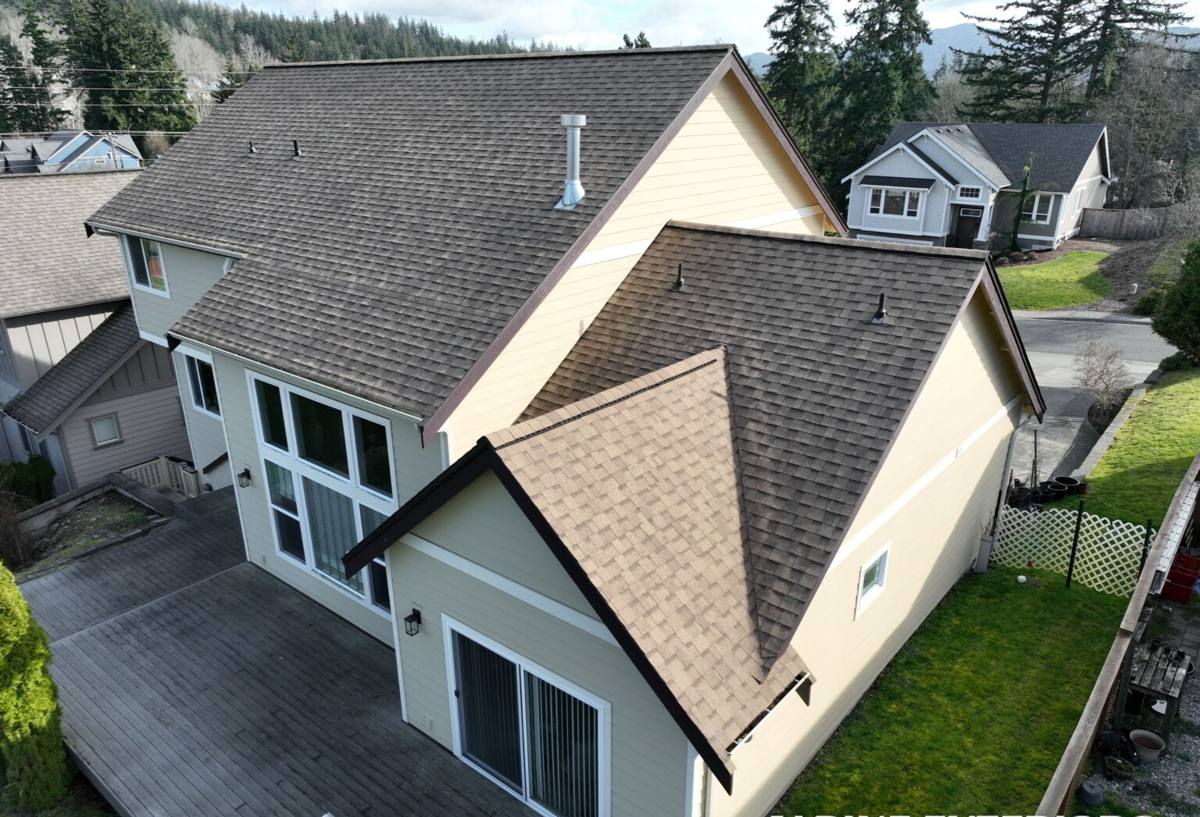
Why We Install Only James Hardie Fiber Cement
We don't offer vinyl, LP SmartSide, or generic fiber cement alternatives like Cemplank or Allura. That's not a marketing position — it's a standard we hold because of what this climate does to a house over ten, twenty, and thirty years, not just what a siding looks like on the day it goes up.
- Non-combustible core: James Hardie fiber cement is cement-based, not wood-based, so it doesn't feed a fire the way engineered wood products can.
- Moisture-resistant by formulation: Hardie's fiber cement is engineered to resist swelling, cracking, and rot from sustained wet exposure — a real advantage in a place where siding rarely gets a full week to dry out.
- Factory-applied ColorPlus finish: the color is baked on in a controlled factory environment, which holds up better against salt air and UV than field-applied paint, and it comes with its own finish warranty.
- Climate-engineered product lines: Hardie builds different formulations for different regions, which matters when you're this close to saltwater.
- A warranty structure that's actually transferable to a future homeowner if you sell, which most competing products don't offer in the same way.
We've seen what happens when cheaper materials get put on homes in this kind of exposure — not through invented statistics, but through the repair calls we take. Engineered wood siding that swells at the cut edges. Vinyl that goes brittle and cracks in a hard freeze, then lets water behind it. Primed spruce and cedar that need repainting on a cycle most homeowners underestimate when they buy the house. James Hardie isn't the cheapest option upfront, but it's the one we're willing to put our name on for the long haul.
What a Correct Fiber Cement Installation Actually Involves
Fiber cement siding is only as good as the installation underneath it. This is where most of the difference between a siding job that lasts thirty years and one that fails in eight actually shows up — and it's almost entirely invisible once the siding is up.
Water Management Comes First
Before a single board goes on, the wall needs a correctly lapped weather-resistive barrier, properly integrated flashing at every window, door, and roof-to-wall intersection, and drainage capability behind the cladding so any water that does get past the surface has somewhere to go. In a place like Bow, where wind-driven rain is routine rather than occasional, skipping or shortcutting this step is the single most common reason siding fails early — and it's the step that's cheapest to shortcut and most expensive to fix later.
Clearances and Fastening
James Hardie specifies clearances from grade, roofing, and other transitions for a reason: those gaps let the material dry rather than wick moisture. We also fasten according to Hardie's published specifications for our exposure zone — the right fastener type, spacing, and depth — because under-driven or over-driven nails, or the wrong fastener metal, are a slow-motion failure point in salt air.
Caulking and Sealant Discipline
Every joint, seam, and penetration gets sealed with a product rated for the exposure, not just whatever's on the truck. Over-caulking is almost as bad as under-caulking — it can trap moisture instead of letting the assembly breathe and drain the way it's designed to.
Our Process on a Bow Job
- On-site assessment: we walk the exterior, check the current siding and sheathing condition where accessible, and note site-specific exposure — how much direct weather and wind the walls actually take, tree cover, and drainage around the foundation.
- Written scope and product selection: we specify the Hardie product line, profile, and color, along with trim details, and put the water-management plan in writing before any material is ordered.
- Tear-off and substrate check: old siding comes off and we inspect the sheathing underneath for hidden rot or moisture damage before covering it back up — this is often where a homeowner learns something about their house they didn't know.
- Barrier and flashing installation: weather-resistive barrier, flashing, and any needed furring or drainage components go in first, correctly lapped from the bottom up.
- Siding installation: boards or panels go up to Hardie's fastening and clearance specifications, with attention to butt joints, corners, and penetrations.
- Trim, caulking, and touch-up: trim is installed, seams sealed, and any factory-finish touch-up done with Hardie's matched touch-up product.
- Final walk-through: we go over the finished job with the homeowner and point out anything they should know for long-term care.
Choosing the Right Hardie Product for This Exposure
Not every Hardie product line or exposure specification is right for every wall on every house. Part of doing this correctly in Bow is matching the product to how much weather a given elevation actually takes — a wall facing open water or prevailing wind needs the same attention to detail as one that's more sheltered, but the exposure conversation still matters for planning trim, flashing, and maintenance expectations.
| Consideration | Why It Matters in Bow |
|---|---|
| ColorPlus factory finish vs. field paint | Holds color and resists salt-air fading longer; reduces repainting cycles |
| Lap siding vs. panel siding | Lap sheds wind-driven rain differently than panel joints; profile choice should match wall exposure and design |
| Fastener material | Corrosion-resistant fasteners matter more this close to saltwater |
| Trim and flashing detail at penetrations | Highest-risk points for the wind-driven rain common in this area |
| Clearance from grade, decks, and roofing | Keeps moss, splashback, and standing moisture from sitting against the board edge |
Living With Moss Season
Moss doesn't just grow on roofs in this part of Washington — it colonizes north-facing walls, shaded siding, and anywhere air doesn't move well. Fiber cement resists the moisture damage moss can cause far better than wood-based products, but it isn't magic. Homeowners still get the best life out of their siding by keeping gutters clear so water isn't sheeting down the wall, trimming back vegetation that shades and dampens a wall for months at a time, and doing an occasional soft wash rather than letting growth build up over several seasons. None of this is heavy maintenance — it's the kind of upkeep that takes an afternoon a year and pays off over decades.
What This Costs, and What Drives the Number
We're not going to quote a number here that doesn't apply to your specific house — every job is different once you factor in square footage, tear-off condition, trim complexity, and product selection. What we can tell you is what actually moves the price up or down:
| Factor | Effect on Cost |
|---|---|
| Condition of existing sheathing | Hidden rot repair adds cost but should never be skipped |
| Home shape and trim complexity | More corners, gables, and penetrations mean more labor and flashing detail |
| Product line and profile | Different Hardie lines and widths carry different material costs |
| Height and access | Multi-story walls or difficult site access add labor time |
| Tear-off vs. new construction | Removing and disposing of old siding adds a line item tear-off doesn't have |
A Contractor Vetting Checklist for Bow Homeowners
Before hiring anyone for fiber cement siding in this area, it's worth asking a few direct questions. A contractor who's confident in their work won't mind answering any of these:
- Are you a certified or factory-trained James Hardie installer, and can you explain your fastening and clearance specs for this house specifically?
- Will you inspect and, if needed, repair the sheathing before re-siding, or just cover what's there?
- What's your plan for flashing at windows, doors, and roof intersections — can you walk me through it?
- Do you carry current liability insurance and workers' comp coverage, and can you provide proof?
- What does your written warranty cover, separate from the manufacturer's material warranty?
- Have you worked in this area before, and do you understand the exposure this specific property faces?
Why a Crew That Already Works This Area Matters
Siding installation isn't one-size-fits-all, and a crew that already does this work around Anacortes and Skagit County brings something a traveling or out-of-area contractor can't: they've already seen how salt air, driving rain, and moss behave on real houses in this exposure, not in a training manual. That shows up in small decisions — where extra flashing attention pays off, which elevations need more sealant discipline, how much clearance really is enough given the site — that a generic installation approach misses. It also means someone local to call if a question comes up five or ten years down the road, not a number that stopped picking up after the invoice was paid.
Get a Straight Answer for Your House
Every home in Bow carries its own exposure — how close it sits to open water, how much wind and tree cover it gets, what condition the current siding and sheathing are actually in. The only way to give you an honest answer on scope and product is to look at the house itself. We offer a free, no-pressure estimate: we'll walk the exterior with you, tell you what we see, and lay out what correct James Hardie installation would look like on your specific home — no obligation attached. Use the form below to get started.