 Anacortes Siding
 Bow sits in the stretch of Skagit County where farmland, tideflats, and forested hillsides meet the water — which means roofs here take a beating from a few directions at once. Homes closer to the shoreline deal with salt-laden air that accelerates corrosion on fasteners and flashing. Homes tucked under trees deal with shade, needles, and a moss season that can run most of the year in a wet Pacific Northwest climate. And every roof in the area deals with driving, wind-pushed rain that finds any weak point in a roofing system faster than a straight-down rain ever would. A roof replacement in Bow needs to be built for all of that, not just for looks.
Why Bow's Climate Is Hard on Roofs
Roofing manufacturers write their installation specs assuming reasonably dry, sheltered conditions. Bow — and Skagit County generally — doesn't offer that. Three conditions do most of the damage:
- Salt air: Properties within a few miles of the water see faster corrosion on exposed metal — nails, flashing, gutters, and vent stacks — than roofs further inland.
- Driving rain: Wind off the water pushes rain sideways and uphill under shingle tabs, around chimneys, and into any flashing detail that isn't lapped correctly. A roof that would hold up fine in a calmer climate can leak here.
- Moss and shade: Tree cover and persistent moisture create ideal conditions for moss and algae growth, which holds water against the roof surface and works into seams over time.
None of this means a roof in Bow is doomed to fail early. It means the installation details — underlayment, flashing, ventilation, and fastening — matter more here than they would in a drier region, and a roof built to the minimum spec is more likely to show problems within a decade instead of holding up for its full expected life.
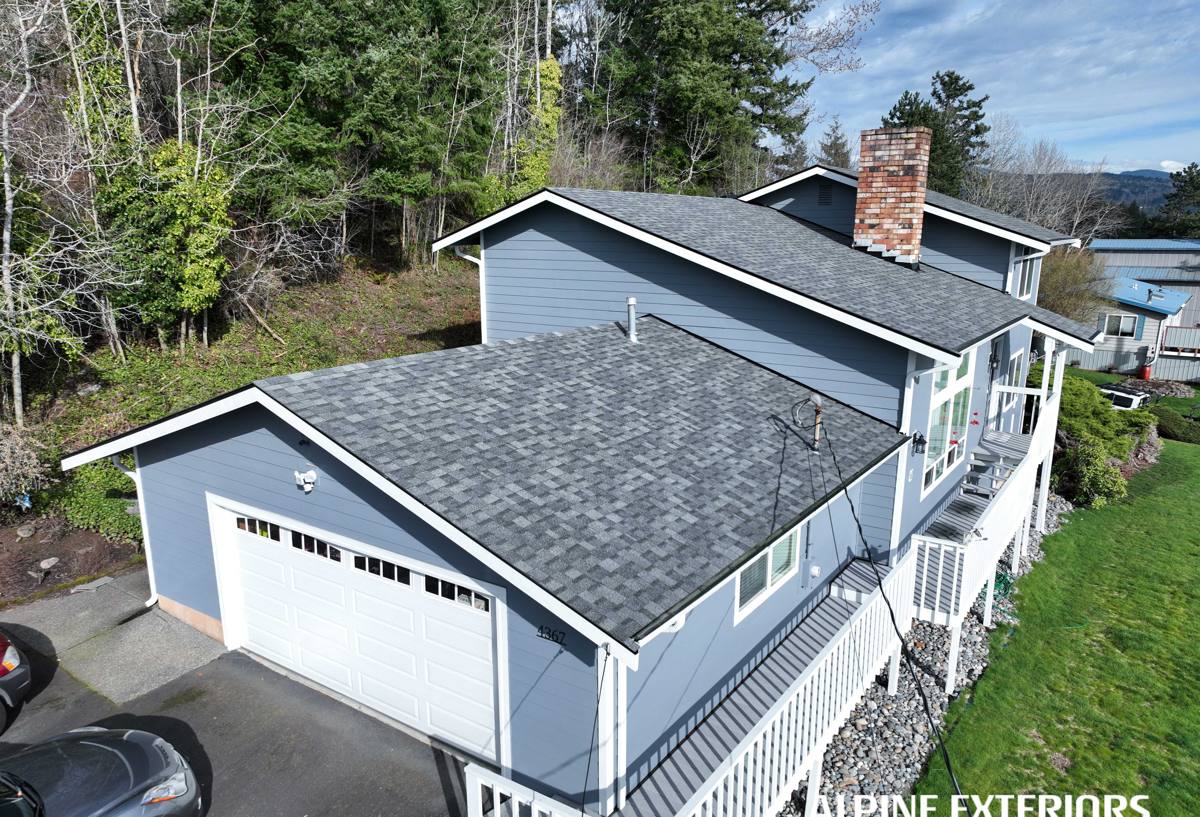
Signs Your Bow Roof Needs Replacing, Not Just Repairing
Not every roof problem calls for a full replacement, but there's a point where patching stops being the honest answer. We look for these signs before recommending a full tear-off:
- Granule loss showing up in gutters or downspouts, or shingles that look bald in patches
- Curling, cracking, or lifted shingle tabs, especially on south- and west-facing slopes
- Soft or spongy decking felt underfoot, or visible sagging along the roofline
- Moss buildup thick enough that it's lifting shingle edges rather than just sitting on the surface
- Repeated leaks in different spots after previous patch repairs
- Roof age at or past the manufacturer's expected service life for the local climate
If a roof is showing one or two of these in isolation, a repair or a shorter-term patch plan can still make sense. If several are showing up together, replacement is usually the more honest recommendation — patching a roof that's failing broadly just delays a bigger repair bill and risks interior water damage in the meantime.
What Correct Roofing Practice Looks Like in This Climate
Underlayment That Actually Handles Wind-Driven Rain
In a wet, wind-exposed area like Bow, underlayment isn't a formality — it's the roof's real backup layer when wind pushes water past the surface material. We use synthetic underlayment across the field and self-adhered ice-and-water membrane at vulnerable points: eaves, valleys, around penetrations, and along low-slope transitions where water has time to pool or back up.
Flashing Details, Not Just Flashing Products
Most roof leaks in this region trace back to flashing that was reused, shortcut, or installed without proper step-and-counter technique — not to the shingles themselves. Chimneys, skylights, dormers, and sidewall transitions all need flashing that's properly lapped and integrated with the underlayment, not just caulked and hoped for.
Ventilation Sized for the Attic, Not Guessed At
Poor attic ventilation traps moisture, which speeds up sheathing rot and gives moss and mildew a head start from the inside as well as the outside. We check intake and exhaust balance as part of a replacement rather than just replacing what was there before, since older roofs in this area are frequently under-vented by current standards.
Fasteners and Metal Suited to Salt Exposure
For properties closer to the water, we pay attention to corrosion-resistant fasteners and flashing metals rather than defaulting to standard-grade hardware. It costs a little more up front and pays for itself by not becoming the first thing that fails.
Material Options for Bow Homes
There isn't one "right" roofing material for this area — the right call depends on the home's slope, exposure, budget, and how long the owner plans to stay in the house. Here's how the common options stack up for local conditions:
| Material | How It Handles This Climate | Maintenance Reality |
|---|---|---|
| Architectural asphalt shingle | Good performance when installed with proper underlayment and flashing; widely available, easy to repair in sections | Moderate — benefits from periodic moss treatment and gutter clearing |
| Standing seam metal | Sheds driving rain and moss very well due to smooth, steep-lapped surface; strong option near the water when properly coated | Low — occasional inspection of fasteners and sealant points |
| Composite/synthetic shingle | Resists moisture absorption better than organic materials; performs well in shaded, damp areas | Low to moderate |
| Cedar shake | Traditional look, but organic material holds moisture longer in a climate this wet, which shortens service life without diligent upkeep | High — we're honest that this is the trade-off, not a defect in the product itself |
We'll walk through these options against your specific roof rather than pushing one default — a heavily shaded roof under fir trees has different priorities than an open roof facing the water.
Our Roof Replacement Process
- On-site inspection: We assess the existing roof, decking condition, ventilation, and flashing points, and take photos of anything that affects the scope.
- Written estimate: A clear scope of work and cost breakdown — no vague allowances, no pressure to sign on the spot.
- Tear-off and decking check: Old roofing comes off down to the deck so we can actually see the sheathing condition, not just guess at it.
- Deck repair as needed: Any soft, rotted, or delaminated sheathing gets replaced before new roofing goes down — this is called out separately, not buried in the base price.
- Underlayment and flashing installation: Ice-and-water membrane at vulnerable areas, synthetic underlayment across the field, and properly lapped flashing at every penetration and transition.
- Roofing material installation: Installed to manufacturer spec and local wind/rain conditions, not just the bare minimum to pass inspection.
- Ventilation check: Intake and exhaust balance confirmed or corrected as part of the job.
- Final walkthrough and cleanup: Site cleared of debris and nails, and we walk the finished roof with you.
What Affects Cost on a Bow Roof Replacement
Every roof is different, so we don't publish blanket pricing — but the main cost drivers on jobs in this area are consistent:
| Factor | Why It Matters |
|---|---|
| Roof size and number of slopes | More squares and more complex geometry mean more material and labor |
| Decking condition | Rotted or delaminated sheathing found during tear-off adds material and labor not visible from the ground |
| Material choice | Asphalt, metal, and composite options carry different material and installation costs |
| Roof pitch and access | Steep or hard-to-access roofs take longer and require more safety setup |
| Flashing and penetration count | Chimneys, skylights, and multiple vent stacks each add detail work |
| Ventilation corrections | Adding or upgrading intake/exhaust vents where the existing setup is inadequate |
We give you the real number after inspecting the roof, not a phone estimate that changes once we're on the ladder.
Why Hire a Crew That Already Works in Bow
A roofing crew that regularly works properties in Bow and around Anacortes already understands the pattern of problems specific to this stretch of Skagit County — where salt exposure tends to matter most, which tree-heavy properties need extra moss and ventilation attention, and how wind direction off the water affects flashing decisions. That's not something you get from a crew that mainly works drier, inland jobs and treats every roof the same way. Local experience shows up in the small decisions — where to add extra membrane, which flashing details to reinforce, how to size ventilation for a specific attic — and those decisions are what determine whether a roof holds up through its full expected life in this climate or starts leaking early.
If your roof in Bow is showing wear, or you just want an honest read on whether repair or replacement makes more sense, we're happy to come take a look. Reach out for a free, no-pressure estimate using the form below.