 Anacortes Siding
 Conway's Climate Is Tougher on Siding Than It Looks
Conway sits low in the Skagit River delta, tucked between farmland and tidal water, with Skagit Bay and Puget Sound close enough that salt-laden air reaches the area regularly. That combination — damp river-bottom humidity plus salt exposure plus a long, gray stretch of driving rain from fall through spring — is a harder environment on exterior siding than most homeowners realize until they're dealing with the results. Add in the shaded, moisture-holding conditions that let moss and algae take hold on north faces and under eaves, and you have a climate that punishes any siding material with weak points in its moisture management.
This isn't a scare story — it's just the honest starting point for any siding decision in this part of Skagit County. Homes here need a product and an installation that account for standing moisture, wind-driven rain getting up under laps and around trim, and long stretches where surfaces simply don't dry out fast. We install one siding system, James Hardie fiber cement, because it's engineered for exactly these conditions when it's put on correctly. This page is about what that looks like specifically for a Conway home.
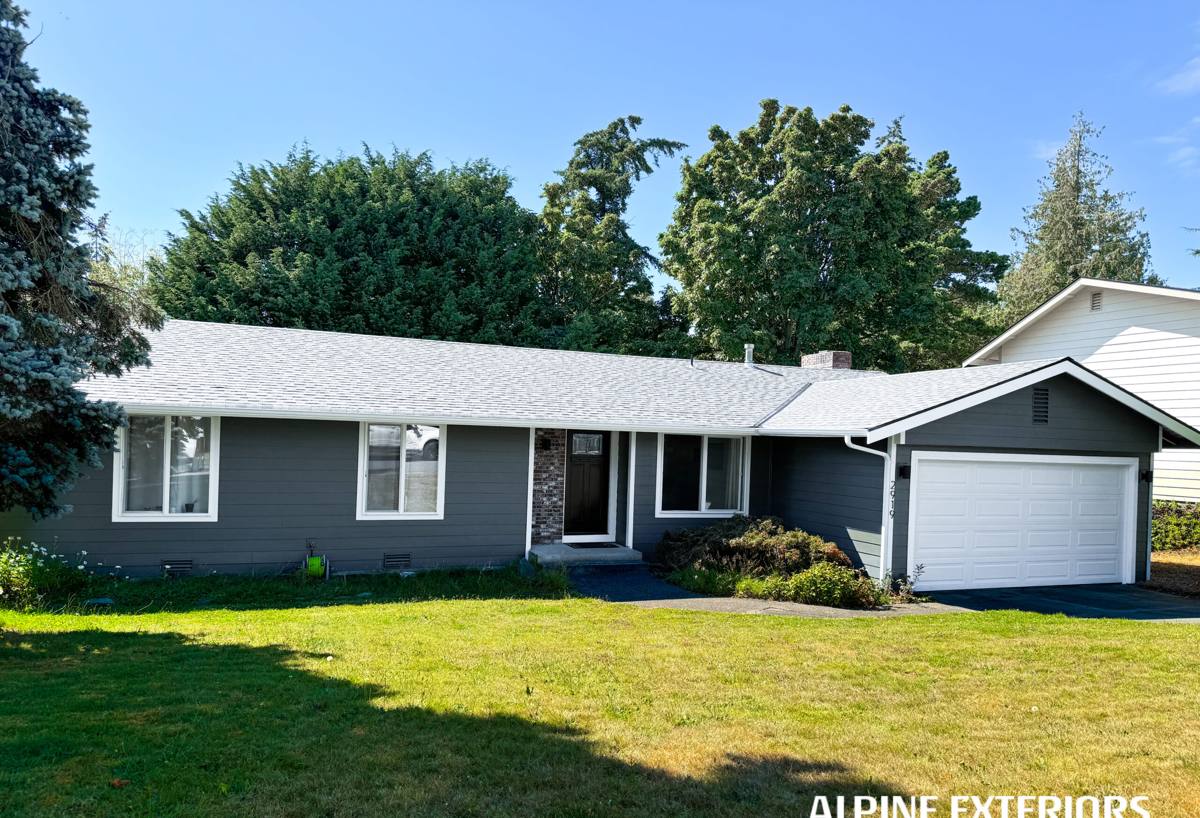
Why Fiber Cement Is the Right Material Here
Fiber cement is cement, sand, and cellulose fiber formed under pressure into a dense, stable board. Unlike wood-based products, it doesn't absorb water into its core and swell, delaminate, or rot from the inside out. Unlike vinyl, it doesn't warp, crack in cold snaps, or fade and go brittle under years of damp-then-dry cycling. And it's non-combustible, which matters as much for insurance considerations as for wildfire-adjacent risk.
We specifically install James Hardie rather than other fiber cement or fiber-cement-alternative brands. Hardie's HZ5 product line is engineered for the Pacific Northwest's wet-side climate — moisture and impact resistance tuned for regions that get sustained rain rather than dry heat. That regional engineering is the difference between a siding product that merely survives here and one that's actually built for it.
| Material | Behavior in Conway's Damp, Salt-Air Climate |
|---|---|
| James Hardie fiber cement (HZ5) | Dense, moisture- and impact-resistant formulation for wet climates; factory-cured ColorPlus finish resists moss staining and salt-driven fade |
| Vinyl siding | Doesn't rot, but expands/contracts with temperature swings, can crack in a hard freeze, and seams give wind-driven rain a path inward |
| Cedar / primed spruce | Attractive but absorbs moisture at end grain and fastener points; needs ongoing sealing/painting to keep ahead of rot in a climate this wet |
| LP SmartSide / other engineered wood | Wood-strand core still relies on the factory coating and field-sealed cuts staying intact; a compromised edge lets moisture into the core |
We're not going to tell you every one of those products fails on every house — plenty perform fine when maintained diligently. But we made a standard decision as a company: for this climate, we only put our name behind fiber cement done to Hardie's spec, because it removes the ongoing maintenance gamble that the alternatives carry here.
What a Correct Fiber Cement Install Requires in a Delta Climate
Fiber cement siding is only as good as the water management system behind it. In a low, damp area like Conway, cutting corners on the details below is exactly how a house ends up with hidden rot despite "good" siding on the outside.
Weather-Resistive Barrier and Flashing
A correctly lapped weather-resistive barrier, properly integrated window and door flashing, and flashing at every horizontal transition (roof lines, decks, trim boards) are what actually keep water out — the siding itself is the second line of defense, not the only one. On a house exposed to driving rain off the delta, any gap in this layer becomes the entry point for the moisture problems fiber cement is supposed to prevent.
Rainscreen Gap
James Hardie's installation instructions call for a drainage gap behind the siding in climates like ours. That gap lets bulk water that gets past the cladding drain and lets the wall assembly dry rather than trapping moisture against the sheathing — a meaningful difference in a location where surfaces stay damp for days at a time.
Fastening and Clearances
Hardie specifies fastener type, spacing, and embedment depth for a reason — under- or over-driven nails compromise the board's ability to move and seal correctly. Ground clearance and clearance from roof lines, decks, and paved surfaces also need to meet spec; siding installed too close to grade or a walkway in a damp climate is siding that stays wet longer than it should.
Caulking and Joint Treatment
Butt joints, trim intersections, and penetrations need the right sealant, applied correctly — not as a cosmetic finishing step but as part of the moisture barrier. This is one of the most common places we find shortcuts on prior installs when we're called out to look at problem areas.
Our Process for a Conway Job
- On-site assessment: We look at existing siding and sheathing condition, moisture readings where relevant, drainage around the foundation, and any areas with a history of moss, staining, or soft spots.
- Removal and sheathing check: Old siding comes off and we inspect the sheathing underneath before anything new goes up. This is where hidden damage from a previous installation's shortcuts usually shows up, and it needs to be addressed before new siding goes on, not covered over.
- Water management install: Weather-resistive barrier, flashing at every penetration and transition, and the rainscreen gap go in per Hardie's specification for our climate zone.
- Hardie panel or plank installation: Fastened, spaced, and clearanced to spec, with attention to butt joints and trim details.
- Finish and inspection: Caulking, trim, and a final walkthrough before we call the job done.
ColorPlus Finish and Moss Resistance
One detail that matters more in Conway than in drier parts of the state: James Hardie's ColorPlus finish is baked on at the factory in a controlled process, rather than field-applied paint. That finish is formulated to resist fading and to shed the grime and biological growth (moss, algae, mildew) that shaded, damp exterior walls collect over a Skagit County winter. It won't make a north-facing wall immune to moss entirely — nothing does in this climate — but it holds up to washing and weathering better than field-applied paint on wood-based siding, and it doesn't need repainting on the schedule that wood does.
Cost Factors for a Conway Fiber Cement Job
| Factor | Why It Affects Cost |
|---|---|
| Existing siding removal | Layers of old siding, or sheathing repair discovered underneath, adds labor beyond a straightforward tear-off |
| Home size and wall complexity | More corners, gables, and trim detail means more cutting, flashing, and finish work per square foot |
| Product line and profile | Lap siding, panel siding, and shingle-style profiles carry different material and labor costs |
| Trim and accessory scope | Fascia, soffit, and trim board replacement alongside siding affects total project size |
| Access and site conditions | Setback from roads, staging area, and any drainage or grading work needed around the foundation |
We don't quote a job without seeing the house — anyone who does is guessing. What we can say is that fiber cement's higher upfront cost compared to vinyl is offset by not needing repainting cycles that wood and some engineered wood products require in this climate, and by the transferable warranty backing the material itself.
Why a Crew That Already Works Conway Matters
Skagit County's building conditions aren't uniform — a house on a delta lot with a high water table and salt air behaves differently than one further inland, and the right flashing and drainage details reflect that. A crew that's already worked on homes in and around Conway has a feel for where moisture tends to collect on this type of site, which corners take the worst of the driving rain, and how much clearance actually holds up here versus what a spec sheet says in the abstract. That local pattern-recognition doesn't replace following manufacturer specs — it's what makes sure those specs get applied to the parts of a house that need the most attention in this particular climate.
What to Check Before You Hire
- Are they a James Hardie-focused installer, or do they install several competing products and default to whatever's cheapest?
- Will they show you the weather-resistive barrier and flashing work before it's covered, not just the finished siding?
- Do they specify a rainscreen/drainage gap for this climate, or skip it to save labor?
- Can they explain fastener spec and clearance requirements without checking a manual on the spot?
- Do they inspect and address sheathing condition before installing new siding, rather than covering over existing damage?
- Is the warranty (material and labor) explained clearly and in writing?
Let's Look at Your House
If your Conway home's siding is showing moss staining, soft spots, peeling paint on wood trim, or you're just planning ahead for a replacement, we're happy to take a look and walk you through what we see — no pressure, no obligation. Use the form below to request a free estimate.