 Anacortes Siding
 Building a Deck on Guemes Island Is Its Own Job
Guemes Island sits just across the ferry channel from Anacortes, and that short crossing changes more about a deck project than most homeowners expect. Every board, fastener, and tool has to make the ferry schedule. Every site visit, delivery, and crew day has to be planned around sailing times instead of just driving over. It's not a hardship, but it does mean a contractor who treats Guemes like an afterthought — squeezing in a quick trip between mainland jobs — is going to cut corners on scheduling, material staging, or follow-up. A deck built for Guemes Island needs a crew that plans the project around the island from the start, not one that's improvising around a ferry line.
Beyond logistics, Guemes homes sit closer to open water and exposed shoreline than most Anacortes properties. That proximity to Rosario Strait and the surrounding waters means more direct salt air, more wind-driven rain, and a longer damp season than you'd get a few miles inland. A deck here has to be built to that reality, not to a generic Skagit County spec.
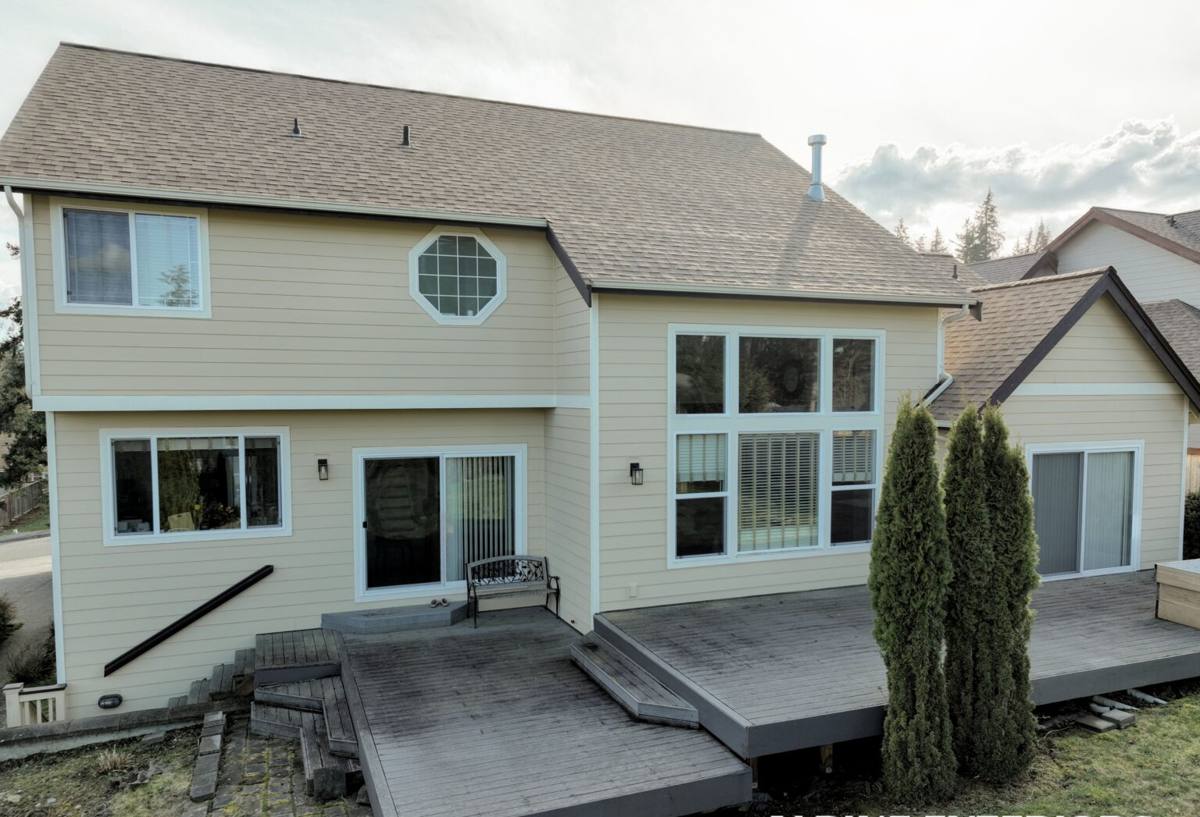
What Salt Air, Driving Rain, and Moss Season Actually Do to a Deck
Homeowners often assume the biggest threat to a deck is rot from standing water, and that's part of it — but on Guemes Island, three factors compound each other in ways that shorten a deck's life faster than people expect.
Salt Air
Airborne salt from the surrounding water settles on every exposed surface, including fasteners, connectors, and railing hardware. Standard coated screws and joist hangers that hold up fine twenty miles inland can start showing rust streaks and pitting within a few seasons on a waterfront or near-waterfront Guemes lot. Once corrosion starts on a structural fastener, it's not cosmetic — it's a slow loss of holding strength.
Driving Rain
Storms coming off the water don't just fall straight down; wind pushes rain sideways and up under rail caps, into fastener heads, and behind ledger boards. Flashing details and gap spacing that are "good enough" for a sheltered inland deck often aren't enough here, because water finds its way into joints that would stay dry elsewhere.
Moss and Prolonged Dampness
Guemes Island's tree cover and marine humidity mean decks stay damp longer between dry spells than decks in more open, sun-exposed parts of Anacortes. Moss and algae take hold on horizontal surfaces that don't get airflow or sun, and once established, they hold moisture against the decking material around the clock. On wood decking, that accelerates rot at the exact spots where boards meet joists. On composite decking, moss is mostly cosmetic, but it still needs airflow underneath to avoid staining and slip hazards.
Choosing Decking Material for a Guemes Island Site
There's no single "right" material for every lot — a sun-exposed clearing and a shaded, tree-covered site a quarter mile away can call for different choices. What matters is picking a material honestly, based on how much sun and airflow the deck will actually get, and how much upkeep the homeowner actually wants to do.
| Material | How It Handles This Climate | Maintenance Reality |
|---|---|---|
| Pressure-treated wood | Affordable and strong, but needs sealing to resist the moisture cycle here; end grain and fastener holes are the weak points | Annual cleaning and re-sealing every 2-3 years; more if shaded or near water |
| Cedar | Naturally rot-resistant and handles damp shade better than most softwoods, but still needs finish maintenance to hold its color and resist moss | Regular cleaning; refinishing every 2-4 years depending on sun exposure |
| Composite decking | Doesn't absorb water or rot, handles salt air well, but needs proper airflow underneath to avoid trapping moisture and growing surface algae | Periodic washing; no sealing or staining required |
| PVC decking | Fully moisture-resistant, holds up well to salt exposure and driving rain, best option for heavily shaded or waterfront lots | Lowest maintenance; occasional cleaning |
On shaded, tree-covered Guemes lots that stay damp most of the year, we usually steer homeowners toward composite or PVC decking specifically because wood in that environment needs a maintenance commitment most people underestimate. On open, sun-exposed sites, a well-built cedar or treated-wood deck can perform well for years, because sun and airflow do a lot of the drying work for you.
Framing and Fasteners: The Part That Determines How Long the Deck Actually Lasts
The decking surface gets all the attention, but the framing underneath and the fasteners holding it together are what determine whether a deck is still solid in fifteen years or needs structural repair in five. This is where salt air does the most damage, because it attacks metal continuously, whether the deck is being used or not.
For Guemes Island projects, we build the structural side to match the exposure:
- Stainless steel or heavy hot-dip galvanized fasteners and connectors — standard electroplated coatings corrode too fast in salt-exposed air
- Corrosion-resistant joist hangers and structural screws rated for coastal or treated-lumber contact
- Proper flashing at the ledger board where the deck meets the house, since this is the single most common point of hidden rot on any deck, coastal or not
- Joist tape or a moisture barrier on top of framing lumber to slow water intrusion at fastener penetrations
- Post bases that keep wood posts off concrete or soil contact, so water doesn't wick up into the post end grain
None of this is visible once the deck is finished, which is exactly why it matters. A deck can look great for the first two or three years regardless of what's underneath it. The fasteners and framing are what decide what it looks like at year ten.
Design Decisions That Matter More on Guemes Island Than Elsewhere
Airflow Underneath
Low decks built tight to grade trap moisture and give moss and algae exactly the damp, shaded environment they need. Where site grading allows it, we build in enough clearance and skirting ventilation to let air move underneath, which measurably slows moss growth on the decking above.
Board Spacing and Drainage
Gap spacing between boards affects how fast water sheds off the surface. Too tight, and water sits on the deck longer between rain events, which is exactly the wrong call in a climate that already stays damp longer than most.
Railing and Wind Exposure
Many Guemes Island lots have partial or full water views, which often means more direct wind exposure too. Railing systems need hardware that matches the same corrosion-resistance standard as the framing — a rusting railing bracket on a view deck is one of the fastest ways a nice deck starts looking neglected.
Tree Cover and Sun Access
Where a deck sits relative to tree cover changes almost every other decision on this list. A deck tucked under fir or cedar canopy needs more attention to drainage, airflow, and material choice than one built in a cleared, sun-exposed yard. We walk the actual site before recommending a material or design, rather than defaulting to the same spec for every lot.
Our Process for a Guemes Island Deck Project
- Site visit and assessment — we look at sun exposure, tree cover, existing drainage, and how close the site sits to open water or wind exposure, since these drive the material and framing decisions above.
- Design and material selection — we walk through honest trade-offs for the specific site, not a one-size-fits-all recommendation, and put together a plan that fits the budget and the maintenance level the homeowner actually wants.
- Permitting — deck projects on Guemes Island fall under Skagit County jurisdiction, and depending on size, height, and proximity to the shoreline, permitting requirements can vary. We handle this step rather than leaving it to the homeowner to sort out.
- Scheduling around the ferry — we plan crew days, material deliveries, and equipment staging around the ferry schedule up front, so the project isn't losing time to logistics that should have been planned for.
- Construction — framing first, with the corrosion-resistant hardware and flashing details covered above, then decking, railing, and finish work.
- Final walkthrough — we go over care and maintenance specific to the material chosen, so the homeowner knows what upkeep to expect given the site's sun and shade conditions.
Keeping a Guemes Island Deck Ahead of Moss and Salt
Even the right materials and framing benefit from some routine attention, especially in a climate where damp weather can stretch on for months at a time. A little consistency goes a long way toward avoiding bigger problems later.
- Sweep debris (needles, leaves, moss spores) off the deck surface regularly, especially under tree cover, so it doesn't sit and hold moisture
- Rinse salt residue off decking and railing hardware a few times a year, particularly on waterfront or wind-exposed sites
- Check fastener heads and railing brackets annually for early rust or corrosion, since catching it early is far cheaper than replacing a failed connector later
- Keep gutters and downspouts near the deck clear so roof runoff isn't adding extra water onto or under the deck structure
- For wood decking, plan on cleaning and re-sealing on the schedule the material actually needs, not just when it starts looking gray
- Trim back overhanging branches where practical to improve sun and airflow across the deck surface
Permits and Local Considerations
Guemes Island falls under Skagit County's building and permitting jurisdiction, and shoreline proximity can bring additional review depending on the specific site and how close construction is to the water. Requirements vary enough by lot that we don't guess — we check what applies to the specific property before finalizing a design, and we handle the permitting process as part of the project rather than handing that task back to the homeowner.
Why a Crew That Already Works Guemes Island Matters
A deck built by a contractor unfamiliar with island logistics and marine climate conditions can still look fine on installation day. The difference shows up over the following years — in fasteners that start rusting early, in decking that never gets the airflow it needed, in a project that ran over schedule because nobody planned around the ferry. Working Guemes Island regularly means we already know what the salt air, the rain patterns, and the tree cover on a given part of the island tend to do to a deck, and we build accordingly from the first site visit rather than learning it the hard way on your project.
If you're planning a new deck or replacing one that's showing its age on Guemes Island, we're happy to take a look and talk through what makes sense for your specific site. Reach out for a free, no-pressure estimate using the form below.