 Anacortes Siding
 Siding Repair for Mount Vernon Homes
Mount Vernon sits inland along the Skagit River, a different setting from our home base out on Fidalgo Island in Anacortes, but the two aren't as far apart — in distance or in climate — as they might seem. Our crew runs out to Mount Vernon regularly, and what we find on siding repair calls there tracks closely with what salt air, driving rain, and a long moss season do to homes anywhere in this part of Skagit County. The valley floor holds humidity a little longer than our coastal lots do, and tree cover around a lot of Mount Vernon properties keeps north-facing walls shaded and damp for stretches at a time. This page is specifically about siding repair — not a full re-side, not roofing or windows — and what an honest, correctly done repair looks like on a Mount Vernon house.
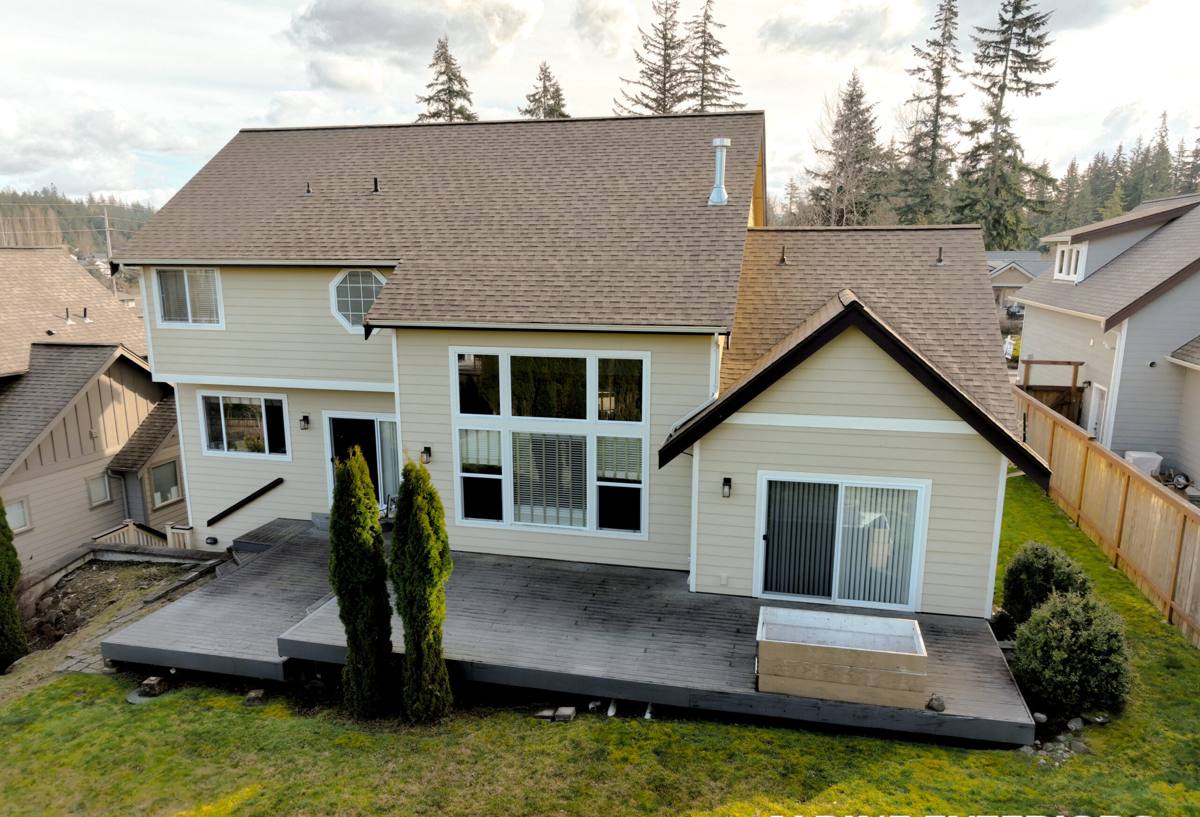
What Mount Vernon's Climate Does to Siding
Three things drive most of the repair calls we get in this area. Driving rain off Pacific storm systems pushes water sideways into walls rather than letting it run straight down, which means it finds every gap in a seam, a corner joint, or a piece of trim that wasn't sealed correctly the first time. A long moss season — helped along by shaded, damp conditions common on north-facing walls and tree-lined lots — holds moisture against a surface for extended stretches rather than letting it dry between storms. And even at Mount Vernon's inland position, salt-laden air moving up the valley from the Sound takes its toll on fasteners and lower-quality finishes over time, just at a slower pace than it does right on the water in Anacortes.
None of that damage happens overnight. It's cumulative — a slow breakdown of caulking, paint film, and fastener integrity that often doesn't announce itself until a homeowner notices a soft spot, a stain, or a section of siding that just doesn't look right anymore. By the time it's visible from the yard, there's usually been water working behind the wall for a while.
Common Siding Repair Issues We See in Mount Vernon
Repair calls in this area tend to fall into a handful of recurring categories. Knowing which one you're actually looking at matters, because the fix — and the cost — is different for each.
| What You See | Likely Cause | Typical Fix |
|---|---|---|
| Soft, spongy, or crumbling siding board | Sustained moisture intrusion, often from a failed seam or flashing gap | Cut out and replace the affected section; inspect substrate for hidden rot before closing it back up |
| Cracked or split boards near corners | Impact damage, or material that wasn't rated for this level of moisture exposure | Section replacement and re-sealing, matched to surrounding material |
| Nail pops or fastener staining | Incorrect original fastening pattern, or fasteners not rated for coastal exposure | Re-fasten with correct hardware and pattern; touch up finish at repair points |
| Persistent moss or dark staining on shaded walls | Prolonged moisture retention on north-facing or tree-covered exposures | Clean and treat the surface, then address the underlying moisture source if staining keeps returning |
| Failed or cracked caulking at trim and window edges | Age, sun exposure, and repeated wet-dry cycling breaking down the sealant | Remove old caulk, re-seal properly, and check flashing behind the joint |
| Visible gap or separation at a butt joint | Original installation without proper lap or expansion allowance | Re-set the joint correctly or replace the section if the gap has let water in |
Repair vs. Replacement: How We Make the Call
Not every siding problem on a Mount Vernon home needs a full tear-off, and we're not going to tell you it does just to sell a bigger job. A lot of what we see is genuinely repairable — an impact-damaged section, a failed joint, a localized moisture issue caught early. What tips a job from repair into replacement territory is usually one of a few things: water that's been tracking behind the wall long enough to compromise the sheathing underneath, siding that's failing in multiple, unrelated spots rather than one isolated area, or a home still wearing an older, non-Hardie product that's simply reaching the end of what it was built to do. We'll walk the house with you and tell you plainly which situation you're in, including when a smaller repair is genuinely the right call.
- Isolated section damaged by impact, weather, or age, with the rest of the wall in solid condition
- Substrate underneath the damaged area still firm when probed, not soft or spongy
- Damage confined to one or two locations rather than spread across multiple walls
- Existing siding is James Hardie, meaning a repaired section can be matched cleanly
- No sign of water tracking laterally behind the wall beyond the visibly damaged spot
If a home doesn't check most of those boxes, we'll say so and explain why a repair would likely be a short-term fix rather than a real solution.
What a Correct Siding Repair Involves
A repair is only as good as the diagnosis behind it. Before we cut into anything, we check how far moisture has actually traveled — not just where it's visible — because patching over a symptom without finding the entry point means the same problem comes back within a season or two. Once we know the real scope, correct repair work on a Mount Vernon home means matching the existing siding profile and reveal, re-integrating flashing at the repair point rather than just caulking over the seam, and fastening the new section to the same pattern and spacing the rest of the wall was installed to.
Repairing Existing James Hardie Siding
If a Mount Vernon home already has James Hardie siding, repair work is genuinely straightforward. HardiePlank and HardiePanel sections can be cut out and replaced cleanly, and because Hardie's ColorPlus finish is a factory-baked, standardized process, a repaired section from the correct color line matches the surrounding wall far better than a field-painted patch ever would. HardieTrim boards repair the same way at corners and window casing, which matters because trim failure is one of the most common repair calls we get.
Repairing Other Siding Materials
We also get calls to repair homes with vinyl, engineered wood, or cedar siding that were installed by someone else, or that came with the house. We'll do honest patch repairs where they make sense — a cracked vinyl panel or a rotted cedar board can often be swapped without a full re-side. But we'll also tell you plainly when the underlying material is the real problem: engineered wood siding with edge swelling from repeated wet-season exposure, or cedar that's past the point where refinishing and spot repair keep paying off, usually isn't solved by patching it and calling it done. In those cases we'll talk through what a full replacement to James Hardie would actually look like, since that's the material we stand behind — but we won't push a bigger job on a home where a targeted repair genuinely covers it.
Our Repair Process
We keep this simple and honest, in that order.
- Walk-through and diagnosis: We inspect the damaged area and the surrounding wall, checking for moisture intrusion beyond what's visible from the outside.
- Substrate check: Where damage looks like it could involve trapped moisture, we check the sheathing and framing underneath before quoting the repair.
- Written scope and estimate: You get a clear explanation of what we found, what we recommend, and why — repair or replacement, with the reasoning behind it.
- The repair itself: Matched material, correct flashing integration, and fastening to spec, not just a patch over the surface.
- Final check: We confirm the repair sheds water correctly and the finish matches before we consider the job done.
Cost Factors for Siding Repair in Mount Vernon
| Factor | What It Affects | Why It Matters Here |
|---|---|---|
| Extent of hidden moisture damage | Whether sheathing or framing repair is needed before new siding goes on | Long-standing leaks in a damp valley climate often travel further than they appear to from outside |
| Material match difficulty | Whether a repair blends in or reads as a visible patch | James Hardie's factory-finished ColorPlus lines match far more predictably than field-painted alternatives |
| Number and location of repair sites | Labor time and staging on the property | Multiple scattered repair spots can push a job closer to a partial re-side in cost |
| Access and site conditions | Labor time and equipment needs | Tree cover and tighter in-town lots common in Mount Vernon can affect staging |
| Existing siding material | Whether the section can be matched or needs a broader approach | Repairing into existing Hardie is more predictable than patching an aging non-Hardie product |
We don't quote repair work off a price sheet, because the honest cost depends entirely on what we find once we're actually looking at the wall. What we can tell you upfront is that we'll always explain the reasoning behind a number before you commit to it.
Signs Your Mount Vernon Home May Need Siding Repair
- Soft or spongy spots when you press on a wall, especially near the bottom edge or around windows
- Visible cracking, splitting, or separation at seams and corners
- Persistent moss, mildew, or dark staining on shaded or north-facing walls
- Cracked or missing caulking around windows, doors, or trim
- Peeling or bubbling paint concentrated in one area rather than across the whole house
- A noticeable draft or higher-than-expected heating bills that could point to a compromised wall seal
Why an Anacortes-Based Crew Serving Mount Vernon Matters
We're based in Anacortes, which means our day-to-day work is shaped by direct salt air exposure and coastal wind right off the water — about as demanding a testing ground as this region offers. Bringing that experience inland to Mount Vernon means we're not guessing at how driving rain and a long moss season behave on a river-valley property; we're adjusting what we already know works on the coast to a setting with more shade, more tree cover, and a slightly different moisture pattern. That's a different starting point than a crew that only works in-town Mount Vernon and hasn't had to solve for direct coastal exposure, or a crew from outside the county entirely that's applying a generic approach built for a milder, drier climate somewhere else. Being close enough to respond quickly also matters for repair work specifically — a callback on a repair should be a quick trip back out, not a multi-hour drive that makes homeowners think twice before calling.
What to Expect When You Call Us
- A straightforward inspection of the damaged area and a check for moisture beyond what's visible
- An honest answer on whether you're looking at a repair or something bigger — not an upsell by default
- A written estimate that explains the reasoning, not just a number
- Repair work matched to your existing siding where that's genuinely the right call
If you've noticed a soft spot, a cracked seam, or staining that won't go away on your Mount Vernon home, we're glad to take a look and give you a straight read on what it needs. Reach out using the form below for a free, no-pressure estimate.