 Anacortes Siding
 Storm Patterns That Put Burlington Roofs at Risk
Burlington sits inland from the coast in Skagit County, but "inland" doesn't mean sheltered. The same Pacific weather systems that push through Anacortes and the coastal areas nearby still carry their wind and rain up the Skagit Valley, and the flat farmland around Burlington offers little to slow a gust once it gets moving. Late fall through early spring, this area sees repeated windstorms strong enough to lift shingles, rack ridge caps, and drive rain sideways under flashing that would stay dry in a calmer climate.
Wind Off the Valley
Wind damage in Burlington rarely looks like a roof "blowing off." More often it's a handful of shingles torn loose along a ridge or rake edge, a section of flashing bent back at a chimney or vent pipe, or nails backed out just enough that the next storm finishes the job. Because the damage is partial, it's easy to miss from the ground, which is exactly why it tends to turn into a bigger leak weeks later, after the homeowner has already forgotten about the windstorm that caused it.
Moss Season's Slow Damage
Skagit County's long wet season and heavy tree cover give moss months at a time to establish itself on north-facing slopes and shaded valleys of the roof. Moss holds moisture against the shingle surface far longer than open air would, which accelerates granule loss and, over years, softens the decking underneath. A storm doesn't create this problem, but it exploits it, since a roof with established moss and a few years of moisture retention is far more likely to leak when wind-driven rain finds a weak spot.
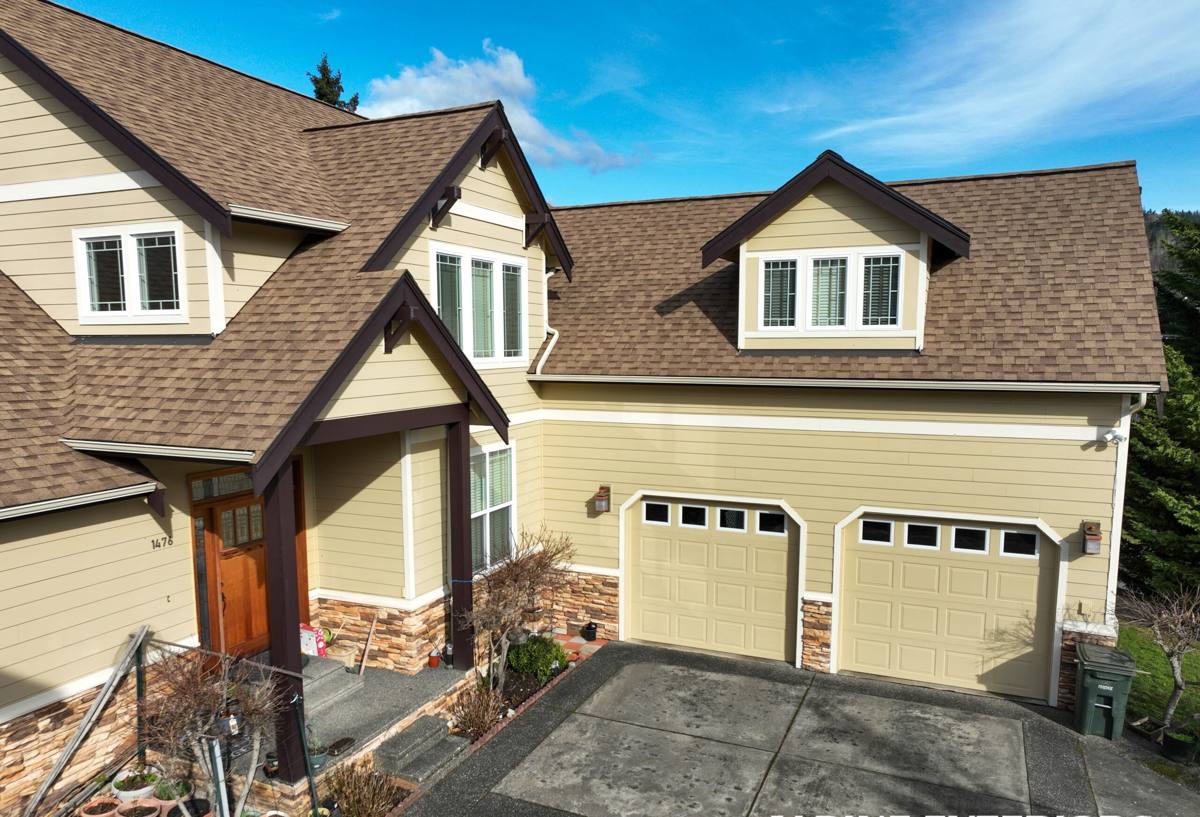
Recognizing Storm Damage: What to Look For
Most storm damage isn't obvious from the driveway. It shows up in small details that are easy to write off until a leak appears in the ceiling. After any significant wind or rain event, it's worth walking the property and checking for the following:
- Shingles that look lifted, curled, or missing entirely, especially along ridges and edges
- Granules collecting in gutters or at the base of downspouts after a storm
- Bent, loose, or missing flashing around chimneys, skylights, and vent pipes
- Soft or discolored spots on interior ceilings, especially near exterior walls
- Debris, branches, needles, or gravel from asphalt shingles, collecting in valleys
- Gutters pulling away from the fascia or sagging under storm debris
- Daylight visible through the attic decking near vents or the ridge line
None of these on their own means a full roof replacement is coming, but any of them left unaddressed through another storm season generally gets worse, not better.
What a Correct Storm Damage Repair Actually Involves
A storm repair that's done right is not just "put a shingle back." It starts with figuring out how far the damage actually extends, because wind and water rarely stop at the visible edge of the problem.
Checking the Decking, Not Just the Surface
Once storm-damaged shingles are pulled back, the decking underneath needs a real look. Water that's been finding its way in for even a few weeks can soften plywood or OSB enough that it needs to be replaced rather than covered over. Skipping this step is one of the most common ways a repair fails within a year, since new shingles laid over compromised decking don't fix the underlying problem, they just hide it again.
Matching Materials Correctly
Shingle color runs and profiles change over time, so a patch repair on an older roof often means sourcing a close match rather than an exact one, and being upfront with the homeowner about that instead of pretending it will be invisible. For a section that's failed repeatedly, it can also mean stepping up to a heavier shingle or better underlayment in that specific area, rather than replacing like-for-like and inviting the same failure next storm season.
Flashing and Underlayment
Most of the leaks we trace back after a storm turn out to be flashing failures, not shingle failures, around chimneys, skylights, dormers, and anywhere two roof planes meet. Correct storm repair means re-flashing those transitions with proper step and counter-flashing and a compatible underlayment, not just running a bead of sealant over the old metal and calling it done. Sealant is a short-term patch; it is not a repair.
Emergency Mitigation: Tarping and Stopping Active Leaks
When a storm has torn open a section of roof and rain is still coming, the first priority is stopping water from getting further into the structure, since insulation, decking, and drywall all get harder and more expensive to deal with the longer they stay wet. A proper emergency tarp job means securing the tarp well past the damaged area, not just over it, fastening it so wind can't get underneath and rip it loose, and checking that water is actually being directed off the roof rather than pooling against the tarp edge.
A rushed or undersized tarp is worse than no tarp at all in a lot of cases, because it gives a false sense that the leak is handled while wind-driven rain still finds a way around the edges. If your roof needs emergency mitigation, that work should always be followed by a full inspection and a real repair plan; a tarp buys time, it doesn't fix anything.
Repair or Replace? Weighing the Factors
Not every storm-damaged roof needs to come off. The right call depends on the roof's age, how localized the damage is, and how it's held up to previous storms. The table below covers the factors we walk through with homeowners during an inspection.
| Factor | Points Toward Repair | Points Toward Replacement |
|---|---|---|
| Roof age | Under 10-12 years, in otherwise good shape | Nearing or past its expected service life |
| Extent of damage | Isolated to one slope or feature | Spread across multiple slopes or repeated storm hits |
| Decking condition | Solid, dry decking under the damaged section | Soft or delaminated decking found during inspection |
| Moss and granule loss | Minimal, mostly cosmetic | Heavy moss with visible granule loss across the field |
| Repair history | First storm-related repair on this roof | Same area has already been patched more than once |
| Material availability | Close shingle match still available | Discontinued shingle, patch would be visibly mismatched |
An honest inspection should walk through each of these with you, not just quote a number. If a repair genuinely solves the problem, that's what we recommend; a full replacement isn't the right answer just because it's the bigger job.
Navigating Insurance Claims After a Storm
Wind and storm damage is one of the more common roofing insurance claims in this part of Skagit County, and most policies do cover it, but the claim tends to go smoother when the documentation is solid from the start.
Documentation That Helps Your Claim
Before any temporary repairs or cleanup, photos of the damage, the roof itself, any debris, and interior water intrusion, give both you and the adjuster a clear record of what happened and when. Keeping receipts for emergency tarping or mitigation also matters, since most policies reimburse reasonable steps taken to prevent further damage.
What Adjusters Look For
Adjusters are generally trying to separate storm damage from ordinary wear; a claim is much stronger when it's clear the damage traces to a specific weather event rather than years of gradual aging. A written inspection report that distinguishes storm-caused damage from pre-existing wear, like moss or granule loss that predates the storm, helps the claim move faster and helps you understand what's actually covered.
We're not a public adjuster and won't promise a claim outcome, but we can provide the kind of documented, specific inspection report that makes the process easier on your end.
Our Step-by-Step Storm Repair Process
- Initial contact and triage: if water is actively entering the home, emergency tarping comes first, before anything else.
- Full roof inspection: not just the damaged section; we check the whole roof, since one storm event often causes more than one weak point.
- Written assessment: what we found, what caused it, and what it will take to fix it correctly, including decking condition where it's relevant.
- Material sourcing: matching shingles, flashing, and underlayment to what's already on the roof wherever possible, and being clear about it when an exact match isn't available.
- Repair work: decking replaced where needed, flashing correctly re-installed, shingles properly fastened and sealed at the repair edges.
- Final walkthrough: reviewing the completed work with the homeowner, including anything worth watching going into the next storm season.
Preventing the Next Round of Damage
Storm damage is easier to prevent than it is to repair, and most of the prevention work is straightforward maintenance rather than anything dramatic.
- Clear gutters and downspouts before the fall storm season so rain has somewhere to go
- Trim back tree limbs that hang over the roof; falling limbs are a common cause of storm damage in wooded parts of Skagit County
- Address moss while it's still light, rather than waiting for heavy growth that holds moisture against the shingles
- Have flashing checked every few years, especially around chimneys and skylights, since it fails quietly before shingles do
- Walk the roofline after any major windstorm, even if nothing looks wrong from the ground
None of this eliminates storm risk entirely; nothing does, in this climate, but it narrows the gap between a minor repair and a major one.
Why a Crew That Already Works Burlington Matters
Roofing crews that work across Skagit County and the greater Anacortes area see the same storm patterns repeat year after year: which slopes take the worst of the wind, which roof styles hold moss longer, which flashing details tend to fail first in this climate. That's not something a crew coming from outside the region has much reason to know, and it shows up in how fast a problem gets correctly diagnosed versus guessed at.
It also matters for response time. When a storm damages a roof, the homes nearby are usually facing the same weather event, and a crew already working in Burlington and the surrounding Skagit Valley can typically get to an active leak faster than one dispatching from farther away. Local experience doesn't replace a careful inspection, but it does mean fewer surprises and a repair built around how this area's storms actually behave, not a generic playbook.
If a recent storm has left your Burlington roof with missing shingles, a new leak, or damage you're not sure how to read, we're happy to take a look. The estimate is free, there's no pressure to sign anything on the spot, and you'll get a straight answer about whether you're looking at a repair or something bigger; just fill out the form below to get started.