 Anacortes Siding
 Board & Batten Siding in Bow, Washington
Bow sits in the part of Skagit County where the farmland meets saltwater, close enough to Samish Bay that homes here deal with a different set of weather stresses than siding twenty miles inland. Board and batten is one of the most popular siding styles in this stretch of the county, and for good reason: the vertical lines suit the mix of farmhouses, newer builds, and shop-style homes common in the area, and the deep shadow lines the battens create hold up visually in the flat, overcast light Skagit County gets most of the year. But board and batten is also a style that punishes sloppy installation faster than most other siding profiles, and Bow's climate makes that even more true.
This page covers what board and batten siding needs to do in Bow specifically, what a correct installation actually involves, and why we install it in James Hardie fiber cement only — not cedar, not LP SmartSide, not vinyl.
What Bow's Climate Does to Siding
Three things define the exterior climate around Bow: salt-laden air off the nearby bay, long stretches of driving, wind-pushed rain, and a moss season that can run from fall through spring. Each one attacks siding differently, and board and batten's vertical seams and exposed battens give all three more places to work.
Salt Air
Homes closer to the water pick up airborne salt that settles on siding and trim. Salt is corrosive to fasteners and hardware, and it accelerates the breakdown of coatings and caulks that aren't built for it. Over years, that shows up as rusting nail heads bleeding through paint, degraded caulk joints at the battens, and faster fading on lower-quality finishes.
Driving, Wind-Driven Rain
Rain in this part of Skagit County rarely falls straight down. Wind off the water pushes it sideways into wall assemblies, which means every seam, joint, and batten edge on a board and batten wall is a potential entry point if it isn't detailed correctly. Vertical siding has more vertical seams per square foot than horizontal lap siding, so the margin for error on flashing and caulking is smaller.
Moss Season
Shaded elevations, north-facing walls, and anything near trees or dense landscaping stay damp for months at a stretch. Moss and algae need sustained moisture to establish, and Bow's fall-through-spring dampness gives them exactly that. Siding that can't shed water quickly or that traps moisture behind it becomes a growing medium, not just a cosmetic problem.
Why Board & Batten Specifically Needs the Right Material
Board and batten relies on overlapping vertical boards (or panels) with narrower battens covering the seams between them. That design is attractive, but it depends entirely on the base material staying dimensionally stable and the battens staying properly fastened and sealed. Wood-based products swell and shrink with moisture cycles; that movement works battens loose, opens hairline gaps at seams, and eventually lets water behind the cladding. In a climate like Bow's, with near-constant humidity swings and salt in the air, that movement happens more, not less.
This is the core reason we standardized on James Hardie fiber cement for every board and batten installation we do, including in Bow.
Why We Only Install James Hardie — Not LP, Vinyl, or Cedar
We get asked regularly why we won't install the board and batten materials other contractors use. Each of those products has legitimate strengths, and we're not going to pretend otherwise. But we've made a professional decision to stand behind one system, and here's the honest reasoning.
Cedar Board & Batten
Real cedar board and batten looks excellent and plenty of older Skagit County homes still wear it well. Its trade-off is maintenance: cedar needs regular refinishing, and in a damp, salt-influenced climate like Bow's, that maintenance window shrinks. Skip a refinish cycle or two and moisture starts working into the wood at the battens and end grain, which is where rot typically starts on this style of siding.
LP SmartSide Board & Batten
LP SmartSide is an engineered wood product, meaning it's still wood fiber at its core with a resin treatment and coating. It performs reasonably in moderate climates. Near saltwater with sustained damp seasons, engineered wood products are more sensitive to sustained moisture exposure at cut edges and fastener penetrations than fiber cement, and any breach in the factory coating is a path for moisture into the wood fiber.
Vinyl Board & Batten
Vinyl board and batten is inexpensive and low-maintenance in the sense that it doesn't rot, but it's a plastic product that expands and contracts significantly with temperature swings, which matters for how tightly battens can be detailed. It also can't be painted to refresh a look later without specialty coatings, and impact resistance is limited.
Why James Hardie
James Hardie fiber cement is non-combustible, doesn't expand and contract the way wood or vinyl does, and holds its factory-applied ColorPlus finish for years without the refinishing cycle cedar demands. Hardie's HZ5 product line is engineered specifically for climates with sustained moisture exposure, which describes Bow well. It's not the cheapest board and batten option on day one, but it's the one we're willing to warranty our workmanship against, because we've seen how it performs over time in exactly this kind of weather.
The James Hardie Board & Batten System We Use
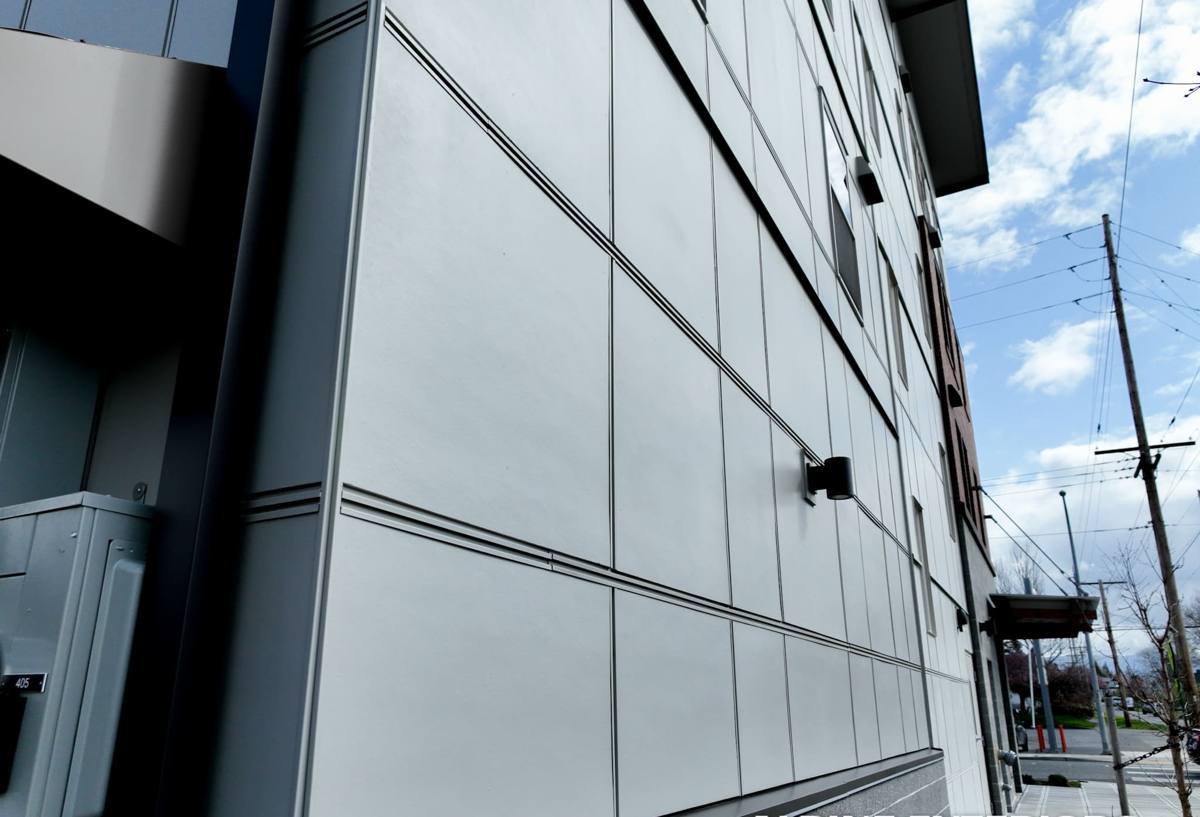
Hardie's board and batten look is built from HardiePanel vertical siding as the base field, with HardieTrim boards installed as the battens over the panel seams. Both come with Hardie's ColorPlus factory finish, which is baked on under controlled conditions rather than field-applied, giving a more consistent, longer-lasting finish than job-site paint.
- HardiePanel vertical siding — the flat field panels that form the "board" portion of the wall
- HardieTrim battens — engineered fiber cement trim installed over each panel seam
- ColorPlus finish — factory-cured color coat, more resistant to fading and chipping than site-painted finishes
- HZ5 engineering — Hardie's climate-adapted formulation for regions with heavy moisture exposure
What Correct Installation Involves
Board and batten is unforgiving of shortcuts because every batten line is a visible seam and a potential water path. Correct installation in a climate like Bow's comes down to a handful of details that are easy to skip and expensive to fix later.
Drainage Plane and Rainscreen Gap
A weather-resistive barrier goes on the wall sheathing first, and on exposed or wind-driven elevations we install furring strips to create a small gap behind the panel. That gap lets any moisture that gets past the cladding drain and dry instead of sitting against the sheathing — important in a climate where walls stay damp for long stretches.
Fastening
Every panel and batten is fastened per Hardie's published spacing and edge-distance requirements, with corrosion-resistant fasteners appropriate for a salt-air environment. Under-fastened or improperly placed nails are one of the most common causes of early siding failure we see on inspections.
Batten Spacing and Seam Coverage
Battens need to fully cover the panel seam with proper overlap on both sides, and spacing needs to stay consistent across the wall — both for water management and for the finished look, since uneven batten spacing is immediately obvious on a vertical siding job.
Flashing at Openings and Transitions
Windows, doors, roof-to-wall intersections, and deck ledger connections all need proper flashing integrated with the drainage plane before any siding goes on. This is where most water intrusion problems actually originate, regardless of what cladding is installed over it.
Caulking Strategy
Hardie's installation guidance is specific about where caulk is required and where it isn't — over-caulking can trap moisture just as easily as under-caulking can let it in. We follow the manufacturer's detailing rather than a one-size-fits-all approach.
Comparing Board & Batten Material Options
| Material | Moisture Behavior | Maintenance Cycle | Fit for Bow's Climate |
|---|---|---|---|
| James Hardie fiber cement | Dimensionally stable, HZ5-engineered for moisture exposure | Minimal — factory finish holds for years | Built for this |
| Cedar | Absorbs and releases moisture; swells/shrinks seasonally | Refinish every few years | Workable with disciplined upkeep |
| LP SmartSide | Engineered wood fiber; sensitive at cut edges/fasteners | Periodic coating inspection and touch-up | Moderate |
| Vinyl | Doesn't absorb moisture but expands/contracts with temperature | Low, but limited repair/refinish options | Limited by detailing and impact resistance |
Our Process for a Bow Board & Batten Project
The steps don't change much from house to house, but the details we pay attention to are shaped by having worked on homes in this exact area.
- On-site walkthrough to assess existing siding, sheathing condition, and any signs of past moisture issues
- Elevation-by-elevation plan — which walls need a rainscreen gap based on wind and sun exposure
- Removal of old siding and inspection/repair of sheathing and framing before anything new goes on
- Installation of the weather-resistive barrier, flashing at all openings and transitions, and furring where called for
- HardiePanel installation followed by HardieTrim battens, fastened and spaced to manufacturer specification
- Final detailing — caulk joints per Hardie's guidance, trim work, and a walkthrough with the homeowner
Why a Crew That Already Works in Bow Matters
Board and batten siding done right depends on reading a specific house — which walls take the worst of the wind-driven rain, which elevations stay shaded and damp longest, where salt exposure is a bigger factor. A crew that already works in Bow and the surrounding Skagit County waterfront communities has seen that pattern repeat across multiple homes, not guessed at it from a spec sheet. That local pattern recognition is what keeps a board and batten install from becoming a callback three years later.
Simple Upkeep Checklist for Bow Homeowners
- Rinse pollen, salt residue, and debris off siding once or twice a year with a garden hose
- Check caulk joints at battens and around windows annually for cracking or separation
- Trim back landscaping that keeps any wall shaded and damp for extended periods
- Watch north-facing and tree-shaded elevations for early moss or algae growth
- Have gutters and downspouts cleared each fall so water isn't dumping against the wall
If you're weighing board and batten siding for a home in Bow, we're happy to walk the property, look at your specific exposure, and put together a straightforward estimate — no pressure, no hard sell, just what your house actually needs.