 Anacortes Siding
 Roof Repair Built for Bow's Marine Climate
Bow sits close enough to Samish Bay and Padilla Bay that homes here take on a version of coastal weather that inland Skagit County doesn't see as much of: salt-laden air off the water, long stretches of driving rain, and a moss season that can run nearly nine months out of the year under the fir and cedar canopy common to this area. A roof that would hold up fine in a drier, more sheltered part of the county can wear out early in Bow if it wasn't installed, or repaired, with that combination in mind. We work on roofs throughout the greater Anacortes area, and Bow's rural-residential mix of older farmhouses, newer builds on acreage, and homes tucked into tree cover gives us a good working sense of where these roofs actually fail first.
This page is specifically about roof repair — patching, fixing, and restoring an existing roof rather than tearing it off and starting over. Repair is the right call more often than homeowners expect, but only when the underlying decking and structure are sound. Part of an honest repair visit is telling you plainly when that's not the case.
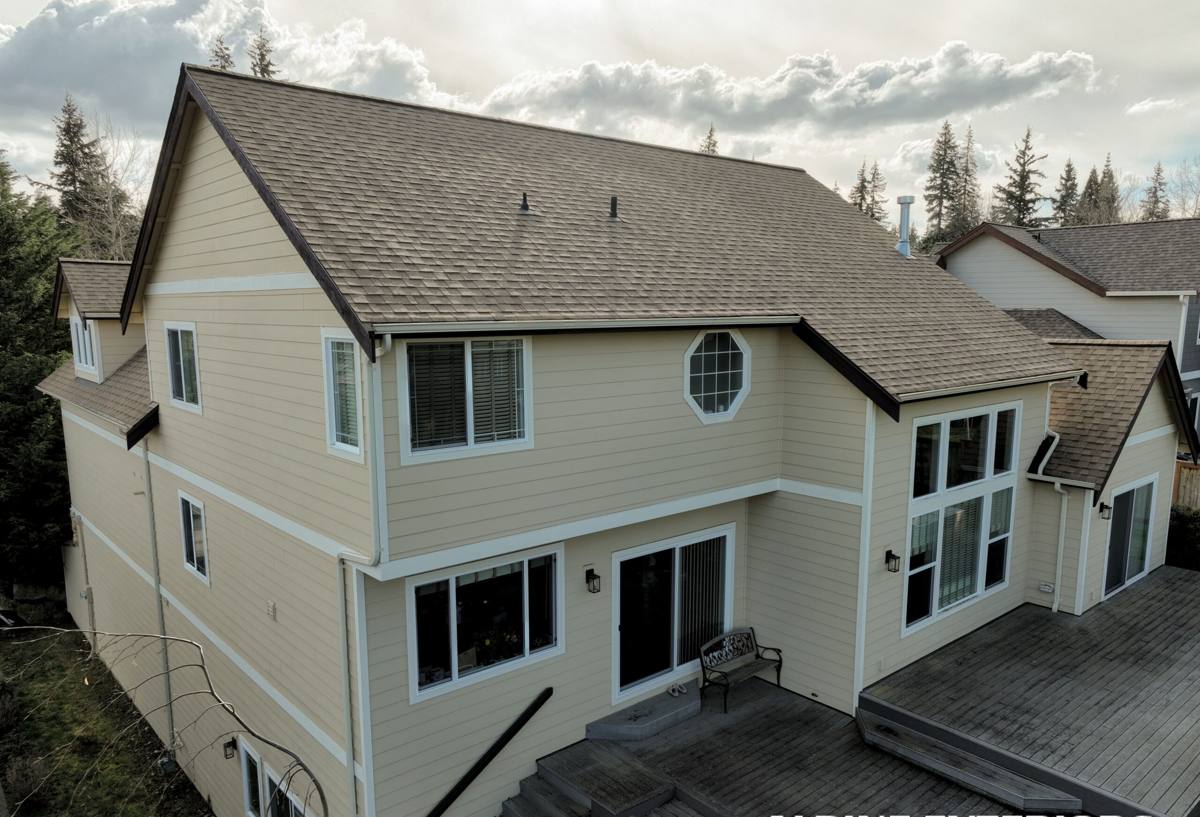
What Salt Air, Rain, and Moss Actually Do to a Roof
Moss and Organic Growth
Moss doesn't just sit on top of shingles looking bad — its root structure holds moisture against the roofing material and slowly lifts shingle edges and granules over time. On shaded, north-facing slopes common on tree-lined Bow properties, moss can establish itself within a couple of years of a roof cleaning if nothing is done to slow it back down. Left unchecked long enough, it works its way under shingle tabs and starts to compromise the seal.
Driving Rain
Wind-driven rain off the water doesn't fall straight down — it gets pushed sideways into flashing, vent boots, and any gap in the roofing system that would be a non-issue in calmer weather. This is why so many roof leaks in this area trace back to flashing and penetrations rather than the field of the roof itself. A roof can look perfectly fine from the ground and still be leaking at a chimney, skylight curb, or valley during a real storm.
Salt Air
Salt exposure accelerates corrosion on exposed metal — nails, flashing, gutter hardware, and fasteners. Once corrosion starts, it's rarely isolated to one spot; it tends to show up wherever similar metal was used across the roof, which is one reason we check fastener condition broadly during a repair visit rather than just patching the one spot the homeowner called about.
Signs a Bow Homeowner Shouldn't Ignore
Roof problems in this climate tend to announce themselves quietly at first. Catching them early is almost always cheaper than waiting.
- Dark streaking, green tint, or visible moss cushions on the roof surface
- Granules collecting in gutters or at downspout outlets
- A stain on an interior ceiling, especially after a windy rainstorm rather than a calm one
- Shingles that look curled, lifted at the edges, or cracked
- Daylight visible through the attic roof deck
- Rusty streaks below metal flashing or vent pipes
- Soft or spongy spots when walked on (we check this, not something to test yourself)
- Debris buildup in valleys that never seems to fully clear
Any one of these on its own might be minor. Several together usually means water has been getting past the surface layer for a while.
What a Correct Roof Repair Actually Involves
A repair that's done right starts with figuring out the actual path water is taking, not just patching the spot where a stain showed up inside. Interior stains and exterior leak points are often several feet apart, since water travels along the underlayment or decking before it finds a way through the ceiling.
Our repair approach generally includes:
- Locating the true entry point, not just the visible symptom
- Checking the decking underneath for soft spots or rot before doing surface repair
- Replacing damaged shingles or roofing material to match existing coverage as closely as possible
- Re-flashing or resealing around chimneys, vents, and skylights where driving rain tends to find gaps
- Clearing and treating moss, then addressing what's feeding it (usually shade and standing moisture) rather than just scraping the surface
- Checking fastener and flashing corrosion nearby, given how salt exposure tends to affect metal broadly rather than in one isolated spot
Repair Types We Commonly Handle
| Repair Type | Typical Cause in Bow | What's Involved |
|---|---|---|
| Flashing repair/replacement | Driving rain finding gaps at chimneys, valleys, vents | Removing old flashing, resealing or replacing with corrosion-resistant material |
| Moss treatment and removal | Shade, tree cover, moisture retention | Careful removal (not pressure washing), moss-inhibiting treatment, gutter clearing |
| Shingle or section replacement | Wind lift, granule loss, age | Matching material as closely as possible, checking underlayment condition |
| Decking repair | Long-term hidden leaks | Cutting out and replacing rotted sheathing before any surface repair |
| Fastener/hardware correction | Salt-air corrosion over time | Replacing corroded nails or clips with appropriate coastal-grade fasteners |
How Our Process Works
1. On-Site Assessment
We walk the roof (weather permitting) and check the attic from inside where accessible. We're looking for both the obvious damage and the quieter signs — staining patterns, fastener condition, ventilation — that tell us whether this is an isolated repair or something that points to a bigger issue.
2. Honest Scope and Estimate
We tell you what we found, what we'd repair, and what it would cost, in plain terms. If the roof is past the point where repair makes sense, we say so — a patch on a roof that's structurally failing isn't a service worth charging for.
3. The Repair Itself
Work is scheduled around Skagit County weather windows since roofing work needs a dry surface to be done correctly. We match materials where possible, seal penetrations properly, and clean up moss and debris rather than just fixing the immediate leak.
4. Walkthrough
We show you what was done and what to watch for going forward, including any maintenance that would extend the life of the repair.
Repair or Replacement? Cost Factors to Weigh
Not every roof problem needs a full replacement, but a repair on a roof near the end of its service life can end up being money spent twice. Here's generally how we help homeowners think through it.
| Factor | Leans Toward Repair | Leans Toward Replacement |
|---|---|---|
| Age of roof | Under roughly 15 years | Approaching or past manufacturer's expected lifespan |
| Extent of damage | Isolated to one area or penetration | Spread across multiple slopes or repeated leak history |
| Decking condition | Solid, no rot found | Soft spots or rot discovered during assessment |
| Moss history | First occurrence, treatable | Long-term moss damage affecting granule loss broadly |
| Material availability | Matching shingles still obtainable | Discontinued product, visible mismatch likely |
We won't push a replacement when a repair will genuinely hold up, and we won't recommend patching something that's going to need the same fix again next winter.
Why a Crew That Already Works in Bow Matters
Roofing crews that mostly work drier, more sheltered parts of the region sometimes underestimate how aggressively moss and wind-driven rain behave this close to the water. A crew that's regularly out on Bow rooflines knows which slopes tend to hold moss longest, how far driving rain can push water sideways during a real Skagit County storm, and which flashing and fastener choices actually hold up under continuous salt exposure rather than just meeting a minimum code spec. That familiarity shows up in fewer callbacks and a repair that's built for how this specific area actually weathers a roof, not a generic fix.
It also means scheduling around real local conditions — knowing when a stretch of dry weather is reliable enough to get flashing and decking work done properly, rather than rushing a repair into a marginal window and risking trapped moisture underneath.
After the Repair: Keeping It That Way
A good repair buys you time, but a little upkeep buys you more of it. In Bow's climate, that mainly means:
- Keeping gutters and valleys clear of needles and debris, which is what holds moisture against the roof longest
- Trimming back overhanging branches where practical to reduce shade and moss regrowth
- A periodic moss check on north-facing or heavily shaded slopes, since it re-establishes faster there
- A quick visual check after any major windstorm for lifted shingles or displaced flashing
None of this requires getting on the roof yourself — most of it is visible from the ground or the gutter line, and we're happy to point out what to look for during the repair walkthrough.
Get a Straight Answer on Your Roof
If you're seeing moss buildup, a ceiling stain after a windy rain, or just want a second opinion before winter, we're glad to take a look. The estimate is free, there's no pressure attached to it, and you'll get a straightforward answer about whether repair makes sense or something bigger needs attention. Fill out the form below to get started.