 Anacortes Siding
 Cap Sante's Climate Is Hard on Decks
Cap Sante sits on the bluff above Anacortes's marina, which means homes here get more of everything the water throws at them: salt-laden air off Guemes Channel and Rosario Strait, wind that isn't slowed down by much on the way up the hill, and rain that comes in sideways more often than it falls straight down. That combination is rough on any exterior structure, but it's especially rough on a deck, because a deck isn't just cladding — it's a load-bearing structure sitting low to the ground, catching runoff, and holding fasteners that are constantly wet, then dry, then wet again.
Add in Skagit County's long moss season — the stretch from fall through spring when shaded, north-facing, or tree-covered surfaces rarely fully dry out — and you get decking that holds moisture longer than it should, hardware that corrodes faster than the manufacturer's spec sheet assumes, and framing that can rot from the inside before the surface boards show much wear at all. None of this means a deck in Cap Sante is doomed. It means the build has to account for the environment it's actually in, not the environment a national product catalog was written for.
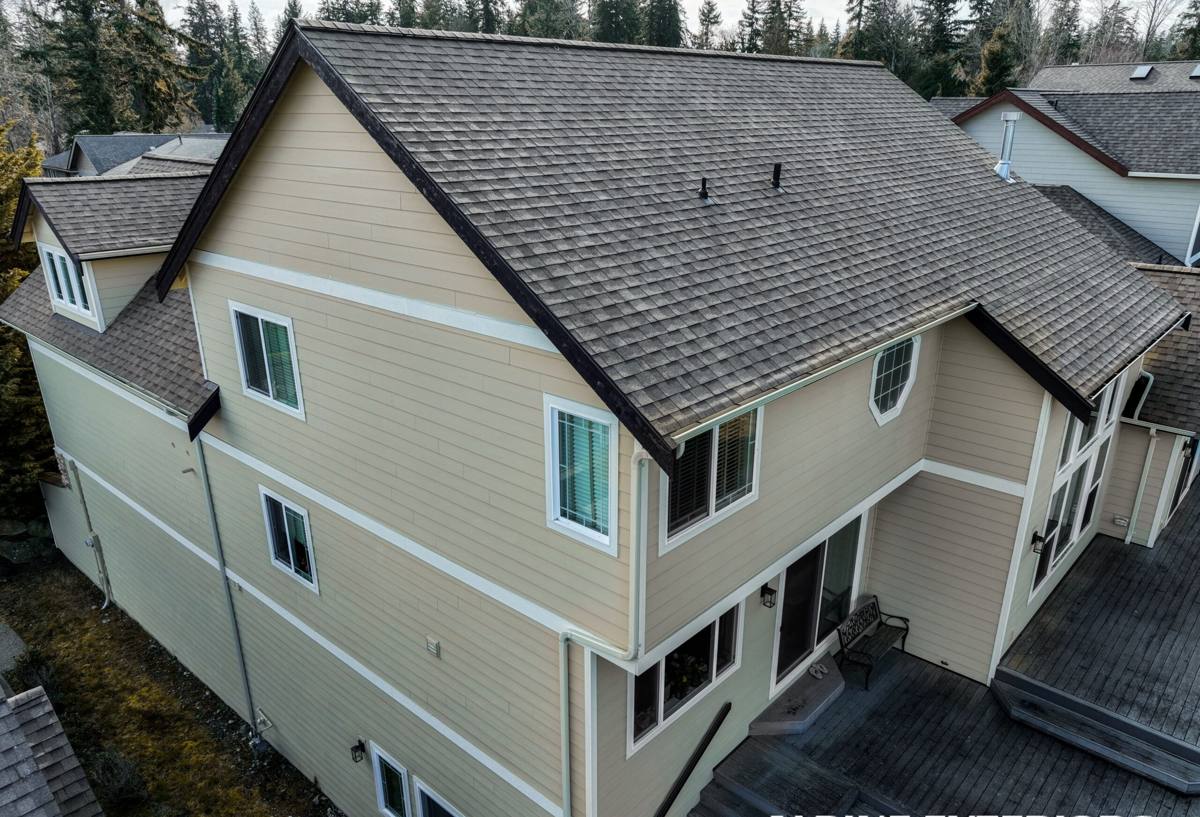
Signs Your Deck Is Due for Replacement, Not Another Repair
Every deck eventually crosses a line where patching a board or resetting a post stops being a fix and starts being a delay. Here's what we look for when we're deciding whether a Cap Sante deck can be repaired or genuinely needs to come out:
- Soft, spongy, or springy decking underfoot, especially near the house or in shaded corners
- Visible gaps or staining where the deck meets the house siding — a common sign the ledger board flashing has failed
- Rust streaking from fasteners, or fastener heads that have corroded and lost their grip
- Persistent moss, algae, or black staining that comes back within weeks of cleaning
- Posts or railing that feel loose or move under moderate pressure
- Visible checking, splitting, or delamination in the deck boards themselves
- A deck older than 15–20 years that has never had the substructure inspected
If you're only seeing one or two of these and they're isolated, a repair may still make sense. Once the ledger, multiple joists, or several posts are involved, replacement is almost always the better use of your money — repeated patchwork on a failing structure rarely holds up through another wet Skagit County winter.
What a Correct Deck Replacement Actually Involves
Ledger Board and Flashing
The ledger board — where the deck attaches to the house — is the single most common failure point on decks in this region, because it sits directly against the wall and catches whatever runs down the siding. A correct replacement means proper flashing behind and over the ledger, a drainage gap where the code and the situation call for it, and lag bolts or through-bolts sized and spaced to hold under real wind and snow load, not just the minimum the old deck happened to use.
Framing, Fasteners, and Post Protection
In a marine-air environment, hardware matters as much as lumber. We use fasteners and structural connectors rated for the exposure they'll actually see — that's a meaningful upgrade from standard galvanized in a lot of coastal applications, since standard coatings can start showing corrosion well before the wood around them fails. Joists get protective tape over the top edge to stop water from wicking into end grain and screw holes, which is one of the cheapest things we do and one of the most effective at extending the life of the frame.
Footings and Posts
If the existing footings are undersized, frost-heaved, or not set to current depth requirements, we replace them rather than build a new deck on an old, questionable foundation. Post bases get set above grade with a gap between the wood and the concrete, so posts aren't sitting in standing water after every heavy rain.
Decking Material Comparison for Cap Sante Homes
There's no single "right" material for every deck — it depends on your budget, how much upkeep you want to do, and how exposed the deck is to wind and salt air. Here's how the common options actually perform in this specific climate:
| Material | How it handles salt air & moisture | Maintenance | Typical lifespan here |
|---|---|---|---|
| Pressure-treated wood | Good if properly sealed and re-coated; end grain and fastener holes are the weak points | Annual cleaning, re-sealing every 1–2 years | 15–20 years with upkeep |
| Cedar | Naturally resists rot and insects but still needs sealing against constant wet/dry cycling | Regular sealing, more attention than treated wood | 15–20 years with upkeep |
| Composite decking | Doesn't absorb moisture the way wood does; performs well against moss and staining | Occasional washing, no sealing or staining | 25–30 years, varies by product warranty |
| PVC decking | Fully resists moisture absorption; among the most stable choices in constant damp conditions | Lowest maintenance of the group | 25–30+ years, varies by product warranty |
We install all of these and will tell you honestly which one fits your situation. Composite and PVC cost more up front but make sense for owners who don't want a re-sealing chore every spring, especially on shaded or hard-to-reach decks where moss keeps coming back. Wood costs less initially and can look great, but only if someone stays on top of the maintenance — and on a bluff-top deck taking direct weather off the Sound, that maintenance schedule is not optional.
Railings and Code on Hillside, View-Facing Decks
A lot of Cap Sante decks are built for the view, which usually means more open railing, taller elevation off grade, and more direct wind exposure than a deck tucked into a sheltered yard. That changes what "correct" looks like. Guardrails need to meet the height and baluster-spacing requirements that apply to your deck's height above grade, and the posts holding that railing need blocking and fastening sized for real wind load — not just enough to pass a light shake test. On an elevated, wind-exposed deck, railing that's undersized or under-fastened is one of the more serious safety issues we find, because it's the piece people actually lean and push against.
We pull permits and build to the current code that applies to your property, which matters more on hillside lots where deck height, guard requirements, and sometimes setback or view-corridor considerations can come into play.
How Our Process Works
- On-site assessment. We inspect the ledger, framing, posts, and footings in person — not just the surface decking — so the estimate reflects what's actually there.
- Honest scope and estimate. You get a clear breakdown of what needs replacing, what materials we recommend and why, and a real price range before any work starts.
- Permit and prep. We handle the permit application where one is required and schedule around weather windows rather than pushing work into a downpour.
- Demolition and disposal. Old decking, framing, and hardware are removed and hauled off — we don't leave debris for you to deal with.
- Rebuild. Ledger flashing, framing, fasteners, footings, decking, and railing go in to the standard described above, inspected as required along the way.
- Final walkthrough. We check the finished deck with you before calling the job done — fastening, railing, drainage, and finish.
What Affects the Cost of a Deck Replacement
Every deck is different, but these are the factors that move the price up or down the most:
| Factor | Why it matters |
|---|---|
| Deck size and shape | More square footage and more corners or angles mean more material and labor |
| Decking material chosen | Composite and PVC cost more per square foot than pressure-treated wood, less than that over time in maintenance |
| Height above grade and stairs | Taller decks need more substantial framing, posts, and railing; added stairs add material and labor |
| Condition of the substructure | If framing, ledger, or footings need full replacement rather than reuse, that adds scope |
| Railing style | Cable, glass, or custom railing systems cost more than standard baluster railing |
| Demolition and disposal | Larger or multi-level decks generate more debris to remove |
| Permit requirements | Permit fees and any required inspections add a modest but real cost |
We'd rather walk you through these factors on-site and give you real numbers than throw out a broad range that doesn't mean much for your specific deck. As a general sense of scale, a full deck replacement is typically a low-to-mid five-figure project, with the material choice and substructure condition doing most of the work to move that number.
Why Hire a Crew That Already Works Cap Sante
A deck built to a generic spec can look fine for a season or two anywhere. What separates a deck that holds up on this particular bluff, in this particular climate, is knowing in advance where the weak points will show up — which is the ledger flashing, the fastener spec, the footing depth, and the railing wind load, in that order. A crew that's already worked on homes up here has seen how fast a standard-coated fastener corrodes in this air, how long moss actually takes to come back on a shaded north-facing deck, and how much wind a bluff-top railing needs to be built for versus a deck in a sheltered yard across town.
That local experience also means fewer surprises during permitting and inspection, because we're already familiar with what the City of Anacortes and Skagit County expect for decks in this area. You're not paying for us to learn your site — you're paying for a crew that's already learned it on the house down the hill.
Ready for a Deck Built for This Bluff, Not a Catalog
If your Cap Sante deck is showing its age, or you just want an honest second opinion on whether it needs repair or replacement, we're happy to come take a look. The estimate is free, there's no pressure, and you'll get a straight answer about what your deck actually needs — not an upsell. Fill out the form below to schedule a time for us to come out.