 Anacortes Siding
 Cap Sante's Marine Climate Is Tough on Siding
Homes in the Cap Sante area sit close to Anacortes's marina and boat basin, often elevated with open exposure toward Guemes Channel and Fidalgo Bay. That location is part of what makes the neighborhood desirable, and it's also exactly what wears siding out faster than it would a few miles inland. Salt-laden marine air rides in on the wind almost year-round, settling into seams, fasteners, and paint film. Add Skagit County's long wet season, frequent driving rain off Puget Sound storms, and shaded north- and east-facing walls that stay damp for days at a time, and you get a climate that punishes anything less than a genuinely weather-tight siding system.
Moss and algae are the most visible symptom. On a lot with tree cover or a home that doesn't get much direct afternoon sun, green-black staining can return within a season of a pressure wash. That's not just cosmetic — it's a sign that moisture is sitting on the wall surface longer than it should, which is the same condition that eventually leads to rot in wood-based or improperly finished siding. A siding replacement in Cap Sante isn't just about appearance. It's about choosing a material and installation method that actually holds up to salt air, standing moisture, and repeated wet-dry cycling.
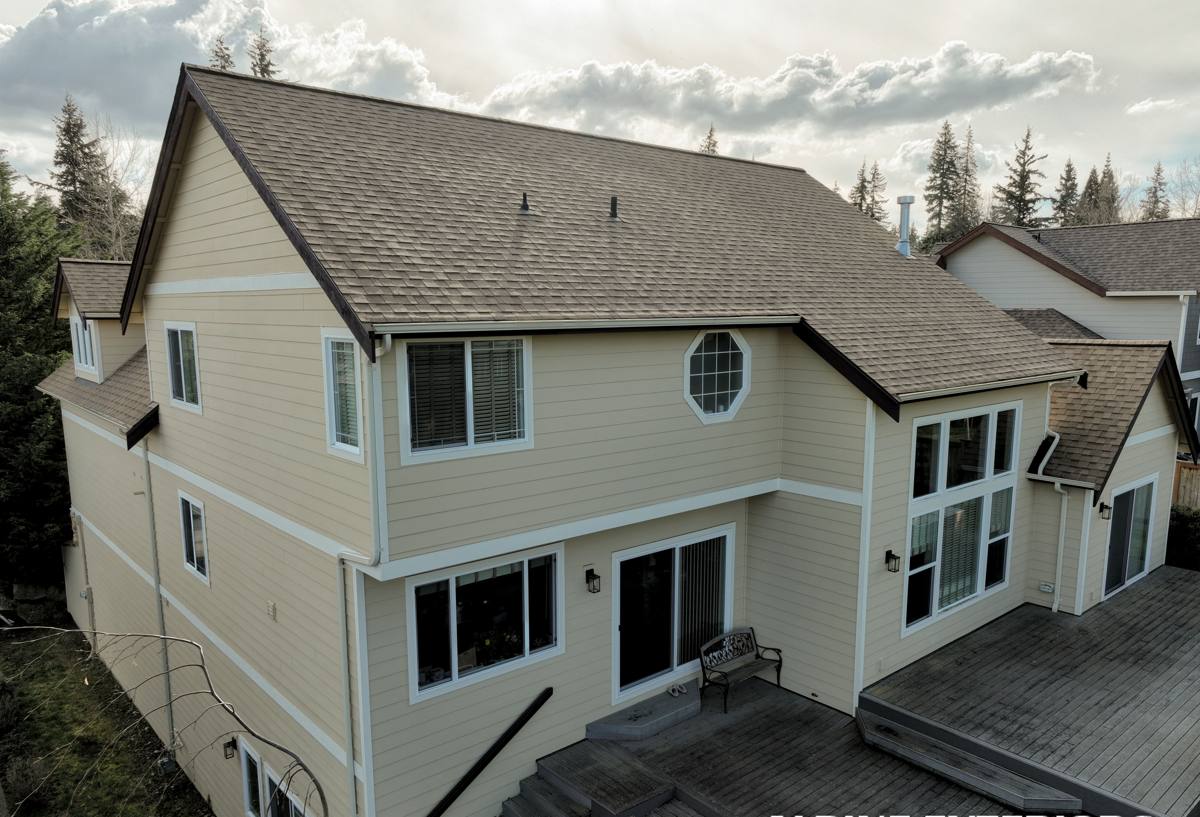
Signs Your Home Needs Siding Replacement, Not Just a Repaint
A lot of homeowners call us first for a paint quote and end up finding out the siding underneath is the actual problem. Paint won't fix soft wood, failed caulk joints, or trapped moisture — it just hides them for a season or two. Here's what tells us a wall needs replacement rather than a refresh:
- Panels that feel soft, spongy, or flex when you press on them, especially near the bottom courses and around window trim
- Paint that keeps bubbling, peeling, or failing within a year or two of a fresh coat
- Visible gaps opening up at butt joints, corner boards, or trim where caulk has pulled away
- Dark streaking or staining running down from nail heads or seams
- Moss or algae that regrows heavily within a few months of cleaning
- Siding that has pulled away from the wall or has a noticeably wavy, uneven surface
- A musty smell, soft drywall, or peeling interior paint on an exterior wall
If you're seeing two or more of these, it's worth having someone actually pull a section and look at the sheathing before spending money on paint.
Why We Install Only James Hardie Fiber Cement
We don't install vinyl, LP SmartSide, primed spruce, cedar, or other fiber cement brands. That's a deliberate standard, not a sales preference. In a climate like Anacortes's — wet, shaded, salt-exposed — the materials that struggle most are the ones sensitive to standing moisture: wood-based products can swell and delaminate at cut edges and fastener points, and vinyl can warp, fade, and offers little real protection against wind-driven rain intrusion at the seams. James Hardie fiber cement is non-combustible, dimensionally stable when it gets wet, and comes with a factory-applied ColorPlus finish that's baked on rather than field-painted, which matters a great deal when salt air is working against a paint film every day of the year. Hardie also builds region-specific HZ product lines engineered for exactly this kind of climate, and backs the material with a strong, transferable warranty. That combination — the right substrate, the right finish process, and the right engineering for a wet marine climate — is why it's the only siding we put on homes.
What a Correct Siding Replacement Actually Involves
Siding is a system, not just a set of boards. A crew that skips steps to save a day can leave a home looking fine for a year or two before problems show up behind the wall where you can't see them. Here's what we treat as non-negotiable on every job.
Tear-Off and Sheathing Inspection
Once the old siding comes off, we inspect the sheathing underneath for soft spots, rot, or prior moisture damage — common around window and door openings and at the bottom few feet of a wall. Any compromised sheathing gets replaced before anything new goes up. Installing new siding over damaged sheathing just re-covers the problem.
Weather-Resistive Barrier and Flashing
This is the step that matters most in a driving-rain climate. A properly lapped weather-resistive barrier, correctly integrated flashing at every window, door, and penetration, and attention to how water is meant to shed down and off the wall — not behind it — is what actually keeps a house dry. Siding is the visible layer; the barrier and flashing behind it do most of the real work.
Manufacturer-Spec Fastening and Clearances
James Hardie publishes specific fastener spacing, nailing patterns, and minimum clearances from grade, roof lines, and decks. Installing outside those specs is one of the most common ways a warranty gets voided and a wall starts taking on moisture it shouldn't. We install to Hardie's published specifications, not shortcuts.
Trim, Caulking, and Paint Lines
Clean trim work and correctly placed caulk joints — only where Hardie specifies them, not everywhere as a catch-all — finish the job and keep water from tracking into seams that are supposed to stay open for drainage.
Our Process From Estimate to Finished Job
- On-site walk and assessment — we look at your current siding, sheathing condition where visible, trim, and any moss, staining, or moisture patterns specific to your lot's sun and wind exposure.
- Written scope and product selection — you get a clear, itemized plan covering tear-off, repairs, the Hardie product line and profile, and color.
- Scheduling around weather — in a region with a long wet season, timing matters. We plan installs to keep walls protected during the work.
- Tear-off and any sheathing repair — nothing gets closed up until the wall underneath is sound.
- Installation to manufacturer specification — barrier, flashing, fastening, and clearances done to Hardie's published requirements.
- Final walk-through — we go over the finished work with you before calling the job done.
- Cleanup — old material and debris hauled off, site left clean.
Material Comparison for a Salt Air, High-Moisture Climate
| Material | Moisture / Salt Air Behavior | Fire Resistance | Typical Maintenance |
|---|---|---|---|
| James Hardie Fiber Cement | Dimensionally stable, engineered HZ lines for wet regions, factory ColorPlus finish | Non-combustible | Occasional rinse; no repainting cycle with ColorPlus |
| Vinyl | Can warp or fade with sun and temperature swings; seams are a common water entry point | Combustible, can melt/deform near heat | Low, but limited repair options if damaged |
| Wood / Primed Spruce / Cedar | Absorbs moisture, prone to swelling and rot in shaded, damp conditions | Combustible | Regular repainting and caulk maintenance |
| LP SmartSide (Engineered Wood) | Wood-strand core sensitive to sustained moisture exposure at cut edges and seams | Combustible | Repainting cycle, edge sealing upkeep |
What Affects the Cost of Your Project
Every Cap Sante home is a little different, and we won't quote a number without seeing the house, but these are the factors that move the price up or down on most jobs:
| Factor | Why It Matters |
|---|---|
| Home size and wall complexity | More corners, dormers, and trim detail mean more labor per square foot |
| Sheathing condition | Rot found during tear-off adds repair scope before new siding goes up |
| Access and site layout | Sloped or elevated lots common near the bluff can add setup and staging time |
| Siding profile and accessories | Lap width, trim style, and accent details affect material and labor cost |
| Existing paint or coatings removal | Some tear-offs require extra care or disposal steps depending on the old material |
Why Local Experience on Cap Sante Matters
A crew that's worked this specific part of Anacortes knows things a first-timer has to learn on your dime. They know which walls face the worst of the wind and rain off the water and need extra attention at flashing and seams. They know how to plan around narrow or sloped driveways common on elevated lots without turning a delivery day into a headache. They're familiar with how quickly moss and algae come back on shaded sides of a house here, and they size the job and materials accordingly instead of applying a one-size-fits-all approach built for a drier inland climate. That local pattern recognition is the difference between a siding job that looks good at the walk-through and one that's still performing well after several Skagit County winters.
Caring for Your New Siding
James Hardie siding installed correctly needs very little upkeep, but a little seasonal attention goes a long way in this climate:
- Rinse the exterior once or twice a year to knock back salt residue and slow moss regrowth, especially on shaded walls
- Keep gutters clear so water sheds off the roof and away from the wall line instead of running down the siding face
- Trim back vegetation that keeps a wall shaded and damp longer than necessary
- Check caulk joints at trim and penetrations every year or two and have any gaps addressed early
If you're seeing early signs of trouble on your current siding, or you just want an honest read on what shape your walls are in, we're glad to come take a look. The estimate is free, there's no pressure, and you'll get a straight answer about whether you need a full replacement, repairs, or nothing at all right now.