 Anacortes Siding
 Siding Repair Built for Conway's Corner of Skagit County
Conway sits low in the Skagit River delta, close enough to Skagit Bay and the Sound that salt-laden air is a daily fact of life, and flat enough that moisture off the fields and river bottom lingers instead of draining away. Homes here take on a specific combination of stress that a siding crew working dry inland neighborhoods rarely has to think about: humid air that never fully clears, driving rain that comes in sideways off frequent storms, and a moss and algae season that can run eight or nine months out of the year on shaded or north-facing walls. Siding repair in this area isn't just patchwork — it's about understanding why the damage happened in the first place and fixing that root cause, not just the visible symptom.
We work throughout the Anacortes and greater Skagit County area, and Conway's low-lying, moisture-heavy setting is one we see regularly. This page covers what siding repair actually involves for homes in this community, what correct work looks like, and how to tell when a repair is the right call versus when it's time to talk about replacement.
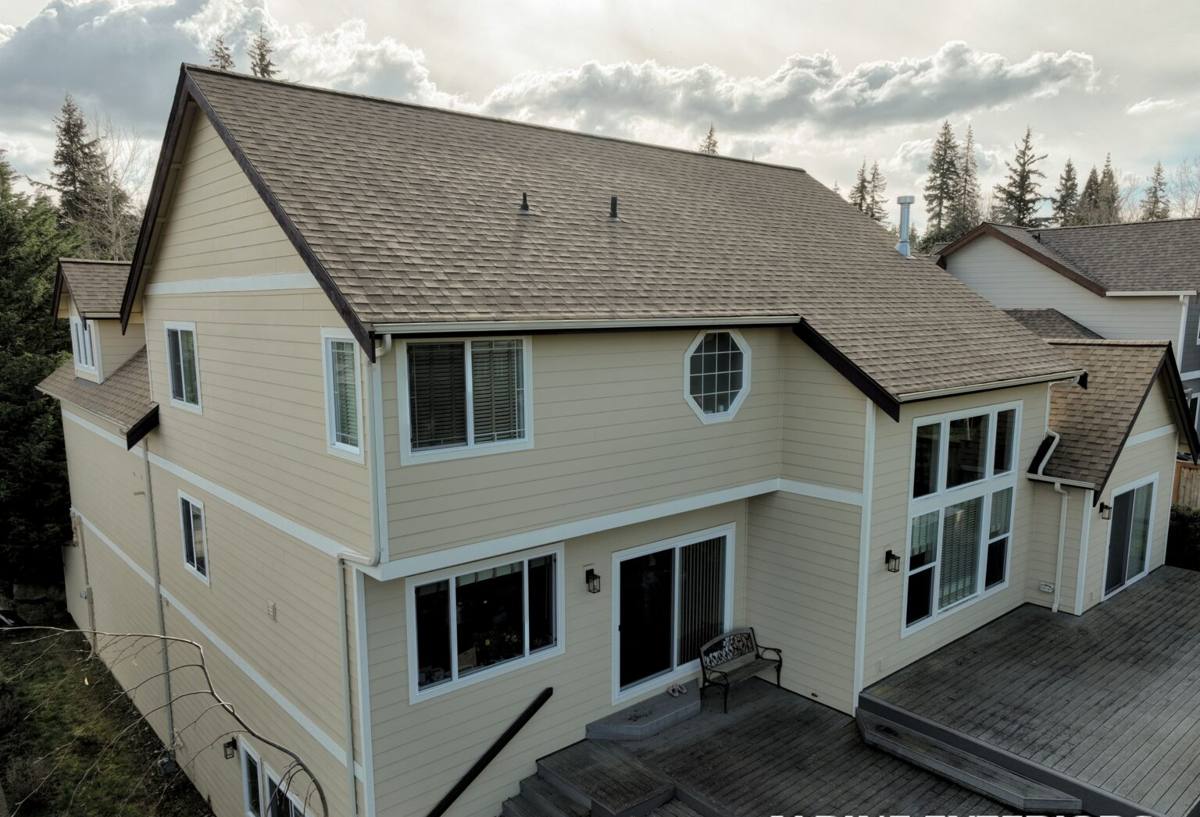
Why Siding Fails Faster Near Conway
Every siding material eventually needs maintenance, but the pace of failure depends heavily on local conditions. In Conway's setting, three factors do most of the damage:
Salt Air and Corrosion
Airborne salt from the Sound and Skagit Bay accelerates corrosion on fasteners, flashing, and any exposed metal trim. Once a nail or screw starts to rust, it loses its grip on the substrate, and that's often the first crack in an otherwise sound wall system. Salt exposure also breaks down paint film faster than it would inland, which is part of why we care so much about factory-applied, baked-on finishes rather than field-applied paint.
Driving Rain
Storms coming off the Sound tend to push rain sideways rather than straight down, which means water gets forced up under laps, into seams, and behind poorly sealed trim in ways that a light, vertical rain never would. Siding systems that rely on caulk and sealant alone to keep water out — rather than proper lapping, flashing, and drainage gaps — are the ones that fail first in this kind of weather.
Extended Moss and Algae Season
The combination of humidity, shade from trees, and mild temperatures means moss and algae can establish on north- and east-facing walls and keep growing for most of the year. Beyond looking bad, sustained moss growth holds moisture directly against the siding surface, which is exactly the condition that leads to rot in wood-based products and finish breakdown in almost anything else.
Signs Your Conway Home Needs a Siding Repair
Most siding problems give warning signs well before they become structural. Walk your exterior a couple of times a year and look for:
- Soft or spongy spots when you press on a panel or board, especially near the bottom courses and around window trim
- Visible gaps, buckling, or panels that have pulled away from the wall
- Paint that's peeling, bubbling, or chalking faster than the rest of the house
- Dark streaking, persistent moss, or algae that comes back within weeks of cleaning
- Cracked or crumbling caulk lines around windows, doors, and trim joints
- Rust streaks running down from nail heads or metal flashing
- Any musty smell or visible staining on interior walls that back up to exterior siding
Any one of these on its own might be a simple repair. Several appearing together, especially on the same wall, usually points to a moisture problem working its way through the wall assembly — and that's worth a proper inspection before it spreads.
Repair or Replace: How We Make the Call
Not every damaged section needs a full re-side, and we're not going to tell you it does. The honest answer depends on how much of the wall is affected, what's causing the damage, and what's underneath.
| Situation | Usually a Repair | Usually Points to Replacement |
|---|---|---|
| Damage extent | Isolated to one or two boards/panels | Spread across multiple walls or whole elevations |
| Cause | Impact damage, a failed caulk joint, a loose panel | Long-term moisture intrusion, rot in the sheathing |
| Material condition | Surrounding siding is sound and holding paint well | Surrounding siding is chalking, cracking, or delaminating broadly |
| Underlying structure | Sheathing and framing test dry and solid | Sheathing is soft, discolored, or shows fungal growth |
| Age of siding | Well within its expected service life | Nearing or past the manufacturer's realistic lifespan |
We'll always start with the least invasive fix that actually solves the problem. If a repair is genuinely the right call, that's what we'll recommend — even though a full replacement is a bigger job for us. If the underlying wood is compromised or the damage keeps recurring in the same spot, we'll tell you why patching it again is throwing money at a symptom.
What a Correct Siding Repair Actually Involves
A repair that only replaces what's visibly broken often fails again within a season or two. Done correctly, a siding repair in a wet, salt-exposed area like Conway includes:
Finding the Real Source
Before any siding comes off, we look for how water got in — a failed flashing detail, a caulk joint that opened up, a penetration (vent, light fixture, hose bib) that was never properly sealed, or grading that pushes water back toward the foundation and up the wall. Replacing the siding without fixing the entry point just buys you a couple of years before the same repair is needed again.
Checking What's Behind the Siding
Once we pull the damaged section, we check the sheathing, house wrap or building paper, and framing underneath. If there's soft or discolored wood, that gets addressed before anything new goes back up — covering rot with new siding just hides the problem, it doesn't fix it.
Matching Material and Finish
Where the surrounding siding is sound, we match the profile, exposure, and color as closely as possible so the repair doesn't stand out. This is one of the real advantages of factory-finished fiber cement over field-painted materials — a matched ColorPlus panel from the same product line holds its color the same way the original did, instead of aging differently the way touch-up paint on a repaired wood board often does.
Proper Flashing and Sealant Detail
We install new flashing at any horizontal joint, window head, or penetration involved in the repair, and use sealants rated for exterior exposure rather than whatever's cheapest at the hardware store. In an area that gets driving rain as often as Conway does, the flashing detail matters more than the sealant — sealant is a backup, not the primary defense.
Why We Repair and Rebuild With James Hardie Fiber Cement
When a repair calls for new siding material — whether it's a patched section or a full elevation — we use James Hardie fiber cement. We don't install LP SmartSide, vinyl, or cedar, and that's a deliberate standard, not a matter of what happens to be in the truck.
In a climate like this one, the reasoning is straightforward. Fiber cement doesn't rot, and it isn't a food source for the moss and algae that thrive in Skagit County's humidity. It's non-combustible. And Hardie's factory-applied ColorPlus finish is baked on under controlled conditions, which holds up to salt air and UV exposure far better than a field-applied paint job that has to cure on a wet job site. Hardie also builds region-specific HZ product lines engineered for exactly this kind of climate — the version installed here is manufactured for the demands of the Pacific Northwest, not a general national spec. When a repair needs new material, that's what goes on the wall, and it's backed by a transferable manufacturer warranty.
Our Process for Conway Siding Repair Calls
- Inspection and diagnosis — We assess the damaged area and check surrounding siding, trim, and penetrations for related issues, not just the spot you called about.
- Honest scope and estimate — You get a clear explanation of what's actually wrong, what a repair involves, and what it costs — no pressure toward a bigger job than you need.
- Moisture and structural check — Once we open the wall, we confirm the sheathing and framing are sound before closing it back up.
- Repair with matched material — Damaged sections are replaced with properly matched fiber cement, correctly flashed and fastened.
- Finish and cleanup — Caulk lines, trim, and paint touch-up are finished to blend with the rest of the wall, and the site is left clean.
Why a Crew That Already Works Conway Matters
Conway isn't a big town, and it doesn't get the volume of contractor attention that denser parts of Skagit County do. A crew that's unfamiliar with the area's flood-plain moisture levels, the specific way storms hit off the delta, or how fast moss re-establishes on shaded walls here is more likely to under-scope a repair — patching the visible damage while missing the moisture source that caused it. We know what this particular stretch of Skagit County does to siding over a wet season, which means our inspections start from the right assumptions instead of generic ones.
It also means we're not learning on your house. When we tell you a repair will hold, or that it won't, that's based on what we've actually seen happen to siding in this specific climate — not a guess.
Get an Honest Look at Your Siding
If you're seeing soft spots, recurring moss, peeling paint, or gaps opening up in your siding, it's worth having someone look before Skagit County's next wet season makes the problem bigger. We offer free, no-pressure estimates for Conway homeowners — we'll tell you straight whether you need a repair, a partial re-side, or nothing at all right now. Fill out the form below to get started.