 Anacortes Siding
 Why Burlington Decks Wear Out Faster Than You'd Expect
A deck in Burlington doesn't fail the same way a deck does in a dry inland climate. Skagit County sits close enough to Puget Sound and the Salish Sea that salt-laden air reaches wood and metal components year-round, slowly accelerating corrosion on fasteners and speeding up the breakdown of exposed wood fibers. Add to that the region's long stretch of driving rain — the kind that comes in sideways during fall and winter storms — and you get moisture working its way into joints, ledger connections, and end grain that a covered porch in a drier climate would never see.
Then there's moss. Western Washington's mild, wet winters create a moss season that can run from early fall well into spring. On a horizontal wood or composite surface, moss holds moisture against the decking day after day, which is exactly the condition that promotes rot in wood and can dull or stain composite surfaces over time. A deck that looks fine in July can be hiding real damage that only shows itself after a full winter of neglect.
None of this means a deck in Burlington is doomed — it means the repair work has to account for how this specific climate attacks a structure, not just patch what's visibly broken.
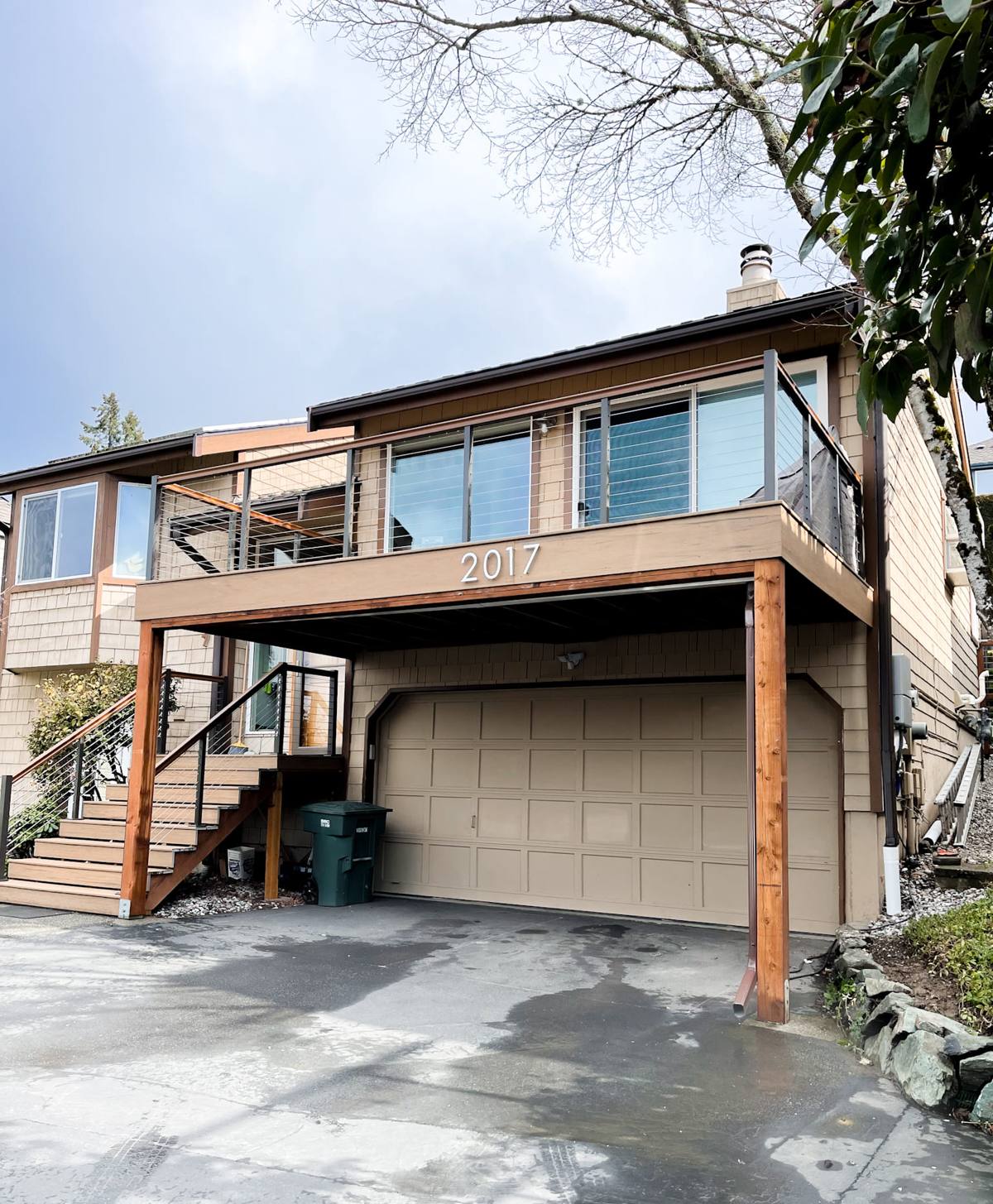
Common Signs Your Deck Needs Repair
Most deck problems start small and stay hidden until they aren't. Here's what we tell Burlington homeowners to check for, especially after the wet season:
- Soft or spongy spots when you walk across the decking, especially near the house or stair landings
- Boards that have visibly cupped, split, or pulled away from their fasteners
- Rust streaks running down from screws, nails, or joist hangers
- Gaps or movement where the deck framing meets the house (the ledger board)
- Railings or stair posts that wiggle when pushed
- Persistent moss or algae buildup that doesn't clear even after cleaning
- A musty smell coming from underneath the deck
- Visible daylight or gaps between joists and beams that weren't there before
Any one of these on its own might be minor. Two or three together usually means the deck needs a proper structural look, not just a cosmetic fix.
What a Correct Deck Repair Actually Involves
A deck repair that actually holds up here isn't just about swapping a rotten board. It means understanding how the whole structure carries load and sheds water.
Structural Framing and the Ledger Board
The ledger board — where the deck attaches to the house — is the single most safety-critical connection on most decks, and it's also the spot most exposed to trapped moisture if it wasn't flashed correctly the first time. When we repair a deck, we check the ledger connection, the joist hangers, and the beam-to-post connections before we ever look at the surface boards. A deck can have brand-new decking on top of a framing system that's quietly failing underneath.
Decking Boards and Surface Material
Whether your deck is wood or composite, individual board replacement has to match the existing material's expansion behavior, fastening pattern, and finish, or the repair will stand out and wear unevenly compared to the rest of the deck.
Railings, Stairs and Guard Posts
Railings take a lot of lateral stress and are often the first thing to loosen. Repairing a wobbly railing properly means re-securing the post connection into solid framing, not just tightening the visible screws.
Fasteners and Connection Hardware
Given the salt air common to this part of Skagit County, we pay close attention to fastener quality. Mismatched or under-rated hardware is one of the most common causes of repeat failures on coastal-influenced decks.
Repair or Replace? How We Make the Call
Not every deck problem calls for a full rebuild, and we won't sell you one if it doesn't. We look at the structure as a whole and give you an honest read on where the deck actually stands.
| Condition Found | Repair Usually Fits | Replacement Usually Makes Sense |
|---|---|---|
| Framing and ledger board | Solid, dry, properly flashed | Soft, rotted, or improperly attached |
| Decking surface | A few damaged or worn boards | Widespread cupping, splitting, or rot |
| Railings and posts | Loose but framing behind them is sound | Posts rotted at the base or undersized for code |
| Age of the structure | Under 15-20 years, built to a reasonable standard | Older deck with outdated framing or no permit history |
| Overall footprint | You're happy with the size and layout | You want a different size, shape, or added features |
Cost is the other half of this decision. A targeted repair — a handful of boards, a railing section, some hardware — often runs a few hundred to a couple thousand dollars depending on scope. A structural rebuild involving framing, ledger reattachment, and full resurfacing is a bigger investment, but it's the right call when the bones of the deck are compromised. We'll walk you through the actual condition we find and let you make that call with real information, not a sales pitch.
Our Deck Repair Process for Burlington Homes
- On-site inspection. We look above and below the deck, checking framing, ledger attachment, fasteners, and surface condition.
- Moisture and probe testing. We probe suspect areas — ledger boards, post bases, joist ends — to find soft wood that isn't visible from the surface.
- Written scope and estimate. You get a clear breakdown of what needs repair, what's optional, and what it costs, before any work starts.
- Permitting when required. Structural repairs involving framing or railings may require a permit through the applicable jurisdiction; we handle that coordination.
- Repair work. Framing and structural issues are addressed first, then surface decking, then railings and finish work.
- Cleanup and walkthrough. We clear debris and walk the finished repair with you so you know exactly what was done and why.
Moss, Mildew, and Long-Term Moisture Management
Given how long the moss season runs in this part of Washington, a deck repair that ignores moisture management is a repair you'll be paying for again in a few years. As part of most repair jobs, we look at how water actually moves across and under the deck — whether boards are spaced to allow drainage, whether the area beneath the deck has adequate airflow, and whether nearby gutters or downspouts are dumping extra water onto or near the structure. Correcting drainage patterns during a repair is often what determines whether the fix lasts five years or fifteen.
We also talk with homeowners about realistic moss control between our visits — periodic cleaning with the right approach for the material, keeping overhanging branches trimmed back, and not letting organic debris sit in board gaps through the wet months.
Materials We Use and Why
We're straightforward with Burlington homeowners about material trade-offs rather than pushing one product for every situation.
- Framing lumber: Pressure-treated lumber rated for ground contact where appropriate, since framing in this climate stays damp for extended stretches through the fall and winter.
- Flashing and joist protection: Proper flashing at the ledger and joist tape on framing members to keep water from sitting directly against cut and fastened wood — a detail that's easy to skip and costly to skip.
- Decking material: Wood decking offers a traditional look but needs regular sealing and cleaning to hold up to our wet season; composite decking costs more upfront but generally needs less ongoing maintenance. We'll explain the honest maintenance burden of each rather than just recommending the higher-margin option.
- Fasteners and hardware: Hot-dip galvanized or stainless connectors and fasteners rated for the type of lumber used, chosen with the area's salt air exposure in mind.
Why a Local Burlington Crew Matters
Deck repair isn't just a generic carpentry task — it's site-specific work that depends on how a particular structure has handled the local climate over time. A crew that regularly works in Burlington and the surrounding Skagit County area has already seen how decks in this specific environment fail: which framing details hold up to the driving rain, which fastener choices rust prematurely, and which drainage mistakes lead to the same moss and rot problems over and over. That familiarity means fewer surprises, a more accurate first estimate, and repair decisions grounded in what actually works here rather than generic best practices from a different climate.
Maintenance After the Repair
A good repair job sets you up to protect that investment going forward. A few habits go a long way in this climate:
- Sweep or blow off leaves and debris regularly through fall, when they pile up fastest
- Clean moss and algae buildup before it has a chance to hold moisture against the surface all winter
- Reseal or refinish wood decking on a schedule appropriate to the product, typically every one to three years
- Check railings and stair connections for looseness at least once a year
- Make sure gutters and downspouts near the deck are directing water away, not onto it
If you're seeing soft spots, loose railings, rust stains, or persistent moss on a deck in Burlington, it's worth getting a straight answer on what's actually going on underneath before it gets more expensive to fix. We offer free, no-pressure estimates — use the form below and we'll take a look.