 Anacortes Siding
 Why Conway Decks Wear Out Faster Than the Manual Says
Conway sits low in the Skagit River delta, close to tidal sloughs, farmland, and the open water of Skagit Bay. That location gives homes here a climate that's harder on exterior wood than most manufacturer warranties and generic maintenance guides assume. Salt-laden air drifts in off the bay and river, driving rain rolls through for months at a stretch, and the shade thrown by mature evergreens on many delta-area lots keeps everything just damp enough for moss to take hold and stay. A deck built to a standard showroom spec, with standard hardware and standard drainage assumptions, tends to show its age here well before it would somewhere drier and more open.
None of that means a Conway deck is doomed to constant repair. It means the repair work has to account for what's actually attacking the structure, not just what's visible on the surface.
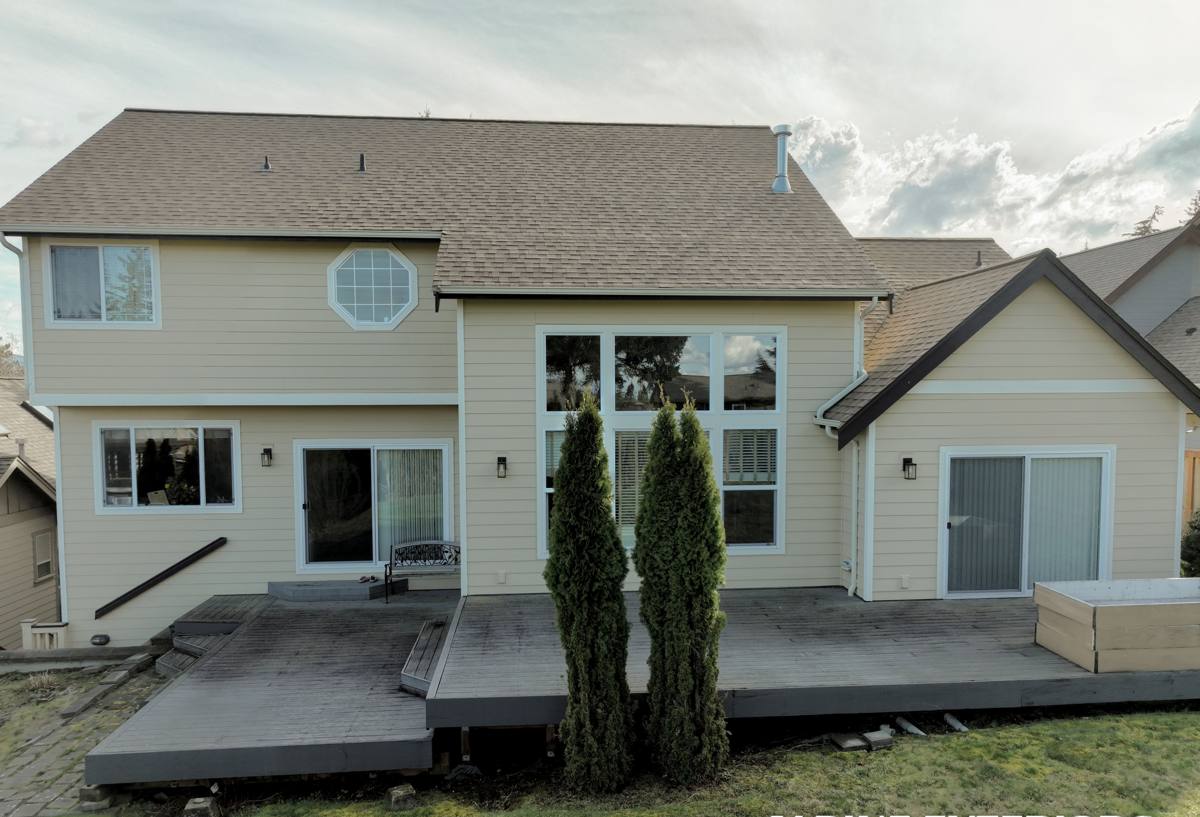
What We Actually Find in Conway Deck Repairs
Fastener and Hardware Corrosion
The most common failure point isn't the lumber — it's the metal holding it together. Nails, screws, and joist hangers that aren't rated for coastal exposure corrode from the inside of the connection outward, so a fastener can look fine on the head and still be losing its grip in the wood. Salt air speeds this up considerably compared to an inland yard.
Ledger Board and Rim Joist Rot
The ledger board — where the deck attaches to the house — is the single most important structural connection on most decks, and it's also the piece most exposed to water that runs off the house or gets driven sideways by wind. When flashing is missing, undersized, or was never properly lapped, water tracks behind it and rots the ledger and the rim joist behind it from the inside, often for years before it shows on the outside.
Post and Footing Movement
Low-lying, saturated ground near the delta puts extra strain on posts and footings. Wood posts set directly in or near damp soil, or footings that were undersized or poured shallow, can shift or soften at the base over time. This shows up as a deck that feels slightly springy, uneven, or pulled away from the house at one corner.
Moss-Damaged Decking
Moss doesn't just make a deck slick — it holds moisture directly against the wood or composite surface for weeks at a time. On wood decking that means soft, spongy boards and surface rot. On composite or wood-plastic decking it usually means staining and a compromised surface layer, since some composite boards handle prolonged moss contact worse than solid wood.
What a Correct Deck Repair Involves
A repair that only addresses what's visible from the top of the deck is a cosmetic fix, not a real repair. Doing this correctly means getting underneath and behind the deck to check the parts that actually carry the load:
- Confirming the ledger board connection is solid wood, properly flashed, and bolted — not just nailed — to the house framing
- Checking joists and beams for soft spots, especially where they meet posts or the ledger
- Testing posts and footings for movement, rot at grade, or undersized bearing
- Inspecting every hanger, bolt, and fastener for rust, pitting, or loss of holding strength
- Evaluating decking boards individually rather than assuming uniform condition across the deck
- Checking drainage — board spacing, slope away from the house, and whether water has a clear path off the structure
Skipping any of these steps means the repair is only as good as the parts nobody looked at.
Repair Scope: What Drives the Work
Every deck repair in Conway falls somewhere on a spectrum from a targeted board swap to a near-total rebuild. What we find at each part of the structure determines where a given job lands.
| Area of the Deck | What We Check | Common Fix Needed |
|---|---|---|
| Ledger board & house connection | Flashing, fastener type, wood condition behind the flashing | Re-flash and re-fasten, or replace rotted ledger section |
| Support posts & footings | Rot at grade, footing depth and condition, plumb and bearing | Sister or replace posts; in some cases repour or extend footings |
| Joists & beam framing | Soft spots, hanger corrosion, sag under load | Sister damaged joists, replace hangers with coastal-rated hardware |
| Decking boards & railings | Board-by-board condition, moss and stain penetration, railing stability | Selective board replacement or full resurfacing |
| Fasteners & connectors | Corrosion grade, holding strength, code compliance | Upgrade to stainless or hot-dip galvanized hardware rated for the exposure |
Repair or Replace? How We Help You Decide
Most homeowners don't want an upsell, and most decks don't need one. If the problems are isolated — a few soft boards, one corroded hanger, surface moss staining — a targeted repair is the honest answer and it costs a fraction of a full rebuild. If the ledger board is compromised, if multiple footings have shifted, or if rot has spread through several structural members, patching around those problems just delays a bigger failure and can end up costing more over time than doing the structural work once, correctly. We'll tell you plainly which category your deck falls into and why, with the specific issues we found laid out so you can see the reasoning.
Materials and Hardware We Use, and Why
For coastal and delta-adjacent properties, we favor stainless steel or hot-dip galvanized fasteners and connectors over standard coated hardware — the extra corrosion resistance matters when salt air is part of the daily environment, not an occasional visitor. For framing repairs, we use properly rated pressure-treated lumber suited to ground contact where posts meet grade, since that's where moisture exposure is worst.
On decking material, we lay out the honest trade-offs rather than pushing one option. Solid wood decking is repairable board-by-board and takes a natural look, but needs regular sealing and is more moss-prone without upkeep. Composite decking resists rot and doesn't need staining, but it isn't repaired the same way wood is — damaged boards typically get replaced whole, and moisture that gets trapped underneath or in fastener penetrations can still cause problems if the substructure isn't built and vented correctly. Neither is the "wrong" choice; the right one depends on how much maintenance you want to do and what you're trying to match on the house.
Our Deck Repair Process
- On-site inspection of the full structure — decking, framing, ledger, posts, and footings — not just the visible surface
- A written scope that separates cosmetic issues from structural ones, so you know exactly what's being repaired and why
- Protecting landscaping and site access before any demolition begins
- Structural repairs first — ledger, framing, posts, footings — since everything else depends on those being sound
- Decking, railing, and hardware work once the structure underneath is confirmed solid
- Final walkthrough where we point out what was fixed and what to watch going forward
Staying Ahead of Moss and the Long Wet Season
A repaired deck stays repaired longer with a little seasonal attention, especially given how long the wet, shaded stretch of the year runs in this part of Skagit County. A few habits go a long way between visits from us:
- Sweep leaves and debris off the deck surface regularly in fall — trapped organic matter is what moss needs to establish
- Keep gutters and downspouts clear so roof runoff isn't dumping extra water onto or near the deck
- Check that board gaps aren't clogged with debris, since that's what allows water to actually drain through instead of sitting on top
- Look underneath the deck once or twice a year for standing water, soft framing, or new rust on hardware
- Re-seal or re-stain wood decking on the schedule the product calls for — skipping a cycle in this climate shows up faster than it would somewhere drier
Why a Crew That Already Works in Conway Matters
A contractor who mostly works drier, more sheltered areas will sometimes underspec what a delta-area deck actually needs — standard fasteners instead of coastal-rated hardware, or flashing details that would be fine fifty miles inland but aren't enough here. Working regularly in and around Conway and the rest of Skagit County means we're used to this exact combination of salt air, driving rain, and heavy moss pressure, and we build and repair accordingly. It also means straightforward, local permitting knowledge and realistic scheduling, since we're not treating your deck as a one-off out-of-town job.
If you're seeing soft boards, rust streaks around your deck's hardware, a corner that feels less solid than it used to, or moss that keeps coming back no matter how often you clean it, it's worth having someone look underneath before it gets worse. We offer free, no-pressure estimates for Conway homeowners — use the form below to get a straightforward read on what your deck actually needs.