 Anacortes Siding
 Why Decks in Skyline Wear Differently Than Decks Inland
Skyline sits up above the water on Anacortes's west side, and that position is exactly what makes it a beautiful place to have a deck — and exactly what shortens the life of a poorly built one. Homes here catch wind and salt spray coming straight off the water, with little to break it up before it hits the house. That combination of exposure and elevation means a deck in Skyline takes a different kind of beating than a deck tucked into a sheltered lot a mile inland, even though both are technically in the same Skagit County climate zone.
Three things do most of the damage over time: salt air that accelerates corrosion on anything metal, driving rain that gets pushed sideways into ledger boards and railing posts instead of falling straight down, and a moss season that can run eight or nine months out of the year on the wetter, shadier lots. None of these are exotic problems — they're the same forces every deck on Fidalgo Island deals with. But a deck built without them specifically in mind will show it early, usually in the fasteners, the ledger connection, and the framing closest to the ground.
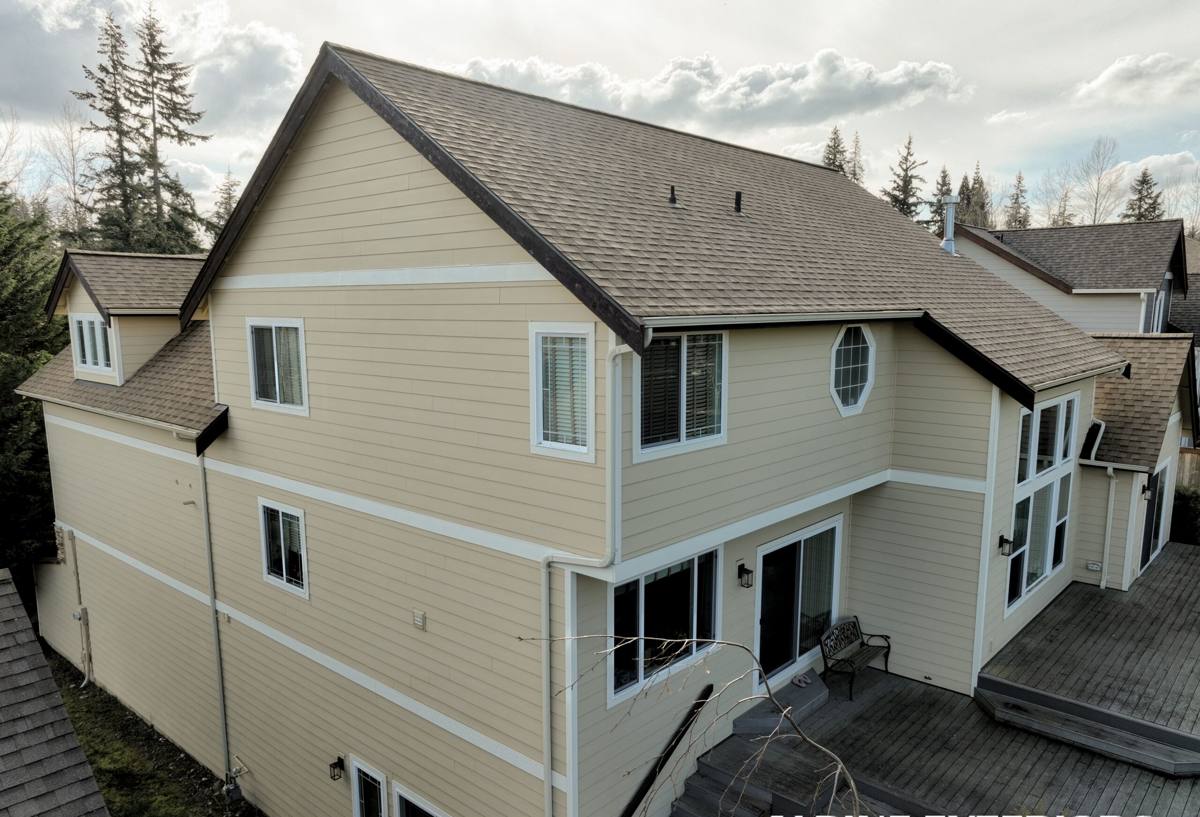
What a Correct Deck Replacement Actually Involves
"Deck replacement" gets used loosely. For some contractors it means pulling up the old boards and screwing down new ones over the same frame. That's a resurfacing job, not a replacement, and on an older Skyline deck it usually just hides a framing problem for another season or two instead of fixing it. A real replacement means the structure itself gets evaluated and rebuilt where needed, not just the walking surface.
Ledger Board and Flashing
The ledger board — where the deck attaches to the house — is the single most common failure point we see, and it's almost always a flashing problem, not a wood problem. If water gets behind the ledger and into the rim joist or sheathing, it can sit there for years before anyone notices, because the damage is hidden behind the siding and decking. A correct replacement means proper step flashing and a water-resistive membrane at that connection, not just lag screws through the siding into the framing.
Framing and Fasteners
Joists, beams, and posts need to be sized and spaced for the actual load and span, not just matched to whatever was there before — codes and best practices have moved on since a lot of older Skyline decks were built. Fasteners matter just as much as lumber. In a salt-air environment, standard coated screws and joist hangers corrode faster than they would a few miles inland, which is why we spec stainless or high-grade coated hardware at connection points that see the most moisture and salt exposure.
Drainage and Airflow Underneath
A deck that traps moisture underneath is a deck that grows moss and rot underneath. Grading the ground below to shed water away from the house, keeping skirting vented rather than sealed tight, and avoiding designs that create dead-air pockets all reduce how much time the framing spends wet after a storm rolls through.
Choosing the Right Decking Material for This Exposure
There's no single "best" decking material — there's a best material for a given budget, exposure, and how much upkeep the homeowner actually wants to do. For a Skyline deck facing wind and salt, we walk homeowners through the real trade-offs rather than pushing whatever has the best margin.
| Material | How it holds up to salt air & moss season | Maintenance | Typical lifespan |
|---|---|---|---|
| Pressure-treated wood | Fine structurally if sealed and maintained; surface checks and gray out faster in salt air | Re-seal or stain every 1-2 years | 10-15 years with upkeep |
| Cedar | Naturally rot-resistant but softer surface; moss and mildew show quickly if not cleaned | Annual cleaning, periodic oil or stain | 15-20 years with upkeep |
| Capped composite | Cap layer resists moisture and moss growth well; core can still absorb water at cut ends if not sealed | Periodic washing, minimal sealing | 25-30 years, per manufacturer warranty |
| Cellular PVC | Fully synthetic, doesn't absorb water at all — strong choice for direct salt exposure | Occasional washing | 25-30+ years, per manufacturer warranty |
Cost generally follows that same order, with pressure-treated wood the least expensive up front and PVC decking the highest initial cost. For most Skyline homeowners, the deciding factor isn't the sticker price of the boards — it's how many hours a year they want to spend maintaining a deck that's exposed to wind and spray most of the year.
Repair or Replace: How to Tell Which One You Actually Need
Not every tired-looking deck needs a full replacement, and we'd rather tell a homeowner they only need repairs than sell a replacement they don't need yet. The honest answer usually comes down to what's happening in the framing, not just the surface.
- Soft, spongy, or spring-y spots when you walk across the deck — usually joist or ledger rot underneath
- Rust streaks running down from screw heads or joist hangers
- A ledger board that feels damp or shows staining where it meets the house
- Railing posts that wiggle at the base, which often means post rot below the surface connection
- Persistent moss or dark staining on the underside of boards even after cleaning
- Visible gaps opening up between the deck and the house at the ledger
If it's just surface graying, splinters, or a few loose boards, a repair and refinish can add real years to a sound structure. If you're seeing soft framing, rust at connection points, or movement at the ledger, that's a structural conversation, not a cosmetic one — and it's worth having before it turns into a safety issue.
How Our Process Works, Start to Finish
We keep the process straightforward because homeowners deserve to know what's happening to their deck and why, not just get a quote and a crew showing up.
- Site visit and assessment. We check the ledger connection, probe the framing for soft spots, and look at how the deck drains and vents underneath before we ever talk materials.
- Written scope and material selection. You get a clear breakdown of what's structural, what's cosmetic, and the honest trade-offs between decking materials for your specific exposure.
- Tear-off and structural repair. Old decking, and any framing or ledger flashing that doesn't pass inspection, comes out and gets rebuilt to current standards.
- Framing, flashing, and fastener upgrades. This is where the long-term durability actually gets built in — it's the least visible part of the job and the most important.
- Decking and railing installation. Boards, railing, and any lighting or fascia details go in per the agreed scope.
- Final walkthrough. We go over the finished deck together, including basic care specific to the material you chose.
Railings, Fasteners, and Hardware in a Salt-Air Environment
Hardware choice matters more here than it would on a deck set back from the water. Standard zinc-coated screws and clips can start showing rust within a couple of seasons in a spot that gets regular salt spray. We use stainless steel or high-grade coated fasteners at the connections that take the most exposure — ledger bolts, joist hangers, and railing post anchors — and reserve standard hardware for interior framing that's more sheltered.
Railings have their own trade-offs. Wood railings need the same upkeep as wood decking. Composite and vinyl railing systems hold up with less maintenance but vary in how well they handle UV and impact over time. Cable and metal railing systems look great with a water view but require corrosion-resistant hardware and periodic tension checks. We'll talk through which fits your deck's exposure and your maintenance appetite rather than defaulting to whatever's easiest to install.
Permits and Code Basics for Anacortes and Skagit County
Most deck replacements that involve rebuilding the structure — not just swapping boards on an existing, unchanged frame — require a permit through the City of Anacortes or Skagit County, depending on where the property sits. Guardrail height, baluster spacing, footing depth, and ledger attachment all fall under current building code requirements, and those requirements have generally gotten more specific over the years than what older Skyline decks were originally built to. We handle the permit process as part of the job rather than leaving it for the homeowner to sort out, and we build to the code that applies to your specific property.
Protecting a New Deck Through Moss Season
A well-built deck still needs some basic seasonal attention, especially through the wetter months when moss and standing moisture do the most damage. None of this is complicated, but it's easy to let slide until a problem shows up.
- Sweep debris and needles off the deck surface regularly through fall, before they trap moisture against the boards
- Rinse off salt residue after storms with heavy onshore wind, especially on metal railings and hardware
- Check that gaps between boards stay clear so water keeps draining through rather than pooling
- Keep the area underneath the deck clear of stored items that block airflow and trap moisture
- Re-seal wood decking or railing on the schedule the material calls for — don't wait for visible graying
- Have the ledger and framing connections looked at every few years, since that's the area most hidden from casual inspection
Why a Crew That Already Works Skyline Makes a Difference
A deck replacement in Skyline isn't quite the same job as the same square footage somewhere flatter and more sheltered. Many of these lots have hillside access, tighter staging areas, and views that mean the finished railing and decking choices get seen and used constantly, not just occasionally. A crew that's already worked in this neighborhood knows what kind of wind exposure to expect on a given orientation, how the drainage tends to behave on these slopes, and what fastener and flashing details actually hold up here versus what looks fine on paper.
That local familiarity also shows up in the smaller logistics — getting equipment and materials onto a hillside lot safely, disposing of old decking and hardware without leaving a mess on a property with limited staging space, and scheduling around the wetter stretches of the year so framing isn't sitting exposed to rain any longer than it has to be. None of that is glamorous, but it's the difference between a deck that gets built once, correctly, and one that needs attention again sooner than it should.
If your Skyline deck is showing its age — or you just want an honest read on whether it needs repair or full replacement — we're happy to come take a look. The estimate is free, there's no pressure attached to it, and you'll get a straight answer about what your deck actually needs. You can request one using the form below.