 Anacortes Siding
 Composite Decking Built for Edison's Climate
Edison is a small, low-lying community tucked into the farmland and tidal water along Samish Bay in Skagit County, just south of Anacortes. It's a beautiful place to have a deck — and a demanding one. The same salt-laden air that blows in off the bay, the steady winter rain, and the long shoulder seasons that never quite dry out all work against outdoor structures here. A deck that's installed the way it would be in a drier inland climate does not hold up the same way in Edison. This page is about what a composite deck actually needs to perform well in this specific stretch of Skagit County, and how we build one that does.
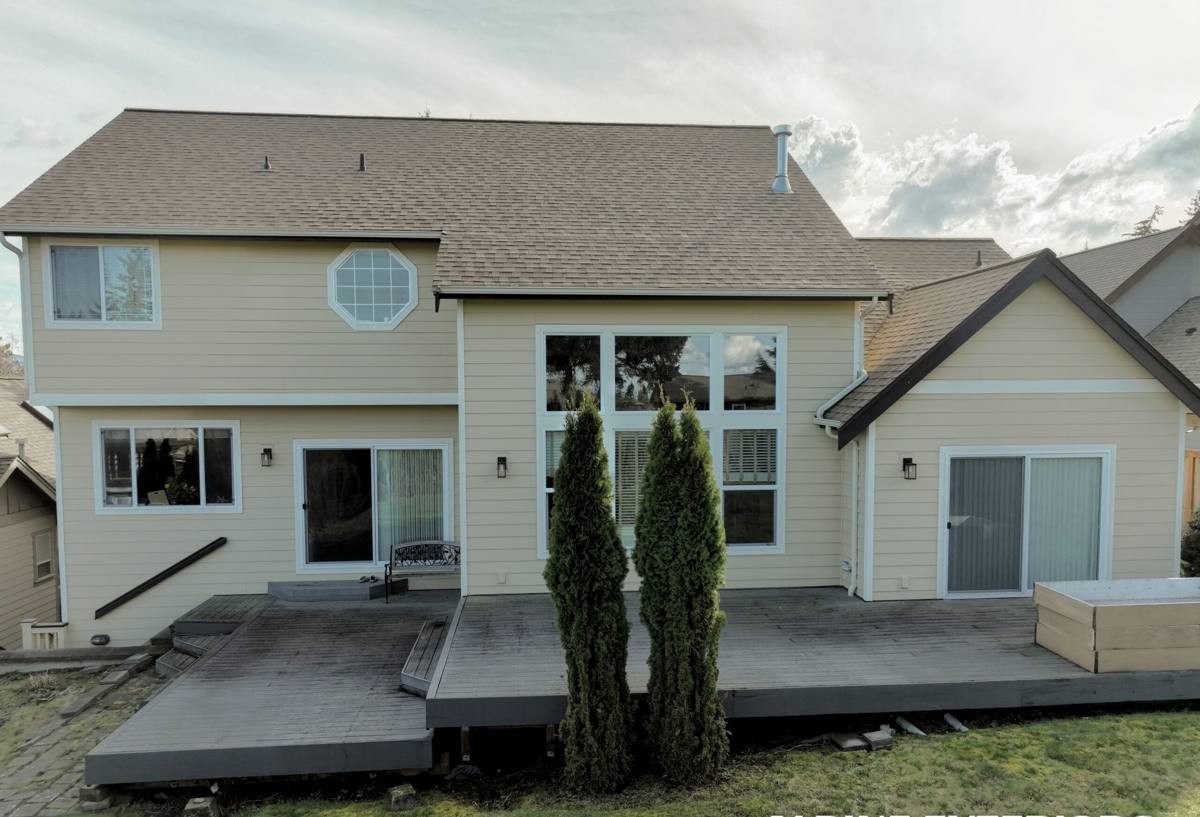
What This Climate Actually Does to a Deck
Three things drive almost every deck problem we see in the Edison area:
- Salt air. Being close to Samish Bay means airborne salt settles on everything, including a deck's hardware. Standard fasteners and connectors corrode faster here than they would twenty miles inland, and corroded hardware is one of the most common causes of a deck failing structurally before the boards themselves ever wear out.
- Driving rain. Rain in this part of Skagit County rarely falls straight down — wind off the water pushes it sideways, which means it gets into places a calmer climate wouldn't reach: behind ledger boards, into end-grain cuts, under railing posts, and into any gap that wasn't sealed or flashed correctly.
- A long moss and algae season. Between the rain, the humidity, and the shade thrown by mature trees on many Edison properties, moss and algae have months to establish themselves on any horizontal surface that doesn't dry out quickly. Decking is flat, low to the ground, and often partially shaded — exactly the conditions moss prefers.
None of this means composite decking is a bad choice for Edison — it generally holds up better than wood against all three of these — but it does mean the installation details matter more here than they would somewhere drier.
Composite, Wood, or PVC: What Actually Holds Up Here
We get asked fairly often why we lean toward capped composite for most Edison projects instead of wood or full PVC. Here's the honest comparison, including the trade-offs of each:
| Material | How it handles salt air and rain | Maintenance burden | Typical trade-off |
|---|---|---|---|
| Traditional wood (cedar, treated lumber) | Absorbs moisture at cut ends and fastener holes; needs a sealed finish to resist rot | Annual cleaning and re-staining/sealing | Lowest upfront cost, but shortest lifespan in this climate without upkeep |
| Capped composite | Moisture-resistant cap shell resists absorption and staining; core doesn't rot | Periodic washing to keep moss/algae off the surface | Higher upfront cost, much lower long-term upkeep |
| Uncapped composite (older-generation) | Core can absorb moisture over time, which shows up as swelling or dark staining in wet climates | More frequent cleaning; some products are prone to mold in shaded, damp spots | We generally steer Edison clients away from this tier for that reason |
| Solid PVC | Fully moisture-proof, unaffected by salt air | Low; mainly surface cleaning | Higher cost, and can look and feel less like a traditional deck to some homeowners |
For most Edison homes, a quality capped composite board strikes the right balance — it's not fooled by the moisture this climate throws at it, and it doesn't ask for a maintenance routine most people don't have time for.
Why We Don't Recommend Uncapped or Bargain-Tier Composite Here
Not all composite decking is built the same. Early-generation and budget uncapped boards were designed before manufacturers fully solved the moisture-absorption problem, and in a climate like Edison's — with rain, humidity, and salt air working on the surface year-round — that shows up faster than it would in a dry climate. Our standard is to spec capped composite products with a documented warranty against staining, fading, and moisture damage, because that's the tier that actually earns its higher price here.
The Substructure Is What Actually Fails First
Homeowners naturally focus on the decking boards, but the framing underneath is what determines whether a deck lasts fifteen years or forty. This is also the part that's easiest for a rushed installer to cut corners on, because it's the part that disappears once the boards go down.
A correct substructure for this climate includes:
- Joist tape on top of every joist, to stop rainwater from wicking into the wood through fastener holes and seams — cheap to add during construction, expensive to fix afterward.
- Stainless steel or marine-grade coated fasteners and joist hangers throughout, not just at the ledger. Standard galvanized hardware corrodes noticeably faster this close to salt water.
- Joist spacing tightened to the board manufacturer's spec — composite boards typically need closer joist spacing than wood, especially for diagonal or picture-frame layouts, and skipping this shows up later as bounce or sag.
- Footings set to the correct depth for the soil — the low-lying, moisture-holding farmland soil common around Edison behaves differently than well-drained upland soil, and footings need to account for that rather than being poured to a generic depth.
- Proper ledger board flashing where the deck attaches to the house, so wind-driven rain can't work its way behind the siding at the attachment point — one of the most common sources of hidden water damage on attached decks in this region.
Installation Details That Matter More Here Than Elsewhere
Beyond the substructure, a handful of details separate a deck that performs well from one that develops problems within a few years:
Gapping and Fastening
Composite boards expand and contract with temperature, and Skagit County's temperature swings between a damp winter and a warmer summer are enough to matter. Boards need correct end-gaps and edge-gaps, and hidden fastener clip systems need to be installed to the manufacturer's spacing — not stretched further apart to save material.
Drainage and Ventilation
The deck surface should be sloped slightly so water sheds off rather than pooling, and the space underneath needs airflow. Fully enclosing the underside of a deck with solid skirting, without vents, traps humid air against the framing — exactly the environment moss, mold, and rot prefer. On lower decks, especially over ground that stays damp much of the year, this detail matters more than most homeowners realize.
Railing and Post Attachment
Post bases and railing attachment points are common leak spots because they penetrate the deck surface. These connections need to be properly flashed and sealed, not just bolted through the boards.
Keeping Moss and Algae From Taking Over
Even a well-built composite deck will grow moss and algae in Edison if it's never cleaned — the surface material is resistant, not immune, since organic growth sits on top of the board rather than penetrating it the way it can with untreated wood. A simple seasonal routine keeps a deck looking and performing the way it should:
- Sweep debris (leaves, needles, seed pods) off the deck regularly, especially in fall — trapped organic matter under debris is what gives moss a foothold.
- Wash the deck with a soft-bristle brush and a composite-safe cleaner once or twice a year, more often in shaded sections.
- Avoid pressure washers on composite boards, or use a wide fan tip at low pressure and keep distance — direct high-pressure spray can damage the cap layer on some products.
- Trim back overhanging branches and vegetation where possible to let more light and air reach the deck surface.
- Check that gaps between boards stay clear so water keeps draining through rather than sitting on the surface.
Our Process, Start to Finish
- On-site assessment. We look at the site conditions specific to your property — grade, drainage, shade, soil, and how the deck will attach to the house — before recommending a board or a framing plan.
- Design and material selection. We walk through board tiers, colors, and railing options honestly, including what each choice actually costs to maintain over time in this climate.
- Permitting. We handle the permit process required through Skagit County for the project.
- Demo and substructure build. Removal of any existing deck, followed by framing built to the specs above — joist tape, corrosion-resistant hardware, correct footing depth, and proper ledger flashing.
- Decking installation. Boards installed with correct gapping and fastening, sloped for drainage, with attention to clean board transitions and railing attachment.
- Final walkthrough. We go over the finished deck with you, including what maintenance it actually needs — and what it doesn't.
Cost Factors for a Composite Deck in Edison
Every deck is priced on its own site conditions, but these are the factors that move the number most:
| Factor | Why it affects cost |
|---|---|
| Deck size and shape | Square footage and cuts (diagonal patterns, curves, picture-framing) drive both material and labor |
| Height off grade | Elevated decks need more substructure, railing, and sometimes stairs, compared to a low deck near grade |
| Board tier | Capped composite and PVC cost more upfront than wood but typically cost less to maintain over the deck's life |
| Existing deck removal | Demolition and disposal of an old wood deck adds labor before the new build starts |
| Site access | Rural and farmland properties around Edison can have longer material carry distances or tighter equipment access than in-town lots |
| Railing style | Composite or metal railing systems vary widely in cost compared to a basic wood rail |
We don't quote a flat per-square-foot number over the phone, because these factors genuinely change the outcome — an accurate number requires seeing the site.
Why Hire a Crew That Already Works Edison
Edison is unincorporated, which means permitting and inspection run through Skagit County rather than a city building department, and the process has its own paperwork and timeline that's worth knowing going in. Many Edison properties also have wells, septic systems, or farmland setbacks that a deck footing plan needs to work around — details that are easy to miss if a crew hasn't dealt with them before. And because a lot of homes in this area sit on rural roads or longer driveways, material delivery and site staging take more planning than a standard in-town lot. A crew that's already built decks in this specific area isn't guessing at any of this — the county requirements, the soil behavior, and the climate demands are all things we've already accounted for before we ever show up with a truck.
If you're considering a composite deck for your Edison property, we're happy to come take a look, walk the site with you, and put together a straightforward, no-pressure estimate — no obligation either way. Use the form below to get started.