 Anacortes Siding
 Guemes Island's Climate Puts Real Demands on Siding
Guemes Island sits just off Anacortes in Skagit County, separated from the mainland by a short ferry crossing but not separated from the weather that batters the rest of the San Juan and Rosario Strait shoreline. Homes here take on a steady diet of salt-laden air, wind-driven rain that hits walls sideways instead of straight down, and a long, damp moss season that can stretch from fall through spring. That combination is harder on exterior siding than most inland Skagit County locations ever see.
Salt air is corrosive to fasteners, trim flashing, and any siding product that isn't dimensionally stable when it gets wet and dries out repeatedly. Driving rain finds every gap in flashing, caulking, and butt joints, and it doesn't need a big gap to do damage over years. Moss and algae thrive in the shaded, moisture-holding conditions common on tree-lined island lots, and they hold water against a wall surface far longer than open, sun-exposed siding does. Any siding installed on Guemes Island needs to handle all three conditions at once, not just one of them.
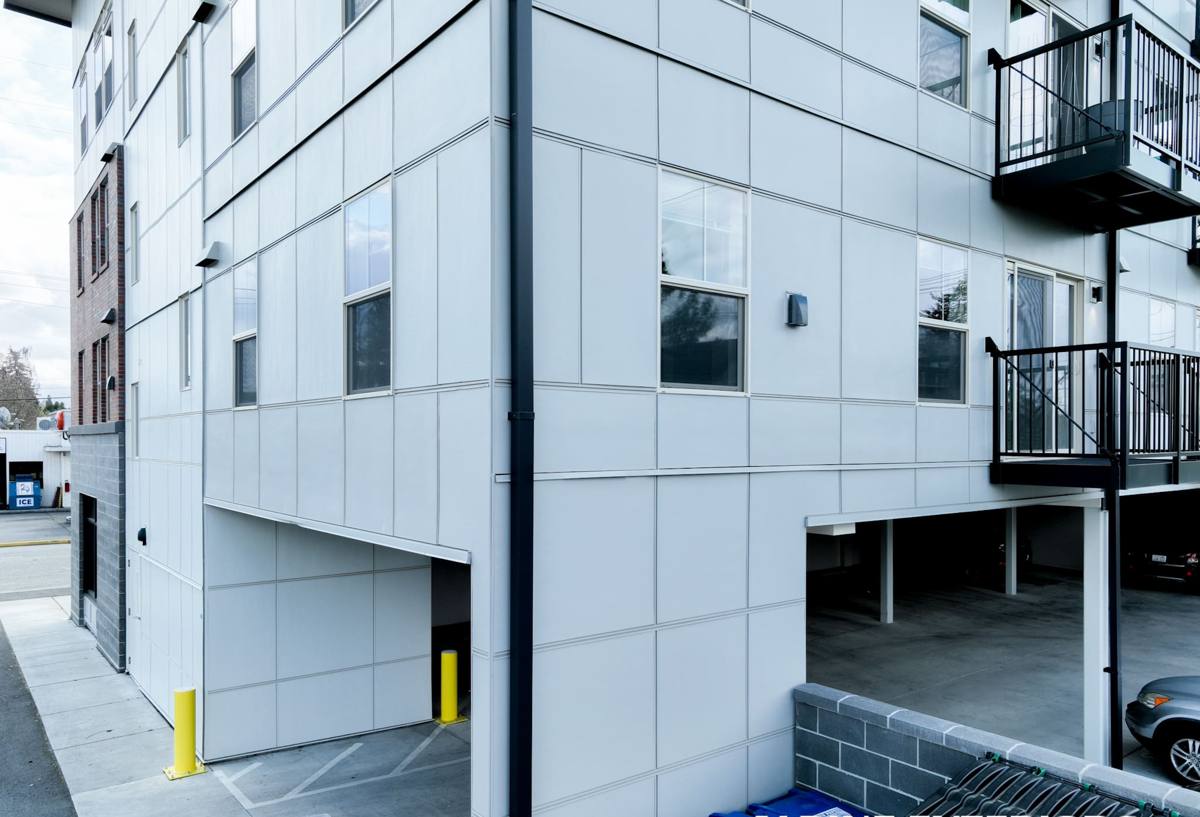
Why We Install Only James Hardie Fiber Cement
We don't install vinyl, LP SmartSide, Cemplank, Allura, primed spruce, or cedar. That's a deliberate standard, not a limitation we work around. James Hardie fiber cement is a cement-based composite — it doesn't rot, it doesn't feed insects, and it isn't a wood or wood-fiber product that swells and shrinks with every wet-dry cycle. On a site like Guemes Island, where the wall assembly is going to see moisture exposure for a large share of the year, that dimensional stability matters more than it does on a dry inland lot.
Hardie's ColorPlus finish is baked on at the factory under controlled conditions, which gives it better adhesion and UV resistance than field-applied paint typically achieves — an advantage in a location where repainting means arranging contractor access around a ferry schedule. Hardie also engineers specific product lines (the HZ5 designation, for example) for wetter, more corrosive climates, and backs the material with a strong transferable warranty. We install to that system because it's the one we're willing to stand behind on a coastal island lot.
What We're Asking Homeowners to Weigh Against Cheaper Options
Vinyl siding is inexpensive and low-maintenance in mild climates, but it can warp under sustained sun and wind exposure and its seams give wind-driven rain a path inward over time. LP SmartSide and other wood-strand products perform well when kept dry and fully maintained, but they rely on an intact paint film and sealed edges to resist moisture — a maintenance schedule that's easy to fall behind on for a part-time or vacation residence, which describes a meaningful share of Guemes Island homes. Primed spruce and cedar are attractive natural materials, but raw wood siding on a salt-air, high-moss site needs more frequent refinishing and edge-sealing than most owners realize going in. None of these are "bad" products in every setting — they're just not what we're willing to warranty on this specific island's conditions.
What a Correct Installation Involves
Fiber cement siding is only as good as the assembly behind it. On Guemes Island projects, the details that matter most are the ones a homeowner can't see once the siding is up:
- A drainage plane (weather-resistant barrier plus a rainscreen gap where the wall assembly calls for it) so any moisture that gets past the siding has somewhere to go besides the sheathing
- Correct fastener type and spacing — stainless or coated fasteners rated for coastal exposure, driven per Hardie's published fastening schedule, not "close enough"
- Proper clearance at the bottom of the wall (siding held up off decks, patios, and grade) so splashback and standing moisture don't sit against the cut edge
- Factory-cut edges used wherever possible, and any field-cut edges sealed per manufacturer specification before installation
- Flashing and kick-out details at every roof-wall intersection, window, and door — the single most common source of hidden water damage on coastal homes
- Tight, consistent caulk joints at butt seams and trim, using a sealant rated for the movement and exposure the wall will see
Skipping any one of these doesn't show up as a problem in year one. It shows up in year five or seven, as staining, soft trim, or moss establishing itself in a joint that was never fully sealed. Correct installation is what makes the difference between siding that earns its 30-plus-year lifespan and siding that needs early rework.
Moss, Algae, and Long-Term Appearance
Guemes Island's tree cover and marine humidity create ideal conditions for moss and algae growth on north-facing and shaded wall sections. Fiber cement doesn't feed organic growth the way wood-based siding can, but moss and algae will still colonize any siding surface that stays damp long enough — the growth sits on top of the material rather than in it. Good installation reduces how long walls stay wet (proper drainage, adequate roof overhangs where the design allows, and grade clearance), which meaningfully cuts down on how often a wall needs washing. ColorPlus finish also holds up to routine cleaning better than field-applied paint, since the color and moisture-resistant topcoat are cured into the board at the factory rather than sitting as a surface layer that thins with each wash.
Working on Guemes Island: Logistics and Scheduling
Island access adds a real logistics layer that mainland Anacortes jobs don't have. Materials, equipment, and crew all move by ferry, which means project scheduling has to account for crossing times and load limits rather than just driving to the site. A crew that already works Guemes Island regularly plans deliveries and crew days around that reality instead of treating it as a surprise mid-project — fewer wasted trips, fewer delays waiting on a missed sailing, and a more accurate timeline from the start.
We scope every Guemes Island project with ferry logistics built into the estimate and schedule, not added as a change order once the crew is already on-site.
Comparing Siding Approaches for This Location
| Factor | James Hardie Fiber Cement | Vinyl / Wood-Based Alternatives |
|---|---|---|
| Moisture stability | Cement-based, does not swell/rot/warp | Can warp (vinyl) or absorb moisture (wood-based) with repeated wet-dry cycles |
| Salt-air exposure | Engineered coastal (HZ5) product lines available | Not typically engineered specifically for marine exposure |
| Finish durability | Factory-baked ColorPlus finish | Field-applied paint (wood) or molded color (vinyl) that fades over time |
| Maintenance for part-time owners | Periodic washing; no repainting cycle in most cases | Regular repainting/resealing needed to stay protected (wood); seam upkeep (vinyl) |
| Fire resistance | Non-combustible | Combustible (vinyl melts/deforms; wood burns) |
What Drives Cost on an Island Job
| Cost Factor | Why It Matters Here |
|---|---|
| Ferry access | Material and crew transport adds scheduling and logistics cost beyond a standard mainland job |
| Existing siding removal | Tear-off and disposal costs vary with what's coming off and how it was fastened |
| Wall assembly condition | Sheathing or framing repairs needed behind old siding, common if there's been long-term moisture intrusion |
| Trim and detail complexity | Corners, window/door surrounds, and roof-wall intersections take more time to flash and finish correctly |
| Product line and profile | HZ5 coastal-rated boards, plank width, and texture selection affect material pricing |
| Access and staging | Steep lots, limited driveway space, or waterfront exposure can affect scaffolding and crew time |
We give straightforward, written estimates that walk through these factors rather than a single bottom-line number with no explanation behind it.
Questions Worth Asking Before You Hire
Whoever you hire for siding work on Guemes Island, it's worth confirming a few things upfront:
- Do they carry current Washington contractor licensing and insurance, and can they show it without hesitation?
- Have they worked on the island before, and do they understand the ferry logistics involved in scheduling?
- Will they put the fastening schedule, flashing details, and drainage plane approach in writing, not just verbally?
- Is the warranty backed by the manufacturer as well as the installer, and is it transferable if you sell the home?
- Do they specify exactly which product line and profile they're bidding, rather than a vague "fiber cement siding" line item?
Why Local Experience on Guemes Island Matters
A crew that has already worked this island knows how the wind sits on a waterfront lot versus a tree-sheltered interior one, how moss behaves differently on the two, and how to build a ferry-dependent schedule that doesn't blow up the first time a crossing gets missed. That experience shows up in fewer surprises during the job and in an installation that's actually detailed for the conditions the wall will face — not a generic install dropped onto an island site.
If you're weighing a siding replacement on Guemes Island, we're happy to walk the property, look at what's there now, and put together a straightforward estimate with no pressure attached. Reach out using the form below to get started.