 Anacortes Siding
 Why Fiber Cement Is the Right Material for a Sedro-Woolley Home
Sedro-Woolley sits inland from the Sound, but it doesn't sit outside the Sound's reach. Salt-laden air still rides up the Skagit Valley on windier weather systems, driving rain gets funneled and intensified as storms move through the valley corridor, and the mild, damp climate here supports a moss and mildew season that runs most of the year. That combination is hard on any exterior material that isn't specifically engineered for it. Fiber cement siding — specifically James Hardie's fiber cement, which is the only siding product we install — is built to handle exactly that kind of sustained moisture exposure without the slow breakdown we see in wood-based and vinyl products across Skagit County.
This page is about the material itself: what fiber cement actually is, how it's built to perform in a climate like Sedro-Woolley's, what a correct installation involves, and why we standardized on it instead of the wider range of siding products most contractors offer.
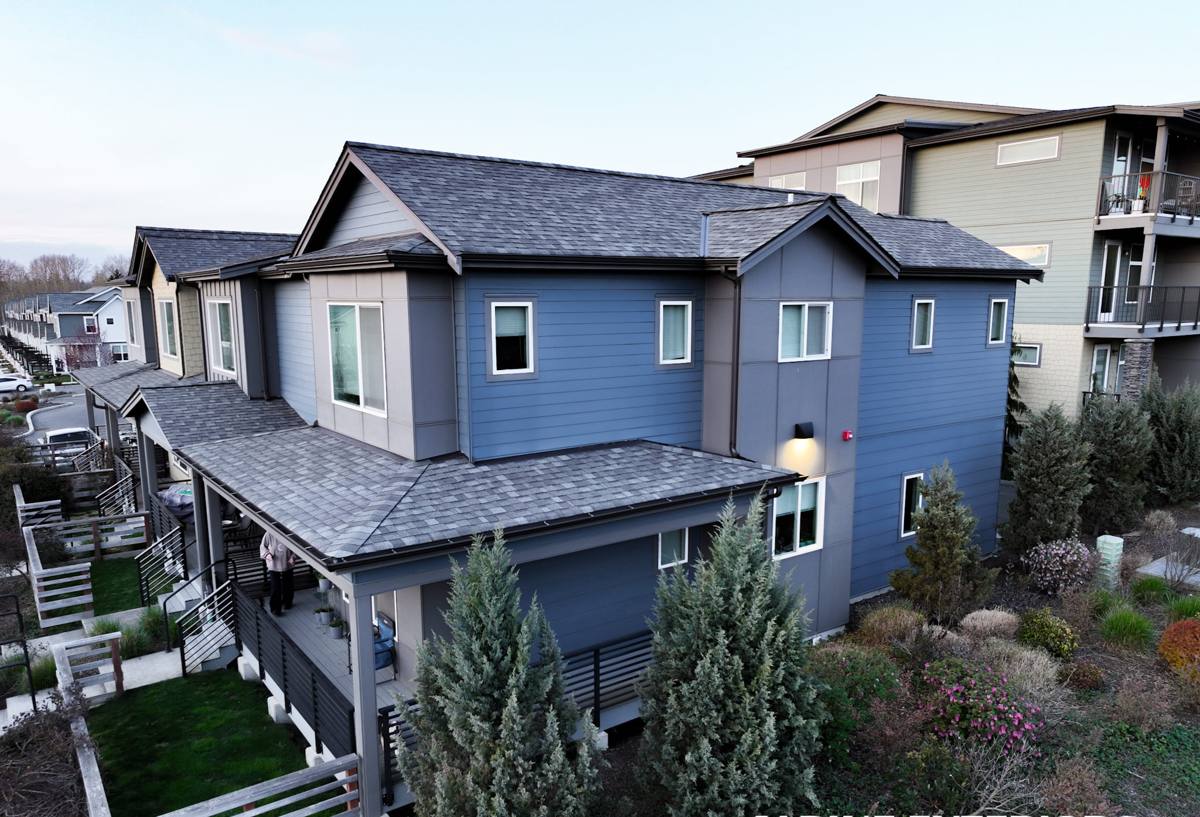
What Fiber Cement Siding Actually Is
Fiber cement is a composite of Portland cement, sand, and cellulose fiber, cured under controlled factory conditions into dense, dimensionally stable planks or panels. It isn't wood, and it isn't plastic — it behaves more like a fired masonry product than either. That composition is what gives it the properties that matter most in a wet valley climate:
- Non-combustible core — it doesn't contribute fuel to a fire the way wood-based siding can
- Dimensionally stable — it doesn't swell, cup, or warp with repeated wet-dry cycling the way engineered wood and cedar can
- Dense, low-porosity surface — it gives moss and mildew far less to grip onto than porous wood grain
- Rigid and impact-resistant — it holds up to the debris and weather stress that comes with a wooded, semi-rural setting like much of Sedro-Woolley
None of that means fiber cement is maintenance-free — it still needs to be installed correctly and occasionally rinsed off — but it starts from a materially stronger position against moisture than the alternatives we used to install.
How Sedro-Woolley's Climate Tests Siding Specifically
Driving Rain Funneled Up the Valley
Storm systems moving off Puget Sound frequently intensify as they're pushed up the Skagit Valley, and Sedro-Woolley catches a real share of that wind-driven rain. Rain that's forced sideways into laps, seams, and trim joints is what exposes weak points in a siding system — not rain that simply falls straight down. Fiber cement's rigidity and factory-controlled dimensions mean tighter, more consistent lap lines than wood products that can shift slightly over time and open small gaps at exactly those joints.
A Long Moss and Mildew Season
Filtered light from tree cover, mild temperatures, and near-constant valley humidity add up to a moss season that runs most of the year in this part of Skagit County. North-facing walls and anything under an overhang with restricted airflow are typically first to show growth. Porous materials — cedar, primed spruce, engineered wood — give moss more surface to establish on, and once it takes hold it traps moisture against the wall behind it. Fiber cement's dense surface is meaningfully harder for organic growth to colonize, though it isn't immune, and proper eave and gutter detailing still matters as much as the siding material itself.
Salt Air's Inland Reach
Sedro-Woolley isn't a waterfront town, but the salt content in Skagit County's air off Puget Sound still travels inland during windier stretches, adding a low but steady corrosion load to fasteners, flashing, and any exposed metal trim over the life of a siding system. It's a smaller factor here than in towns sitting directly on the water, but it's still part of why we spec fastener and flashing materials rated for coastal-adjacent exposure rather than the cheapest option available.
Freeze-Thaw Near the Foothills
Sedro-Woolley's position closer to the foothills than Sound-facing towns means slightly more frequent freeze-thaw cycling through the winter. Materials that absorb water and then freeze are prone to cracking and surface breakdown over repeated cycles. Fiber cement's low water absorption compared to wood-based products limits how much moisture is available to freeze in the first place.
The James Hardie Product Line for This Climate
James Hardie makes region-specific formulations, and for the Pacific Northwest we spec the HZ5 line — engineered specifically for climates with significant moisture exposure and freeze-thaw cycling, rather than the warmer, drier-climate formulations the company also sells. On top of that base product, the ColorPlus finish is baked onto the panels in a factory process rather than brushed on at the jobsite, which produces a more even, more durable topcoat that resists fading, chipping, and cracking longer than field-applied paint. For a Sedro-Woolley home, that factory finish matters more than it might in a drier region, since it's absorbing more wet-dry cycling over a given year than siding in most of the country ever sees.
Common Profiles We Install
| Profile | Look | Best Fit |
|---|---|---|
| Lap Siding (HardiePlank) | Traditional horizontal board look | Most home styles; the most common choice countywide |
| Shingle Siding (HardieShingle) | Staggered or straight-edge shingle texture | Craftsman and cottage-style homes |
| Board and Batten (HardiePanel + trim) | Vertical panel with raised battens | Modern farmhouse and accent walls |
| Trim and Soffit (HardieTrim) | Matches window, corner, and fascia detail | Completing the system with a consistent material |
The right profile is mostly a style decision — all four are built on the same HZ5 fiber cement base and carry the same moisture performance for this climate.
What a Correct Fiber Cement Installation Requires
Fiber cement rarely fails on its own. When we're called out to look at a failing Hardie job someone else installed, the material almost never turns out to be the problem — the installation does. Manufacturer specification isn't a suggestion; it's the difference between a system that sheds water correctly for decades and one that traps it behind the wall.
- Correct nailing pattern and fastener depth — over-driven or under-driven nails compromise the panel's ability to move and seal properly
- Minimum clearance above grade, roofing, and decks — siding installed too close to the ground or a roofline wicks moisture it was never designed to handle
- Proper flashing at every window, door, and penetration — this is the single most common place we find hidden moisture intrusion on other companies' work
- Correct lap and seam spacing — factory-cut panels need consistent gaps and sealant application, not a "tight is better" shortcut
- Rainscreen or drainage plane where conditions call for it — giving water a path to escape behind the siding matters more in a climate that stays damp as long as Sedro-Woolley's does
We also check the sheathing and framing underneath before any new siding goes up. Rotted or water-damaged substrate gets repaired, not covered over — installing new siding on top of compromised sheathing just hides the problem for a few more years instead of fixing it.
Fiber Cement Compared to the Alternatives
| Product | Moisture Resistance | Maintenance | Typical Lifespan |
|---|---|---|---|
| James Hardie Fiber Cement (HZ5) | High — engineered for Pacific Northwest moisture and freeze-thaw exposure | Low — factory ColorPlus finish, occasional rinse | 30+ years with proper installation |
| Vinyl | Moderate — moisture can collect behind panels; seams flex over time | Low upfront, but prone to warping and fading in sun and cold | 15-25 years |
| LP SmartSide (engineered wood) | Moderate — most vulnerable at cut edges and seams | Moderate — cut edges need ongoing sealing and monitoring | 15-30 years, variable |
| Cedar / Primed Spruce | Low to moderate — absorbs and holds moisture in a wet valley climate | High — regular refinishing and close inspection needed | 10-20 years without diligent upkeep |
These are general industry ranges, not guarantees — actual performance always depends on installation quality, maintenance habits, and how exposed a given wall or elevation is to sun, wind, and rain.
Why We Only Install James Hardie Fiber Cement
We used to install a broader range of siding products. We stopped after years of tearing off failed siding on service calls across Skagit County and seeing the same moisture damage repeat itself on materials that weren't built for a climate this consistently wet. LP SmartSide, vinyl, Cemplank, Allura, primed spruce, and cedar all have legitimate use cases and homeowners who are satisfied with them — we're not telling you they're worthless products. But given the driving rain, the long moss season, and the freeze-thaw cycling Sedro-Woolley homes see year after year, we made a professional call not to install anything that demands more maintenance vigilance than we think is realistic to expect from a homeowner over 20 or 30 years. James Hardie's fiber cement, backed by a strong transferable warranty when installed to spec, is what we're willing to put our name behind.
Signs Your Current Siding Is Losing the Fight
- Green or dark staining that returns within a few months of cleaning
- Soft or spongy spots when you press near the bottom courses or under windows
- Peeling, bubbling, or chalking paint, especially on shaded or north-facing walls
- Visible gaps or separation at seams, corners, or trim joints
- Warping, cupping, or swelling in existing boards or panels
- A noticeable draft or rising energy bills near exterior walls
Why a Local Crew Matters for This Job
Fiber cement installed correctly for a wind-exposed waterfront property isn't automatically installed correctly for an inland valley setting like Sedro-Woolley, and the reverse is just as true. A crew that works Skagit County regularly knows which wall orientations dry out slowest here, where moss establishes first, and how the valley's rain behaves across a full year rather than on a single install day — knowledge that shapes flashing choices, clearances, and product decisions that hold up for decades, not just on the day the crew packs up. It also means accountability: a local company is easy to find if something needs a second look, and has a reputation in the community worth protecting.
If your Sedro-Woolley home needs new siding, or you're planning ahead before small problems become expensive ones, we're glad to take a look and give you a straight, no-pressure assessment of what fiber cement siding would involve for your home. Use the form below to schedule a free estimate.