 Anacortes Siding
 Why West Anacortes Siding Takes a Different Approach
West Anacortes sits closer to open water than most of Skagit County, and that changes what a house needs from its exterior. Homes here take on wind-driven rain straight off the water, carry a fine dusting of salt air more days than not, and sit under a marine layer that keeps everything damp for long stretches of the year. Siding that would hold up fine twenty miles inland, in a drier or more sheltered spot, can start showing problems in West Anacortes within a few seasons — soft spots at the bottom courses, chalky or peeling paint, dark streaking under eaves, moss creeping across horizontal trim. None of that is a defect in the house. It's what happens when a siding product isn't matched to the climate it's installed in.
This page is about one service, in one part of town: fiber cement siding installation and replacement for West Anacortes homes. We install James Hardie fiber cement exclusively, and the reasons for that decision matter more here than almost anywhere else we work in Skagit County.
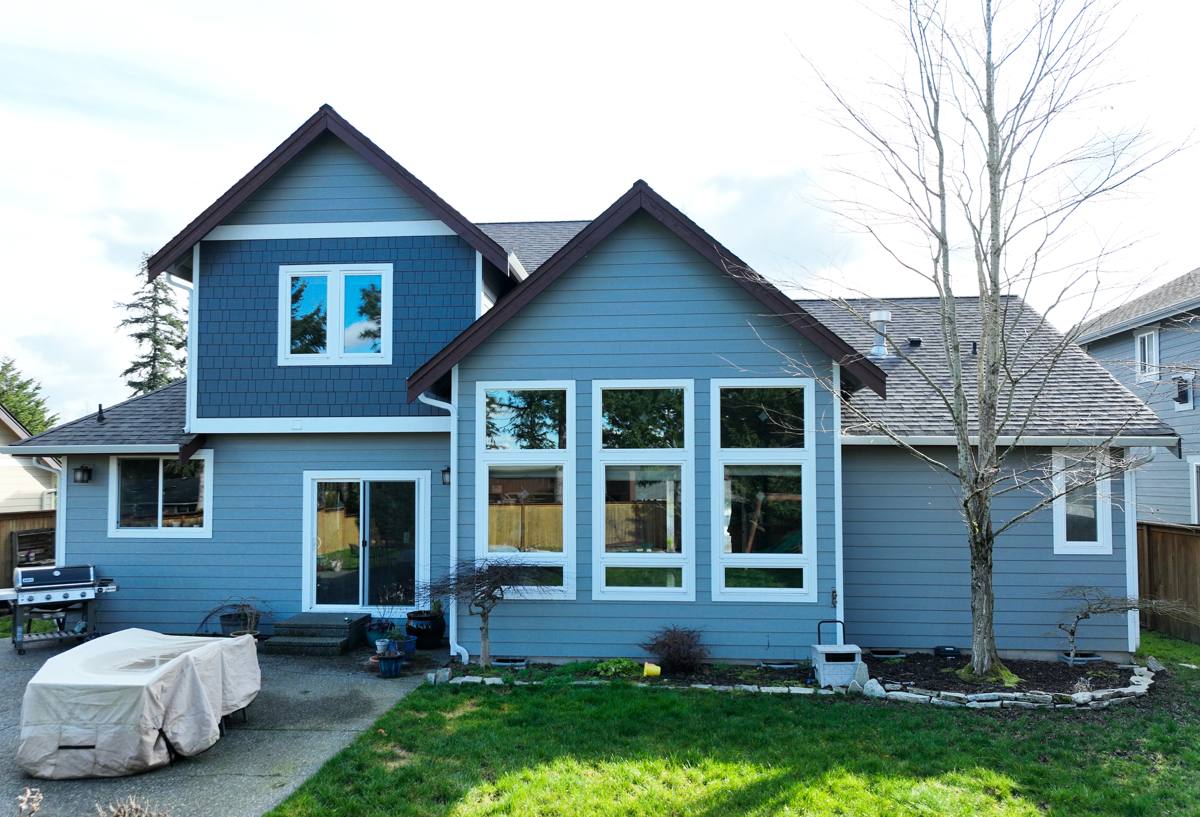
What the Marine Climate Actually Does to Siding
It helps to be specific about what's working against your siding on this side of Anacortes, because the failure points aren't hypothetical — they're predictable.
Salt Air
Airborne salt is corrosive. Over years, it attacks exposed metal fasteners, flashing, and trim, and it accelerates the breakdown of surface finishes — especially field-applied paint, which chalks and fades faster near the water than it would a few miles inland.
Driving Rain
Rain in West Anacortes doesn't just fall — wind off the water pushes it sideways into wall assemblies. That puts real stress on every seam, lap, and penetration in the siding system. A house can look fine from the curb for years while water is slowly working its way behind poorly flashed trim or an undersized gap.
A Long Moss Season
Consistent dampness and mild temperatures give moss and algae a long growing window here — longer than in drier parts of the state. Shaded walls, north-facing elevations, and horizontal surfaces like window sills and trim boards are the first places it takes hold, and it holds moisture against the siding once it does.
Why We Only Install James Hardie Fiber Cement Siding
We don't install vinyl, LP SmartSide, cedar, primed spruce, or other fiber cement brands. That's not a marketing position — it's a standard we hold because of what happens to alternative products in exactly the conditions West Anacortes homes deal with every year. Wood and engineered-wood sidings absorb moisture at cut edges and fastener points; over time in a wet climate, that leads to swelling, delamination, or rot, no matter how carefully they're installed. Vinyl can hold up reasonably well against moisture but flexes, fades, and becomes brittle with age and UV exposure, and it isn't a fire-rated material. Fiber cement, done right, avoids most of those failure modes because it's not an organic material and it doesn't rely on a field-applied coating to stay protected.
Engineered for This Climate Zone
James Hardie manufactures its siding in different formulations for different climate zones — a version engineered for wet, freeze-prone regions like ours behaves differently in the field than a version built for hot, humid climates. That distinction matters in a place like West Anacortes, where the product is dealing with rain and dampness far more than heat.
ColorPlus Factory Finish
Most of what we install uses Hardie's ColorPlus finish — a finish baked onto the board at the factory rather than sprayed or brushed on-site. It holds color and resists chalking and fading noticeably longer than field-applied paint, which matters directly here: salt air and UV are two of the fastest ways a painted finish breaks down. It also carries its own finish warranty, separate from the substrate warranty on the board itself.
What Correct Installation Involves
Fiber cement is only as good as the installation behind it. In a climate that pushes rain sideways into wall assemblies, the details most homeowners never see are the ones that determine whether siding lasts fifteen years or fifty.
- A weather-resistive barrier installed correctly behind the siding, lapped so water sheds outward rather than in
- Flashing at every window, door, and roof-to-wall intersection — not caulk used as a substitute for flashing
- Kick-out flashing wherever a roofline meets a sidewall, to keep runoff from dumping behind the siding
- Correct fastener type and placement, driven to manufacturer spec rather than overdriven, which cracks the board and opens a path for water
- Proper gapping and sealant at butt joints and trim, sized for the material's expansion and contraction
- Adequate clearance between the bottom edge of the siding and grade, decks, or patios, so the lowest courses aren't sitting in standing water or splash-back
Skip any one of these and the siding itself can be a good product on a house that still fails early. This is where a lot of the problems we get called out to inspect actually originate — not the material, the installation.
Fiber Cement vs. Other Siding Options in a Marine Climate
| Factor | James Hardie Fiber Cement | Vinyl | Cedar / Wood | Engineered Wood (e.g. LP SmartSide) |
|---|---|---|---|---|
| Moisture resistance | High — cement-based, not organic | Moderate — doesn't rot but can trap moisture behind it | Low without diligent upkeep | Moderate — vulnerable at cut edges and fastener points |
| Salt air / corrosion behavior | Good; finish resists chalking | Fair; can become brittle over time | Poor; finish breaks down faster near salt air | Fair; coating wears faster in marine exposure |
| Moss / algae resistance | Good, especially with factory finish | Fair; surface can hold organic growth | Poor; wood surface promotes growth | Fair; similar concerns to cedar at exposed edges |
| Maintenance | Low — occasional rinse, inspect caulking | Low, but repairs are limited to replacement | High — regular sealing/staining | Moderate — coating maintenance required |
| Fire rating | Non-combustible | Combustible | Combustible | Combustible |
No product is maintenance-free in this climate. The differences above are why fiber cement, installed correctly, tends to be the lowest-hassle option for homes taking direct exposure off the water.
Our Process for West Anacortes Projects
Every job starts with an honest look at what's actually happening behind the existing siding, not just what it looks like from the driveway.
Assessment
We check the walls that take the worst of the weather first — typically west- and south-facing elevations that catch prevailing wind and rain — along with any areas showing staining, soft spots, or moss buildup. This tells us whether we're dealing with a straightforward re-side or whether there's sheathing damage from a prior siding failure that needs to be addressed before new siding goes on.
Removal and Prep
Old siding comes off, sheathing gets inspected and repaired where needed, and we don't cover up rot — it gets fixed first. Skipping this step is one of the most common ways a new siding job fails early.
Water Management and Installation
Weather-resistive barrier, flashing at every penetration, and correct fastening come before a single course of Hardie siding goes up. The panels or lap siding are installed to manufacturer spec, with the gaps, clearances, and fastening patterns built for this climate, not a generic install.
Trim, Caulking, and Cleanup
Trim and caulking are finished last, using products compatible with the ColorPlus finish so the whole system — not just the field siding — is built to hold up to salt air and rain.
Keeping Your Siding Looking Right
Fiber cement is low-maintenance, not no-maintenance. A few habits go a long way in this climate:
- Rinse siding periodically with a garden hose, especially on walls facing open water where salt spray settles
- Keep gutters and downspouts clear so overflow isn't running down the siding and feeding moss growth
- Trim back shrubs and trees that keep a wall shaded and damp longer than the rest of the house
- Check caulking at trim joints, window and door surrounds, and butt joints once a year, and re-caulk where it's cracked or pulling away
- If moss or algae shows up, use a soft wash approach rather than a pressure washer, which can force water behind the siding or damage the finish
Why Hiring a Crew That Already Works West Anacortes Matters
A lot of siding problems in this part of town trace back to work done by crews used to drier, more sheltered conditions elsewhere in the state. Detailing that's adequate inland — lighter flashing, fewer fasteners, tighter gapping — doesn't hold up against wind-driven rain off the water. Knowing which elevations in West Anacortes take the worst weather, how long moss season actually runs here, and what Skagit County and City of Anacortes permitting requires for exterior work all comes from doing this specific job in this specific area repeatedly, not from a general siding background.
If your current siding is showing staining, soft spots, persistent moss, or a chalky, fading finish, or you're planning a re-side and want it done to hold up to this climate rather than just look good on installation day, we're happy to take a look and put together a straightforward, no-pressure estimate — use the form below to get started.