 Anacortes Siding
 Roofing on the Water's Edge
Flounder Bay sits right up against open saltwater on Fidalgo Island, and that location shapes everything about how a roof ages here. Homes a few blocks inland in Anacortes deal with plenty of rain, but roofs closer to the bay also take on salt-laden air, near-constant humidity, and wind that drives rain sideways under shingle edges and flashing laps that would stay dry almost anywhere else. None of that means a roof in Flounder Bay is doomed to fail early. It means the repair has to account for conditions a generic patch job doesn't.
We work on roofs throughout Anacortes and Skagit County, and the repairs we do near the water are consistently different from the ones a few miles inland — not in what tools we use, but in what we're watching for and how we detail the work so it actually holds up.
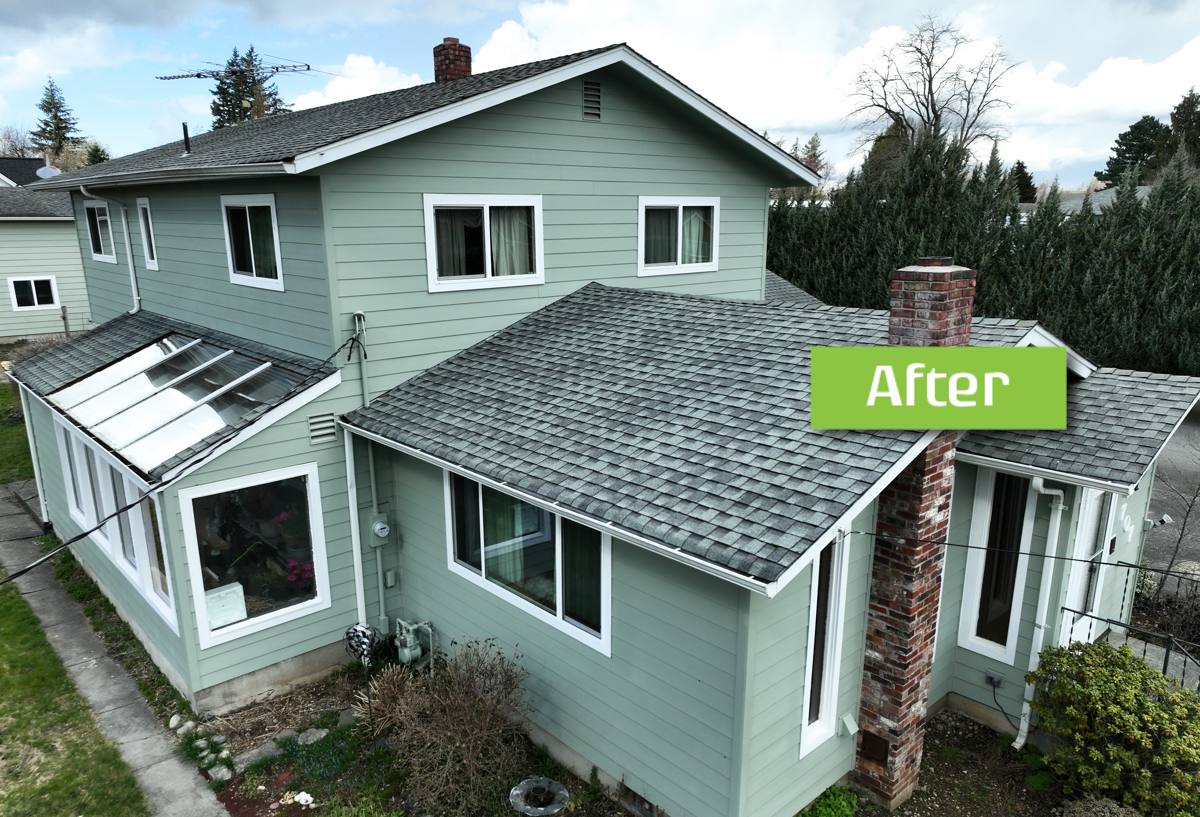
What the Climate Does to a Flounder Bay Roof
Salt Air and Metal Fatigue
Airborne salt accelerates corrosion on anything metal — nail heads, flashing, gutter fasteners, vent caps, even the exposed screws on a metal roof panel. On a standard roof, a fastener might slowly loosen over decades. Near saltwater, that same fastener can corrode enough to lose its grip in a fraction of that time, and a corroded nail under a shingle tab is one of the more common hidden causes of a leak that seems to come from nowhere.
Driving Rain
Flounder Bay's exposure to open water means wind-driven rain isn't occasional weather, it's a regular event. Rain that's being pushed sideways instead of falling straight down finds its way under shingle tabs, into poorly lapped flashing, and through nail holes that aren't properly sealed. A roof that would be watertight in calm rain can still leak here if the underlayment, flashing laps, and fastening pattern weren't built for wind-driven conditions in the first place.
Moss and Organic Growth
Western Washington's long, wet, mild-temperature stretch of the year is close to ideal for moss, and shaded or north-facing roof sections near the bay often stay damp longer than roofs in more exposed, sun-drenched spots. Moss doesn't just look bad — its root structure lifts shingle edges, holds moisture directly against the roofing material, and works its way into gaps that were never meant to hold water. A moss mat left untreated for a season or two turns small maintenance issues into real repair work.
Common Repair Calls We See in This Area
- Lifted or cracked shingle tabs along roof edges and ridges exposed to wind
- Flashing separation around chimneys, skylights, and roof-wall intersections
- Corroded or backed-out nails causing isolated leaks that are hard to trace from inside
- Moss buildup along north-facing slopes and valleys that stay shaded most of the day
- Clogged or corroded gutters causing water to back up under the roof edge
- Soft or stained roof decking where a slow leak has been going unnoticed
- Deteriorated pipe boots and vent seals letting water track down into the attic
Most of these start small. A single lifted shingle or a hairline gap in flashing isn't an emergency, but left through one more wet Skagit County winter, it becomes decking repair or an interior ceiling repair — a far bigger job than the roof work that would have prevented it.
What a Correct Repair Actually Involves
A roof repair that's done right isn't just "find the leak, cover the hole." It's a sequence, and skipping steps is how a repair fails again within a year or two.
1. Find the Real Source
Water travels. A stain on a ceiling or ripple in a wall often shows up several feet from where the water is actually entering the roof. We trace the path — checking flashing, fasteners, underlayment condition, and decking — before touching anything, so the fix addresses the actual cause instead of the visible symptom.
2. Match Materials, Not Just Color
Shingles, underlayment, and flashing all need to be compatible with what's already on the roof — not just visually close. Mismatched metals in flashing can accelerate corrosion through galvanic reaction, and shingles from a different product line can shed water differently than the surrounding field. A patch that looks fine on day one but behaves differently in the rain isn't a repair, it's a delay.
3. Detail for Wind-Driven Rain
Near the water, we lap flashing and step flashing generously, seal fastener penetrations, and pay close attention to any spot where wind can push water uphill against a normal water path. Standard installation practices that work fine a few miles inland sometimes need extra attention in a location this exposed.
4. Check What's Underneath
If decking is soft, stained, or delaminating, replacing shingles over it doesn't solve anything. Part of doing this correctly is being honest about when decking or additional structure needs attention before the roofing goes back down.
Repair or Replace? How We Help You Decide
Not every roof problem in Flounder Bay needs a full replacement, and not every leak is a quick fix. The right call depends on the roof's age, how widespread the damage is, and what's happening underneath the surface.
| Factor | Usually Points to Repair | Usually Points to Replacement |
|---|---|---|
| Roof age | Well within expected material lifespan | At or past the end of its expected service life |
| Damage location | Isolated to one section or feature | Spread across multiple slopes |
| Decking condition | Solid, no rot or delamination found | Soft, stained, or failing in more than a spot or two |
| Shingle condition overall | Granule loss and wear limited to the damaged area | Widespread granule loss, curling, or brittleness |
| Leak history | First or isolated occurrence | Repeated leaks in different spots over time |
We'll always tell you plainly which category your roof falls into. A roof that's a candidate for repair doesn't need a sales pitch for replacement, and a roof that's genuinely at the end of its life doesn't need us patching it repeatedly and charging you for it.
Materials and Fasteners: Why Marine-Grade Matters Here
Standard galvanized fasteners and mismatched flashing metals are common causes of early corrosion failure in coastal locations, and Flounder Bay's proximity to open saltwater puts it squarely in that category. On repairs in this area, we default to corrosion-resistant fasteners — stainless steel or heavy hot-dip galvanized, depending on the application — and we're deliberate about which metals touch which in flashing details, since dissimilar metals in contact with each other can corrode faster than either would on its own.
| Component | Standard-Environment Choice | Our Approach Near Flounder Bay |
|---|---|---|
| Roofing nails/fasteners | Electro-galvanized | Hot-dip galvanized or stainless |
| Flashing metal | Basic galvanized steel | Metal matched to surrounding materials to limit galvanic corrosion |
| Gutter hardware | Standard fasteners | Corrosion-resistant fasteners and hangers |
It costs a little more up front. It also means the repair is still doing its job in ten years instead of needing to be redone in three or four because the fasteners gave out before the shingles did.
Our Roof Repair Process
- Inspection. We get on the roof (weather permitting) and in the attic if accessible, tracing the actual water path rather than guessing from ground level.
- Honest assessment. We explain what we found, what's causing it, and whether it's a repair, a larger repair, or something pointing toward replacement — in plain terms, no pressure either direction.
- Written estimate. You get a clear scope of work and price before anything happens, no vague allowances.
- The repair itself. Matched materials, corrosion-resistant fasteners, proper flashing laps, and decking addressed if it needs it — not just covered over.
- Cleanup and walkthrough. Debris and old material hauled off, and we show you what was done and why.
Moss and Ongoing Roof Health
A repair fixes the immediate problem, but in a shaded, damp environment like much of Flounder Bay, ongoing moss and debris management is what keeps a repaired roof from needing the same attention again in a couple of years.
- Keep gutters and downspouts clear so water isn't sitting against the roof edge
- Clear overhanging branches where practical to reduce shade and debris buildup
- Have moss treated or removed before it establishes a thick mat, not after
- Check flashing around chimneys, skylights, and vents at least once a year
- Watch for granules collecting in gutters, a sign of shingle wear worth having looked at
- Address small leaks promptly rather than waiting for a wet-season worst case
Why a Crew That Already Works Flounder Bay Matters
A roof repair contractor who mainly works inland can still do competent work, but they're often applying general practices to a location that doesn't behave like a general location. Working repeatedly in Flounder Bay and similar waterfront pockets of Anacortes means we already know to expect wind-driven rain from a particular direction, to plan for tighter or view-conscious lot access, and to spec fasteners and flashing that hold up against salt air by default rather than as an afterthought. That familiarity shows up in fewer callbacks and repairs that are still solid years later, not just at the final walkthrough.
We're also familiar with the access realities of waterfront and hillside properties in this part of Anacortes — narrower driveways, steeper lots, and neighbors close enough that we plan our work to be considerate of the whole street, not just the one roof we're on.
Get an Honest Look at Your Roof
If you're dealing with a leak, missing shingles, moss buildup, or just want a second opinion on a roof's condition before the next round of Skagit County storms rolls through, we're happy to take a look. The estimate is free, there's no pressure to move forward, and you'll get a straight answer about whether you're looking at a repair or something bigger. Fill out the form below to get started.