 Anacortes Siding
 Why Guemes Island Decks Wear Out Faster Than You'd Expect
Guemes Island sits right in the marine weather that moves through the San Juans and up the Skagit County coastline, and that weather is harder on a deck than most homeowners realize until they're standing on soft boards. A deck on Guemes Island isn't dealing with one problem — it's dealing with three at once: salt-laden air off the water, wind-driven rain that gets up under railings and into end grain, and long stretches of shade and dampness that keep surfaces from ever fully drying out. Any one of those will shorten a deck's life. Together, they're why we see decks on the island fail structurally 10-15 years before a comparable deck built inland.
Salt Air and Marine Exposure
Salt in the air doesn't just dull finishes — it accelerates corrosion in every metal fastener, bracket, and connector holding the deck together. On waterfront and near-waterfront lots, we routinely find galvanized nails and standard deck screws that have rusted through in half the time you'd expect anywhere else in Anacortes. Once fasteners start failing, the framing they're holding starts moving, and movement opens gaps that let water in — which speeds up rot underneath.
Driving Rain and Wind-Driven Moisture
Rain here rarely falls straight down. Wind off the Guemes Channel and Rosario Strait pushes it sideways, which means it gets driven under railings, into the gaps between deck boards, and behind ledger boards that weren't flashed correctly the first time. A deck that would shed water fine in a calm rain can still end up soaked at every joint and seam during a typical Skagit County storm.
Moss, Shade, and Slow-Drying Surfaces
Guemes Island's tree cover and marine humidity add up to a long moss season — often eight or nine months of the year where surfaces stay damp longer than they dry. Moss and algae hold moisture directly against the decking surface, and on wood that moisture works its way into checks and cracks. On composite, it's mostly cosmetic, but on real wood it's a direct path to rot, especially where boards run tight against each other with no airflow underneath.
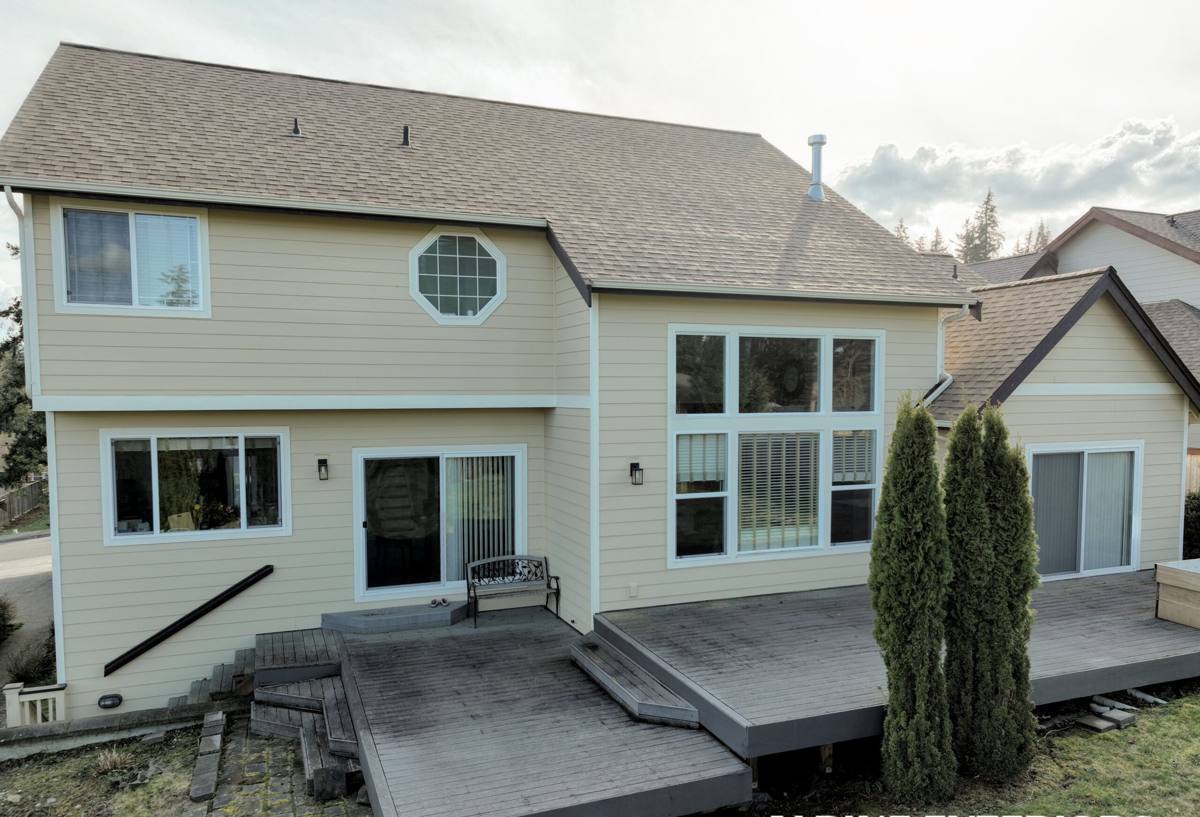
Signs Your Guemes Island Deck Needs Replacing, Not Just Repair
Not every deck problem calls for a full rebuild. But there's a point where patching individual boards is throwing money at a structure that's already compromised underneath. Here's what tells us a deck is past the point of repair:
- Soft, spongy spots anywhere on the decking surface, especially near the house or along the rim joist
- Visible rust bleeding from fastener heads or brackets, or fasteners that back out on their own
- A ledger board (where the deck attaches to the house) that's dark, swollen, or separating from the siding
- Railings or posts that flex or wobble when pushed — this is a safety issue, not a cosmetic one
- Persistent moss or black staining that comes back within weeks of cleaning, even after treatment
- Footings that have shifted, cracked, or heaved, changing how level the deck sits
- A deck older than 15-20 years that's never had the substructure inspected or opened up
If you're only seeing surface graying or minor splintering on a deck that's otherwise solid underneath, that's usually a refinishing or board-replacement job, not a full rebuild. We'll tell you honestly which category your deck falls into before we quote anything.
What a Correct Deck Replacement Actually Involves
A deck replacement done right isn't just swapping old boards for new ones on top of whatever framing is already there. On Guemes Island in particular, cutting that corner just means the new decking fails on the same schedule the old decking did.
Substructure First
We start below the surface — footings, posts, beams, joists, and the ledger connection. Any framing member showing rot, insect damage, or fastener corrosion gets replaced, not patched. Footings that are undersized or improperly set for the soil conditions get corrected as part of the rebuild, not left as-is because "they've held this long."
Decking Material Choice
What goes on top depends on the home, the budget, and how much maintenance the owner actually wants to do — we'll walk through the real trade-offs in the material comparison below rather than push one product for every job.
Marine-Rated Fasteners and Hardware
Given the salt exposure across most of the island, we build with stainless steel or heavy-duty coated fasteners rated for coastal use, not the standard galvanized hardware that's fine 20 miles inland but corrodes fast here. The same goes for joist hangers, post bases, and any structural connectors — coastal-rated hardware costs more up front and is the difference between a deck that lasts and one that needs its fasteners replaced in a decade.
Drainage, Flashing, and Airflow
Every ledger connection gets proper flashing so water is directed away from the house structure, not into it. We also make sure decking has consistent spacing and the substructure has airflow underneath — a deck that can't breathe stays damp longer, which is exactly what feeds moss and rot in this climate.
Comparing Decking Materials for Guemes Island Conditions
There's no single "best" decking material for every home on the island — it depends on how close you are to the water, how much shade the deck sits in, and how much upkeep you want to do. Here's how the common options actually perform under the conditions we see locally:
| Material | Moss / Algae Resistance | Salt Air Performance | Maintenance | Typical Lifespan |
|---|---|---|---|---|
| Cedar or pressure-treated wood | Needs regular cleaning and treatment to resist growth | Requires diligent sealing near the water; end grain is vulnerable | Annual cleaning, periodic sealing or staining | 10-20 years with upkeep |
| Composite decking | Resists staining better; some growth still needs washing off | Handles salt exposure well; core doesn't rot | Occasional washing, no sealing or staining | 25-30+ years |
| PVC / capped polymer | Fully capped surface sheds moss and algae easiest | Excellent — no organic material for salt or moisture to break down | Lowest — rinse as needed | 25-30+ years |
We install real wood decks when that's what the homeowner wants — there's nothing wrong with cedar on a covered, well-ventilated deck maintained on schedule. But on an exposed, shaded, or waterfront lot on Guemes Island, we'll say plainly that a capped composite or PVC product will save you money and headaches over the life of the deck, because it isn't fighting the moss season the way wood is.
Working on Guemes Island: Ferry Logistics and Local Know-How
Guemes Island is only reachable by ferry, and that changes how a deck project has to be planned — not just executed. Material deliveries, crew scheduling, and equipment access all have to account for ferry sailing times, which means a contractor who doesn't regularly work the island will underestimate the project timeline or show up with the wrong plan for getting lumber and tools across.
Because we already work on Guemes Island regularly, we plan material loads and crew days around the ferry schedule from the start, so you're not paying for wasted trips or delays caused by a crew figuring out island logistics for the first time on your job. It also means we already understand which parts of the island sit closest to the water and need the most conservative material and hardware choices, versus more sheltered, wooded lots where standard coastal-grade materials are plenty.
Our Deck Replacement Process
- On-site assessment — we inspect the full structure, including opening up sections of decking to check the framing underneath, not just a visual walk-around.
- Honest scope and estimate — you get a clear breakdown of what's being replaced, what materials we recommend and why, and a real cost range before any work starts.
- Permitting — we handle the Skagit County permit process for work that requires it, based on the size and structural scope of the project.
- Demolition and disposal — old decking and any compromised framing is removed and hauled off, including a load-out plan that accounts for ferry access.
- Framing and structural rebuild — footings, posts, beams, and joists are corrected or replaced as needed, with coastal-rated hardware throughout.
- Decking, railing, and stair installation — installed to manufacturer spec with proper spacing and fastening for the material chosen.
- Final walkthrough — we go over the finished deck with you, including care instructions specific to the material installed.
Permitting and Code Considerations
Most full deck replacements in Skagit County — especially anything involving structural framing, footings, or a deck attached above a certain height — require a building permit. Guardrail height, baluster spacing, and stair requirements are all governed by code, and a deck built or rebuilt without meeting current requirements can become a liability and a resale problem down the line. We pull the necessary permits and build to current code as a standard part of every replacement, not an upsell.
Keeping a New Deck Ahead of the Moss Season
A correctly built deck still needs some seasonal attention on Guemes Island — the climate doesn't change because the deck is new. A yearly rinse and a soft-bristle sweep to clear debris before it composts into organic material for moss to take hold in goes a long way, especially heading into fall. Wood decks need their sealer or stain checked annually; composite and PVC decks mostly just need to stay clear of leaf litter and standing water. We'll walk you through the specific maintenance schedule for whatever material we install, since wood, composite, and PVC each ask for something a little different.
If you're dealing with a soft, aging, or moss-covered deck on Guemes Island, we're happy to come take a look and give you a straight answer on whether it needs a full replacement or just targeted repair. Reach out using the form below for a free, no-pressure estimate.