 Anacortes Siding
 Roof Damage on Guemes Island Looks Different Than It Does Inland
Guemes Island sits out in Skagit County's marine weather, and that changes what "storm damage" actually means for a roof out here. On the mainland side of Anacortes, a roof might mostly deal with rain volume. On the island, you're getting that same driving rain plus higher, less-obstructed wind off Rosario Strait and Guemes Channel, more direct salt spray, and a slower drying cycle because trees and moisture hang around longer between storms. A roof that would shrug off a windstorm in a sheltered inland neighborhood can lose shingles, flashing, or ridge caps on Guemes because there's simply less standing between the house and the weather.
That combination is why storm damage repair here needs to be treated as its own job, not a smaller version of what we'd do in town. The ferry schedule alone changes how repairs get planned and staged. We factor that in up front so a repair doesn't turn into a multi-week wait because materials or a second trip got missed on a sailing.
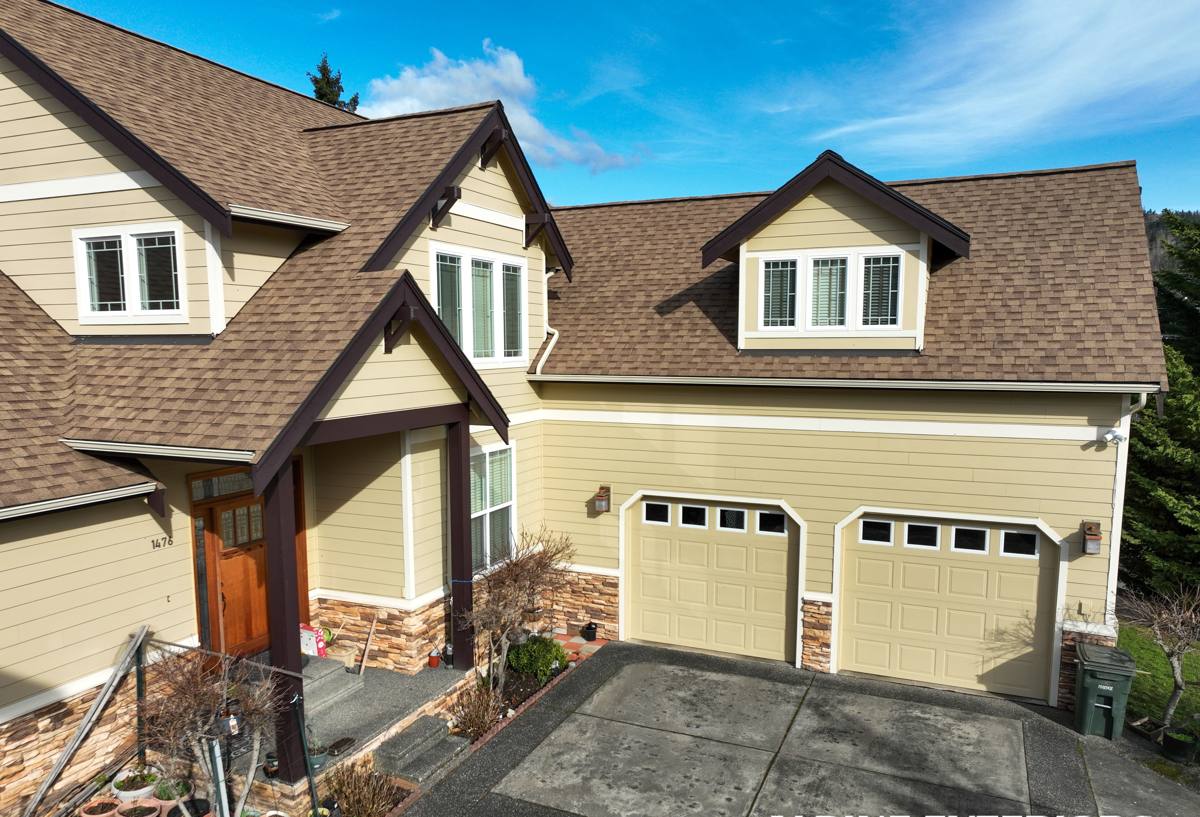
What Actually Causes Storm Damage Out Here
Wind Off the Water
Guemes Island roofs catch wind with fewer windbreaks than roofs tucked into Anacortes neighborhoods. Gusts coming across open water can get up under shingle tabs, lift ridge cap, or peel back the edges of a roof where fastening was already marginal. Once wind gets a starting point — a lifted tab, a loose piece of flashing — it works that spot on every subsequent storm until something tears loose completely.
Driving Rain and Wind-Driven Water
Storms here rarely drop rain straight down. Wind pushes it sideways and up under laps, edges, and flashing that would stay dry in a calm rain. This is how a roof can look intact from the ground after a storm but still be leaking — the water got in sideways, not through an obvious hole.
Salt Air
Being surrounded by saltwater means metal roofing components — flashing, fasteners, vent caps, gutter hardware — corrode faster here than they would a few miles inland. Corrosion weakens metal at exactly the points that are supposed to keep water out: valleys, step flashing, and penetrations around chimneys and vents. A storm doesn't have to be severe to finish off a flashing detail that salt air has already been quietly working on for years.
Moss and the Long Wet Season
Western Skagit County's moss season runs long, and Guemes Island's tree cover and moisture hold onto that dampness even longer. Moss doesn't just look bad — it holds water against the roofing material, works itself under shingle edges, and adds weight. A storm can dislodge moss-loosened shingles that would have otherwise stayed put, and moss-clogged valleys and gutters back water up under roofing during heavy rain, which often gets misread as a "storm damage" leak when the real problem is a maintenance issue that a storm exposed.
How to Tell If Your Roof Actually Needs Storm Repair
Not every roof needs a full repair after a windstorm, and not every leak after a storm is storm damage. Here's what we actually look for:
- Shingles that are missing, cracked, curled at the edges, or creased from wind flex
- Granules collecting in gutters or at downspout outlets in unusual amounts right after a storm
- Lifted, bent, or missing flashing around chimneys, vents, skylights, and roof valleys
- Ridge cap that's loose, cracked, or partially blown off
- New or worsened ceiling stains, especially near exterior walls or chimneys, showing up within a day or two of a storm
- Debris impact marks — branches or wind-thrown debris are common on tree-lined island lots
- Soft or spongy spots on a walk-across inspection, which usually mean water has already gotten into the decking
A single missing shingle in the middle of a roof field is a small, fast fix. Damage clustered at an edge, ridge, or valley is worth a closer look, because those are the spots where a small storm event and years of salt-air corrosion tend to combine.
What a Correct Storm Damage Repair Involves
Storm repair done right isn't just replacing what's visibly missing. It's finding out why that spot failed and making sure the fix holds up to the next storm, not just this one.
1. Full-Roof Inspection, Not Just the Obvious Spot
We check the whole roof, not only where the homeowner spotted damage from the ground. Wind damage is often worse on the leeward or upwind side depending on how the storm tracked, and there's frequently a second problem area that isn't visible from the yard.
2. Decking Check at Every Repair Point
Any spot where shingles are missing gets checked for wet or soft decking underneath. Replacing shingles over damaged decking is a short-term fix that fails again in the next storm. If decking is compromised, that gets addressed as part of the repair, not left for later.
3. Flashing and Penetration Review
Given how much salt air affects metal out here, storm repair on Guemes Island almost always includes a look at flashing condition — not just at the damaged spot, but at chimneys, vents, and valleys generally. Replacing shingles while leaving corroded flashing in place just moves the next leak a few feet over.
4. Matching Materials Correctly
Shingle color and profile changes over a few years of UV exposure, so a patch repair on an older roof won't always disappear visually — we're upfront about that rather than promising an invisible match we can't guarantee. What we do guarantee is that the repair performs correctly, ties into the existing roofing properly at the laps and fasteners, and doesn't create a new weak point.
5. Fastening Built for Wind Exposure
Repairs on exposed, water-facing roofs get fastened with wind exposure in mind — correct nail placement and count, proper sealing at ridge and hip caps, and attention to any spots where the original installation was under-fastened for a site this exposed.
Temporary vs. Permanent Repair: What Homeowners Should Know
After a bad storm, especially if a leak is active, the priority is stopping water intrusion, not necessarily doing the final repair on day one. We're honest about which is which so there are no surprises.
| Situation | Typical Response | Why |
|---|---|---|
| Active leak during or right after a storm | Temporary tarp or dry-in to stop water intrusion | Stops interior damage while materials or scheduling catch up; ferry-dependent access can add a day or two on Guemes |
| Isolated missing/damaged shingles, no active leak | Direct permanent repair | Straightforward fix, no reason to delay |
| Damaged or corroded flashing at valleys/penetrations | Permanent repair, may require partial reroofing of that section | Flashing failures repeat if not fully corrected, not just patched |
| Wet or soft decking discovered under damage | Decking replacement before new roofing goes on | New shingles over bad decking fail again quickly |
| Widespread damage across an aging roof | Repair now, with an honest conversation about remaining roof life | Sometimes a repair is the right call now, with replacement planned ahead rather than reactive |
Our Process for Guemes Island Storm Repairs
We work Guemes Island regularly, which matters more here than it does for a mainland Anacortes address, because access and timing work differently on an island.
- Contact and initial assessment — we talk through what you're seeing (missing shingles, a leak, storm timing) to understand urgency before anyone drives out.
- On-site inspection — we walk the roof and check decking, flashing, and fastening at every damaged area, plus a general condition check of the rest of the roof.
- Written scope and estimate — you get a clear explanation of what's actually damaged, what caused it, and what the repair involves, in plain language, before any work starts.
- Trip and material planning — because of ferry scheduling, we plan material needs and crew timing so a repair isn't held up mid-job waiting on a second sailing.
- The repair — decking, flashing, and roofing addressed together, not just the visible symptom.
- Final walkthrough — we show you what was done and what to watch for, particularly around moss and drainage given how long the wet season runs here.
Why It Matters to Hire a Crew That Already Works This Island
Storm damage repair on Guemes Island isn't just a smaller version of a mainland job. A crew that doesn't regularly work the island can underestimate two things: how much more exposed a given roof is compared to a similar-looking roof in town, and how much the ferry adds to scheduling if a return trip is needed for materials or a follow-up detail. Neither of those is a big deal if it's planned for from the start — but both turn into delays and repeat trips if they're not.
Working Guemes Island regularly also means we've seen how different lots on the island handle wind and moisture differently — tree-sheltered interior lots versus open, water-facing ones — and that shapes what we look for during inspection and what fastening and flashing details we prioritize on the repair.
Preventing the Next Storm From Doing the Same Damage
A storm repair is a good moment to address the conditions that made the damage worse than it needed to be, not just the immediate fix.
- Clear moss and debris from valleys and gutters before the next wet season builds up — this is the single biggest preventable contributor to storm-related leaks we see on the island
- Check flashing condition on a normal schedule given how much faster salt air corrodes metal here than inland
- Trim back branches that overhang the roof, since wind-thrown debris is a recurring cause of storm damage on tree-lined lots
- Address any known weak points — a previously patched area, an older flashing detail — before they fail during the next windstorm rather than after
- Keep gutters and downspouts flowing freely so wind-driven rain has somewhere to go instead of backing up under roofing edges
None of this prevents every storm from causing damage — Guemes Island's exposure means that's not realistic — but it meaningfully reduces how often a normal storm turns into an emergency repair.
What This Typically Involves, Cost-Wise
Every storm repair is different, and we won't quote a number without seeing the roof, but the general cost drivers are consistent:
| Factor | Effect on Cost |
|---|---|
| Number and location of damaged areas | A single isolated spot costs far less than damage spread across multiple areas of the roof |
| Decking condition underneath | Dry decking keeps a repair simple; wet or soft decking adds material and labor to replace it |
| Flashing involvement | Repairs limited to shingles cost less than repairs that also require new flashing at valleys or penetrations |
| Roof access and pitch | Steeper roofs and harder-to-reach areas take more time and equipment |
| Material matching and availability | Older or discontinued shingle profiles can take longer to source a close match |
| Site logistics | Ferry scheduling can affect trip planning and, occasionally, timeline more than cost directly |
Most isolated storm repairs are a modest, single-visit cost. Jobs involving decking replacement or significant flashing work cost more because they involve more labor and material, not because of markup — we walk through exactly what's driving the number before any work begins.
Get an Honest Look at the Damage
If a recent storm left your Guemes Island roof with missing shingles, a new leak, or damage you're not sure how serious it is, it's worth having it looked at before the next system rolls through. We offer a free, no-pressure estimate — we'll tell you plainly what we find, what it will take to fix it correctly, and what can reasonably wait. Fill out the form below to get started.