 Anacortes Siding
 Why Mount Vernon Decks Wear Out Faster Than the Brochure Says
Mount Vernon sits inland from the water compared to Anacortes proper, but it's still squarely inside Skagit County's marine climate, and that means the same slow, patient damage shows up on decks here that shows up on the coast — just on a slightly different timeline. Salt-laden air off Fidalgo Bay and the Sound rides inland on prevailing winds, driving rain soaks into end grain and fastener holes, and a long, mild, wet stretch from fall through spring gives moss and algae months to get established on any deck surface that doesn't dry out quickly. None of that is dramatic on its own. It's the accumulation — season after season of moisture cycling in and out of wood and hardware — that eventually shows up as soft boards, rusted fasteners, and a structure that doesn't feel as solid underfoot as it used to.
A deck built or repaired without that climate in mind will usually look fine for the first few years. The problems tend to surface in year five, six, or seven, right around when a homeowner assumes a deck is "done" and stops thinking about it. That's the gap we focus on closing.
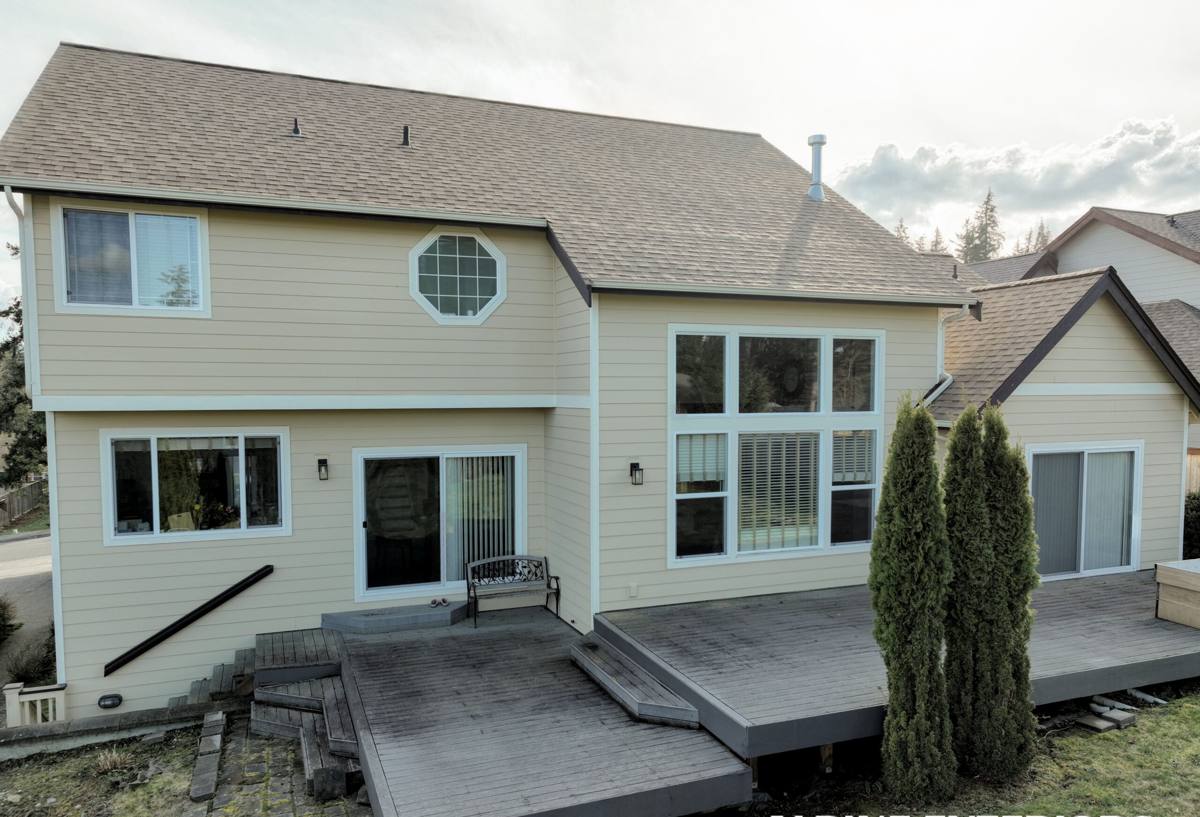
Signs a Mount Vernon Deck Needs Repair — Not a Full Rebuild
Most decks we look at in this area don't need to be torn out. They need targeted work on the parts that actually fail first. Here's what we watch for:
- Boards that feel spongy or flex more than their neighbors when you step on them
- Fastener heads that have rusted, popped up, or stained the wood around them
- Gaps opening between boards, or boards cupping so water pools instead of running off
- Persistent green or black growth in shaded spots that pressure washing only knocks back temporarily
- A ledger board (where the deck attaches to the house) that shows staining, gaps, or soft wood — often the single most safety-critical spot on the whole structure
- Railings or posts that wiggle more than they should, especially near the base where moisture collects
- Visible rust bleed on fasteners or connectors, which usually means the metal underneath is compromised, not just cosmetically stained
If the damage is isolated to a few boards, the railing system, or the surface finish, repair is almost always the right call — it's less disruptive and less expensive than a rebuild, and it extends the life of a structure that's often still structurally sound underneath.
What a Correct Deck Repair Actually Involves
Structural Framing First
Before we touch a single board on the surface, we check what's underneath: joists, beams, posts, and footings. A deck can look fine on top and still have a joist that's been slowly rotting from moisture trapped against the framing. Any repair that skips this step and just replaces the visible boards is only fixing the part you can see.
The Ledger Board and Flashing
This is where the deck meets the house, and in a climate like ours it's the number one place we find hidden damage. If flashing was installed poorly — or not at all — water gets channeled directly behind the ledger board and into the rim joist, sometimes for years, before it ever shows up as a visible problem. A proper repair means pulling back decking near the house, inspecting the ledger and flashing, and correcting the water path, not just caulking over a symptom.
Decking Boards and Fasteners
Individual board replacement only works well when the fasteners go in correctly the first time — proper spacing for expansion and contraction, corrosion-resistant hardware rated for treated lumber or composite, and attention to how each board sheds water rather than holding it against the joist below.
Railings, Stairs, and Guards
Railing posts take a different kind of abuse than the deck surface — they're often the last thing to get resealed or repainted, and the base of a post is exactly where standing moisture likes to collect. We check post attachment, baluster spacing against current code, and stair stringer condition as part of any repair scope, even if that's not what the homeowner originally called about.
Repair vs. Replacement: What Actually Drives the Decision
| Factor | Leans Toward Repair | Leans Toward Replacement |
|---|---|---|
| Framing condition | Joists and beams are solid, damage is limited to surface boards | Multiple joists or the ledger show rot or structural softness |
| Age of structure | Under 10-15 years, built to a reasonable original standard | Older structure nearing the end of typical service life |
| Extent of damage | Isolated boards, railing sections, or fastener issues | Damage spread across most of the deck surface and framing |
| Original construction quality | Sound layout, adequate footings, reasonable flashing | Undersized footings, missing flashing, or code gaps throughout |
| Budget goals | Lower upfront cost, extends usable life several more years | Higher upfront cost, resets the clock and allows layout changes |
We'll give you an honest read on which side of that table your deck falls on. There's no reason to pay for a full rebuild when a repair will hold up, and there's no reason to keep patching a structure whose framing is genuinely failing.
Our Process When We Come Out to Mount Vernon
- Full inspection. We check framing, ledger and flashing, surface boards, railings, stairs, and hardware — not just the spot you called about.
- Honest scope and estimate. You get a clear picture of what actually needs fixing, what's optional, and roughly what it costs, before any work starts.
- Repair the root cause first. If water intrusion or a flashing failure caused the damage, that gets corrected before we replace anything cosmetic — otherwise the new material fails the same way.
- Match materials and fasteners correctly. Replacement boards and hardware are chosen to hold up in a wet, salt-influenced climate, not just to match on day one.
- Final walkthrough. We check that boards drain properly, railings are solid, and nothing was left as a "we'll get to it later" item.
Materials: What Holds Up Here and What We Steer Away From
Untreated or minimally treated lumber struggles in this climate — it looks fine when it's fresh, but without consistent maintenance it doesn't shed moisture well over multiple wet seasons. Pressure-treated framing lumber, properly fastened with corrosion-resistant hardware, remains a solid and economical choice for structural components that will be covered by decking boards. For the visible surface, homeowners generally choose between treated wood, cedar, and composite decking, each with real trade-offs:
| Material | Maintenance | Moisture Behavior | Typical Trade-off |
|---|---|---|---|
| Pressure-treated wood | Needs periodic sealing/staining | Good if maintained, prone to cupping if neglected | Lower upfront cost, more upkeep |
| Cedar | Regular sealing to hold appearance | Naturally decay-resistant but still needs care | Attractive, higher maintenance than composite |
| Composite decking | Minimal — occasional cleaning | Doesn't rot, but board and fastener choice still matters at seams | Higher upfront cost, less long-term upkeep |
We don't push one product over another as a blanket rule — we walk through the maintenance commitment, budget, and how the deck gets used, and let that drive the recommendation.
Maintenance That Actually Extends a Mount Vernon Deck's Life
- Sweep debris off the deck regularly — trapped leaves and needles hold moisture against boards
- Rinse or lightly wash moss and algae growth before it gets a foothold, especially on shaded north-facing sections
- Reseal or restain wood decking on the schedule the product actually calls for, not "whenever it looks bad"
- Check fastener heads once a year for early rust staining
- Keep gutters and downspouts clear near the deck so runoff isn't dumping directly onto it
- Look under the deck once a season — problems in the framing show up from below long before they show up on top
Why a Crew That Already Works Mount Vernon and Skagit County Matters
Deck repair done by someone unfamiliar with this region tends to treat every deck the same way, regardless of climate. A crew that regularly works Mount Vernon, Anacortes, and the rest of Skagit County knows where water actually collects on decks built here, which fastener and flashing choices hold up through a real wet season instead of just the first year, and how moss establishes differently depending on a deck's orientation and shade pattern. That local pattern recognition is the difference between a repair that fixes the visible problem and one that fixes the actual cause.
Being local also means we're not guessing about permitting or inspection expectations for the county, and we're around after the job is done if a question comes up — not a one-time crew passing through.
Permits and Code: What to Expect
Not every deck repair requires a permit — replacing a handful of boards or resealing a surface generally doesn't. Structural work, however, including ledger reattachment, railing modifications, or framing repairs, can trigger permit requirements under Skagit County's building code. We'll tell you upfront if your scope of work is likely to need one, and we build code-current railing height and baluster spacing into any railing repair regardless of whether a permit is required, since that's a safety issue first and a code issue second.
If your deck in Mount Vernon is showing soft spots, rust stains, moss that keeps coming back, or a railing that doesn't feel as solid as it used to, we're happy to take a look. Reach out for a free, no-pressure estimate — use the form below and we'll get back to you with an honest assessment of what your deck actually needs.