 Anacortes Siding
 Sedro-Woolley's Climate Is Different From the Coast — But Just as Hard on Siding
Sedro-Woolley sits up the Skagit Valley, inland from the saltwater that pounds waterfront homes on Fidalgo Island and along the Anacortes shoreline. That's worth saying plainly: if a contractor tells you Sedro-Woolley has the same salt-air exposure as a bluff house on the water, they haven't spent much time here. What Sedro-Woolley does have is its own set of problems, and in some ways they're tougher on siding than salt spray is.
The valley traps moisture. Driving rain off the Cascade foothills settles in, humidity lingers under the tree canopy that shades so many older Sedro-Woolley lots, and the sun that would normally dry out a wall doesn't reach it for long stretches of the year. The result is a moss and algae season that can run nearly year-round on north-facing walls and anything tucked under fir or cedar trees. Add in the freeze-thaw swings Skagit County gets in a cold snap, and you've got a climate that rewards siding built to shed water fast and resist rot — not siding that just looks good going up.
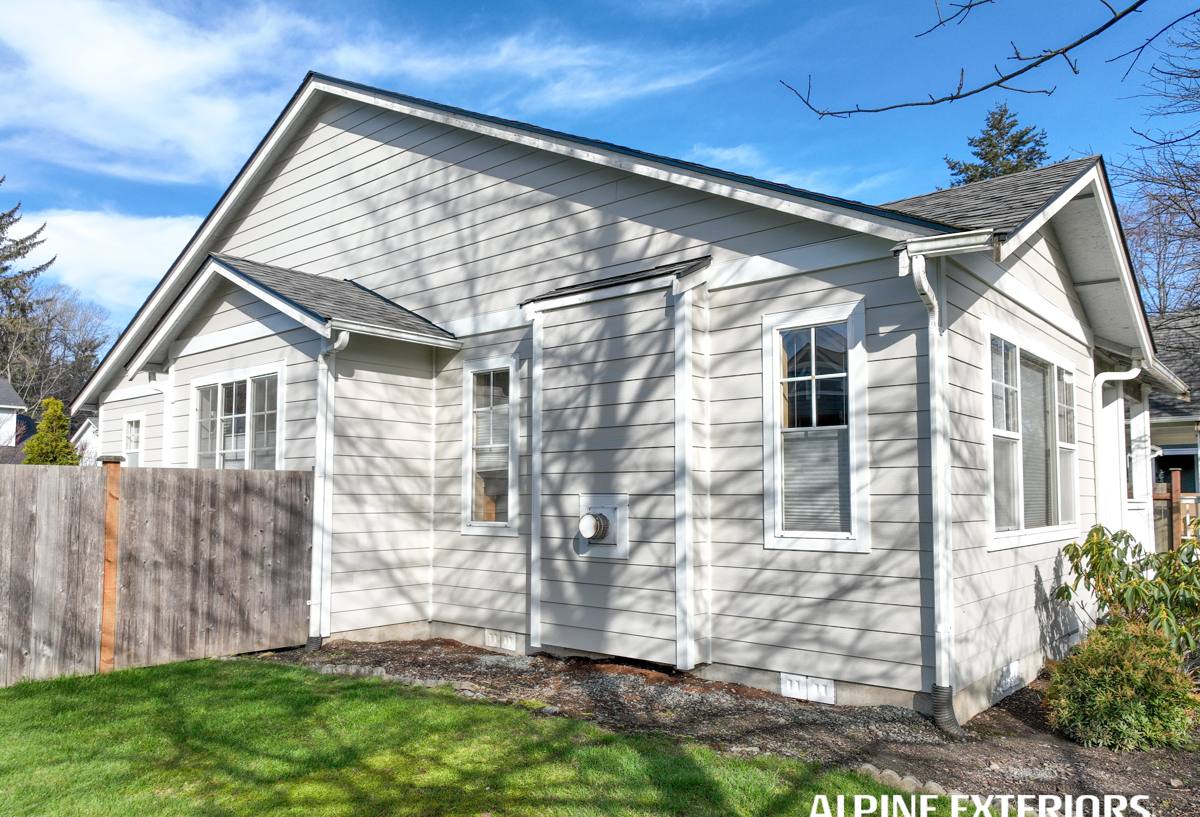
Why We Standardized on James Hardie for Homes in This Valley
We install James Hardie fiber cement siding exclusively. We don't install vinyl, LP SmartSide, Cemplank, Allura, primed spruce, or cedar, and in a climate like Sedro-Woolley's, that's not a marketing position — it's a practical one.
Engineered for This Moisture Zone
Hardie's HZ10 product line is engineered specifically for the wetter, cooler climate zones of the Pacific Northwest. Fiber cement doesn't absorb water the way wood-based products do, and it doesn't warp or swell when it stays damp for weeks at a stretch, which is exactly what happens on a shaded Skagit Valley wall through the fall and winter.
A Factory Finish That Holds Up Without Direct Sun
ColorPlus factory-applied finish is baked on and cured before the boards ever reach the jobsite, so the color and the protective topcoat aren't relying on UV exposure to fully set the way field-applied paint can. That matters here — a lot of Sedro-Woolley siding sits in dappled shade most of the day, and finishes that need full sun to cure properly don't get it.
Non-Combustible
Sedro-Woolley backs up to timberland and rural acreage more than most Anacortes-area neighborhoods do. Fiber cement won't ignite from wind-blown embers, which is a real consideration for homes closer to forested edges, even without a specific fire event to point to.
What a Correct Installation Actually Involves
Hardie siding fails early almost exclusively because of installation mistakes, not product defects. In a wet valley climate, the margin for error is smaller, because any gap in the water management gets exploited by moisture that never fully dries out.
- A drainable house wrap or building paper installed shingle-style, lapped correctly at every seam
- A rainscreen gap (furring strips or a drainable wrap mat) so water behind the siding has somewhere to go besides the sheathing
- Z-flashing over every window, door, and horizontal trim board — not caulk used as a substitute for flashing
- Minimum ground clearance maintained so splash-back and soil contact don't wick moisture into the bottom course
- Fasteners driven to the depth and spacing Hardie specifies, not overdriven, which crushes the board's edge and opens a path for water
- Caulk used only at the joints Hardie's install guide calls for — over-caulking traps moisture in more than it keeps it out
- Field-cut edges sealed or back-primed before installation, especially at inside corners
None of this is complicated, but it's easy to skip when a crew is moving fast, and none of it is visible once the siding is up. It only shows up two or three winters later as a stain, a soft spot, or a section that's holding water behind it.
Hardie Product Lines That Fit Sedro-Woolley's Housing Stock
Sedro-Woolley has a mix of older farmhouse and craftsman-style homes closer to town, newer construction on the edges, and a fair number of houses with mixed siding profiles from past additions. Hardie's lineup covers all of it.
| Product | Best Fit | Why It Works Here |
|---|---|---|
| HardiePlank Lap Siding | Traditional and craftsman-style homes | Classic horizontal reveal, wide range of ColorPlus tones, the most common match for existing Skagit Valley homes |
| HardieShingle | Accent gables, dormers, farmhouse details | Staggered or straight-edge shingle profile for architectural detail without the upkeep of real cedar shingle |
| HardiePanel | Modern builds, shops, accent walls | Vertical board-and-batten look popular on newer Skagit County construction |
| HardieTrim | Corner boards, window and door casing, fascia | Matches the siding's moisture resistance so trim doesn't become the weak point |
What Actually Drives the Cost of a Sedro-Woolley Job
We don't publish flat per-square-foot pricing because the honest answer is "it depends," and anyone who quotes a number sight unseen is guessing. What we can tell you is what actually moves the price up or down.
| Factor | Why It Matters |
|---|---|
| Tear-off vs. new construction | Removing old siding, disposing of it, and repairing any rotten sheathing underneath adds labor a fresh install doesn't need |
| Siding profile mix | Combining lap siding with shingle accents or board-and-batten sections takes more cutting and detail work than one profile throughout |
| Home size and stories | Multi-story homes need more staging, scaffolding, and time per square foot than a single-story ranch |
| Trim and accessory scope | Full trim replacement, new flashing, and fascia work add material and labor beyond the field siding itself |
| Site access | Tight lots, fencing, mature landscaping, or steep grades near the river valley can slow staging and material handling |
How We Handle a Sedro-Woolley Project, Start to Finish
- On-site inspection and estimate. We look at the existing siding, check for soft spots or trapped moisture in the sheathing, and measure for an accurate, written quote — no pressure, no obligation.
- Moisture and substrate check. Before we order material, we confirm what's underneath the old siding is sound or scope the repair if it isn't. This is the step that gets skipped when a job comes in "too cheap."
- Material order and scheduling. Hardie boards, trim, and house wrap are ordered to spec for your home's specific profile and color selection.
- Tear-off and prep. Old siding comes off, any damaged sheathing gets replaced, and the drainage plane goes on correctly the first time.
- Installation to Hardie's spec. Rainscreen, flashing, fastener pattern, and clearances — done in the order that keeps water moving out, not in.
- Trim, caulk, and finish detail. The parts that make a siding job look finished instead of just installed.
- Final walkthrough. We go over the job with you before we consider it done.
Why a Crew That Already Works Sedro-Woolley Matters
A contractor who's worked this specific valley knows which older Sedro-Woolley homes tend to have sheathing issues under the siding by the time you notice a problem on the surface, which lots stay damp under tree cover long after a storm has passed elsewhere, and how to sequence a tear-off around the wetter months instead of getting caught mid-project by a week of rain. That's the kind of judgment that doesn't show up on a bid sheet but shows up in how the job actually holds up five winters later.
It also means fewer surprises during permitting and scheduling — a crew that regularly works Skagit County jobs already knows the local process instead of learning it on your project.
Living With Hardie Siding in a Moss-Prone Valley
Fiber cement doesn't feed mold and moss the way wood-based siding can, but nothing stops moss from growing on top of a surface in a shaded, damp valley — it just won't rot the siding underneath the way it can with untreated wood. A little routine care keeps a Hardie job looking like it did on day one:
- A gentle rinse once or twice a year removes surface moss and algae before it builds up — no pressure-washing directly into seams or up under laps
- Keeping gutters and downspouts clear prevents the streaking and staining that comes from overflow running down the wall
- Trimming back tree limbs and shrubs near the siding improves airflow and cuts down how long a wall stays wet after rain
- A periodic look at caulk joints and trim, especially after a hard winter, catches small issues before they become bigger ones
If you're weighing a siding replacement in Sedro-Woolley and want a straight answer about what your home actually needs, we're glad to take a look. The estimate is free, there's no pressure, and you'll get a clear picture of the work and the cost before you decide anything.