 Anacortes Siding
 Why Ship Harbor Decks Wear Differently Than Decks Inland
Homes near Ship Harbor sit close enough to the water that the air itself works against a deck year-round. Salt-laden air off the strait accelerates corrosion on fasteners and hardware, driving rain gets pushed sideways under railings and along ledger boards, and the shade from mature trees and marine fog keeps deck surfaces damp long after a storm has passed. That combination — salt, moisture, and shade — is exactly what moss and algae need to take hold, and it's why decks in this part of Anacortes often show wear years before a deck built in a drier, sunnier part of Skagit County would.
We're not describing a hypothetical. It's the pattern we see call after call in this neighborhood: fasteners that have rusted and bled orange streaks into the wood, boards that stay slick with algae from October through May, and ledger connections that were fine when built but were never detailed for this much sustained moisture. A deck repair here has to account for all of that, not just patch the board that's currently soft underfoot.
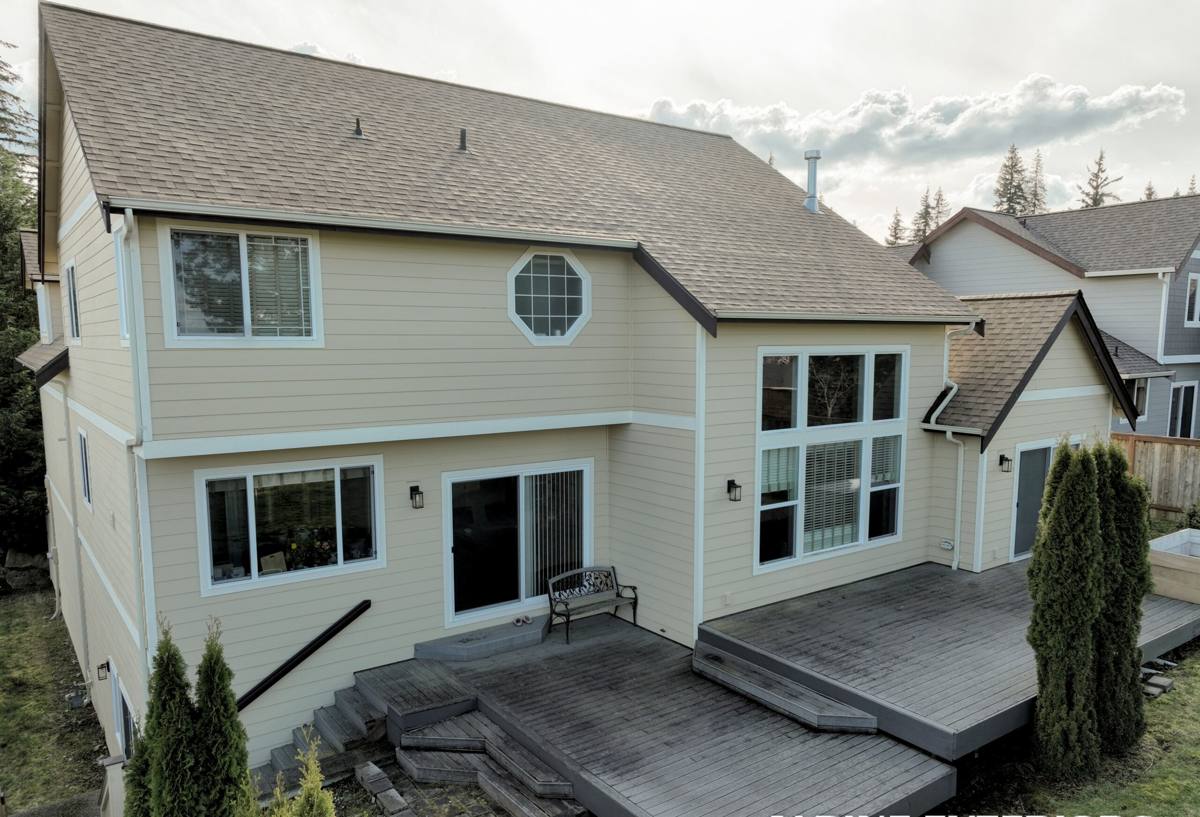
The Deck Problems We See Most Often Near the Water
Fastener and Hardware Corrosion
Standard galvanized screws and nails hold up fine in most of the country. Close to salt air, that coating breaks down faster, and once it does, rust migrates into the surrounding wood fibers and weakens the grip of every fastener nearby. This shows up first as rust staining, then as loose boards, then as hardware that shears off when you try to remove it.
Moss and Algae on Walking Surfaces
Beyond being a slip hazard, moss and algae hold moisture directly against the decking material. On wood, that means faster rot underneath the growth even while the surface looks intact. On composite decking, it's mostly cosmetic, but it still needs to be cleaned correctly so it doesn't stain permanently.
Ledger Board and Structural Rot
The ledger board — where the deck attaches to the house — is the single most important connection on the whole structure, and it's also the hardest to inspect without pulling boards. Water that isn't properly flashed at this joint runs behind the siding and into the framing, and by the time it shows on the surface, the damage is often already significant.
Warped, Cupped, or Split Decking
Repeated wet-dry cycling — soaked all winter, then briefly dried out in summer — causes wood decking to cup, crown, or split at fastener holes. Composite boards handle this better but aren't immune, especially with older, lower-grade products.
What a Correct Deck Repair Actually Involves
A repair that's done right starts with figuring out what's actually wrong, not just replacing the board that's visibly failing. We check the ledger connection and flashing, probe joists and beams for soft spots, test railing posts for movement, and look at how water has been draining (or not draining) off the surface. Only after that do we scope the repair.
- Inspect the ledger board and flashing where the deck meets the house
- Probe joists, beams, and posts for soft or spongy wood, especially near ground contact
- Check every railing post for lateral movement, a common early sign of post-base rot
- Identify which fasteners are corroding and whether surrounding wood is compromised
- Assess drainage — does water pool, or does it shed off the edge as designed
- Determine whether individual boards can be replaced or if larger sections need rebuilding
Once we know the real scope, we replace only what needs replacing, upgrade fasteners and flashing details where the original build fell short, and match new material to what's already there as closely as possible.
Repair or Replacement: How We Make That Call
Not every deck near Ship Harbor needs to be torn out. A lot of the decks we look at have a sound structural frame with isolated problems at the surface or at connection points. The table below outlines how we generally think through that decision, though every deck gets a hands-on inspection before we recommend either path.
| Condition Found | Usually Points To | Why |
|---|---|---|
| Soft decking boards, frame probes solid | Board-level repair | Surface wear from moisture doesn't always mean the structure is compromised |
| Rust-streaked fasteners, boards otherwise tight | Fastener replacement | Swapping corroded hardware for stainless is often enough to stop the problem |
| Soft or spongy ledger board | Full replacement of that section, minimum | This connection carries structural load — it can't be patched |
| Multiple posts with base movement or rot | Rebuild of the substructure | Once several load-bearing points fail, the frame as a whole is unreliable |
| Deck over 20 years old with recurring issues | Full replacement discussion | Older framing built to older standards may lack modern flashing details entirely |
Materials That Actually Hold Up in This Climate
Material choice matters more here than in drier parts of the county. We'll talk through the honest trade-offs with you rather than push one product — every option below has a place, depending on your budget, your maintenance appetite, and how close your deck sits to salt spray and shade.
| Material | Strength Near the Water | Trade-Off |
|---|---|---|
| Pressure-treated lumber | Affordable, easy to repair board-by-board | Needs regular sealing and cleaning to resist moss and rot in shaded, damp spots |
| Cedar | Naturally rot-resistant, ages well visually | Softer wood, more prone to surface wear and requires ongoing maintenance |
| Composite decking | Resists moisture damage and rot at the board level | Higher upfront cost; still needs cleaning to prevent algae staining |
| Stainless steel fasteners | Far more resistant to salt-air corrosion than standard galvanized | Costs more per fastener, but far cheaper than repairing rust damage later |
Our standard on repairs near Ship Harbor is to upgrade to stainless or heavily coated marine-grade fasteners whenever we're already opening up a connection, even if the original hardware was galvanized. It's a small cost increase for a repair that should last years longer.
Our Deck Repair Process
- On-site inspection — We walk the full deck, probe suspect areas, and check the ledger, posts, and drainage before quoting anything.
- Clear scope and estimate — You get a straightforward breakdown of what's failing, what we recommend, and why, before any work starts.
- Demo of affected areas only — We remove what's damaged without disturbing sound sections unnecessarily.
- Structural repair first — Framing, ledger, and post issues get addressed before any new decking goes down.
- Flashing and fastener upgrades — Where original details were insufficient for this climate, we correct them as part of the repair.
- New decking and finish work — Matched as closely as possible to existing material, or fully replaced if that's what the deck needs.
- Final walkthrough — We show you exactly what was done and what to watch for going forward.
Deck Maintenance Between Repairs
A deck repair lasts longer when it's paired with basic upkeep, especially in a moss-prone, salt-air environment like this one. None of this requires special equipment — it's mostly about staying ahead of moisture instead of reacting to it.
- Sweep or rinse moss and algae off walking surfaces at least once during moss season
- Keep gutters and downspouts clear so runoff isn't dumping extra water onto the deck
- Trim back vegetation that keeps sections of the deck in constant shade
- Check railing posts for movement once a year, especially after winter storms
- Look for rust streaking around fasteners as an early warning sign
- Reseal wood decking on the manufacturer's recommended schedule, not just when it looks dry
Why Local Experience in This Neighborhood Matters
A contractor who mostly works inland can still do competent framing, but they may not have a feel for how fast salt air degrades standard hardware, or how much shade and moisture a given spot near Ship Harbor holds onto compared to a deck a mile away in more open sun. That local pattern recognition changes what we flash, what fasteners we spec, and where we tell a homeowner to expect trouble first. It's the difference between a repair that's technically correct and one that's actually built for where it sits.
We work throughout Anacortes and Skagit County, and decks in this part of town — close to the water, often shaded, exposed to driving rain off the strait — are a large part of that work. That's not a sales pitch, it's just what the calls we get here tend to look like.
Get an Honest Look at Your Deck
If your deck near Ship Harbor has soft spots, rust-streaked hardware, or boards that never seem to dry out, it's worth having someone look at it before a small issue becomes a structural one. We offer free, no-pressure estimates — use the form below to get a time set up.