 Anacortes Siding
 Why Skyline Homes Face Unique Siding Repair Needs
Skyline sits on Fidalgo Island, close enough to the water that homes here take on a different kind of weather load than siding just a few miles inland. Salt-laden air off the Salish Sea works on exposed fasteners and cut edges year-round. Wind-driven rain off the water doesn't just fall straight down — it gets pushed sideways into laps, trim joints, and anywhere a seal has started to fail. And Skagit County's long, wet stretch of the year gives moss and algae months at a time to take hold on shaded and north-facing walls.
None of that means siding here fails faster than anywhere else in the Pacific Northwest. It means the failure points are predictable, and a repair that doesn't account for them is a repair that comes back. That's the difference between patching what you can see and fixing what's actually causing the damage.
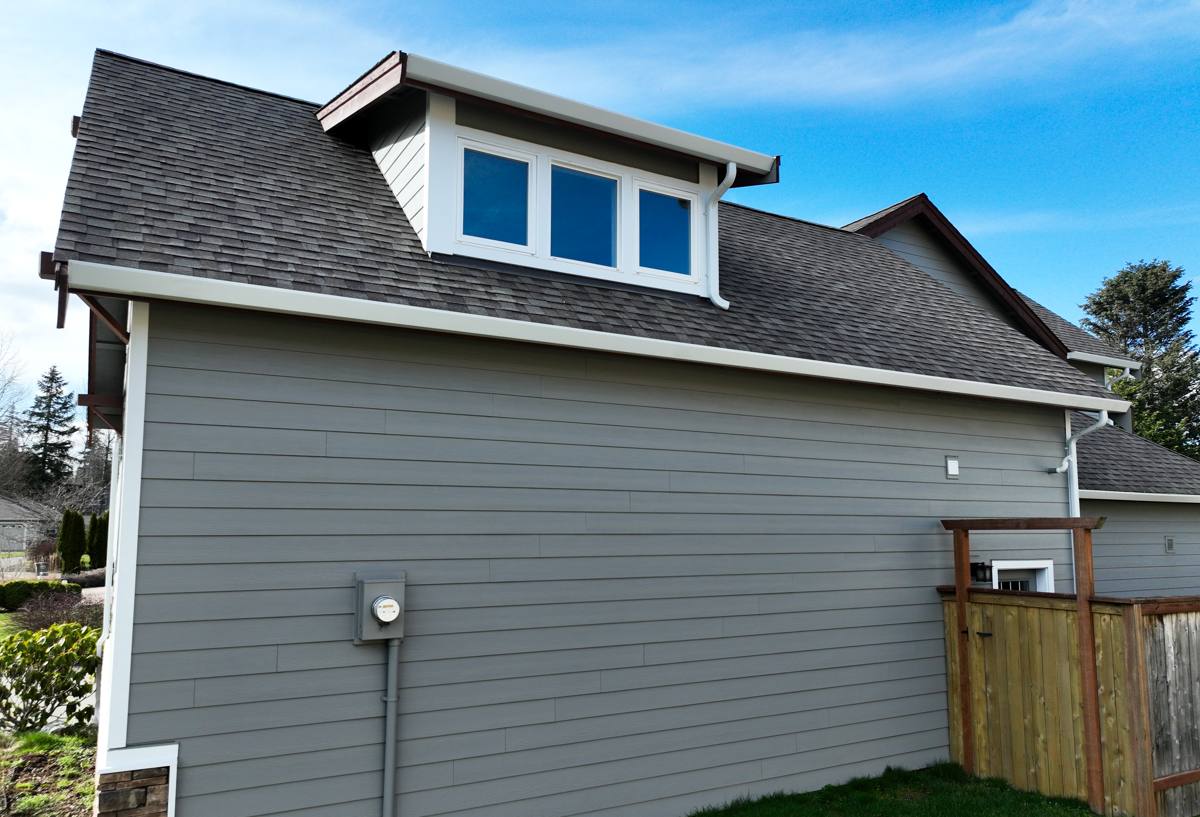
The Damage Patterns We See Most Often in This Area
Every region has its own signature wear pattern on siding, and Skyline's is shaped directly by its exposure. The issues we get called out for most consistently include:
- Cracked or split boards at butt joints, where repeated wetting and drying stresses the material over time
- Caulk failure around trim, window returns, and butt joints, which opens a direct path for wind-driven rain
- Green or black staining from moss and algae on shaded elevations, holding moisture against the surface longer than it should sit there
- Soft or swollen sections where water has been getting behind the siding for a while, often before anyone notices from the street
- Popped or corroding fasteners, especially on older installations that didn't use corrosion-resistant hardware
- Paint or finish failure on south- and west-facing walls that take the brunt of sun and rain exposure
Individually, most of these look minor. Left alone through another wet season, several of them turn into sheathing damage — which is a bigger and more expensive problem than the siding itself.
What a Correct Repair Actually Involves
A siding repair that only addresses what's visible from the driveway isn't really a repair — it's a cosmetic patch that buys a year or two before the same spot fails again. Doing it right means figuring out why that section failed in the first place.
Finding the Root Cause
Before we replace a single board, we're looking at what's behind it. Is water getting in because a flashing detail was missed above a window or door? Is the grade or a downspout dumping water against the wall? Is the weather-resistive barrier torn or improperly lapped behind the damaged section? Cracked siding is often a symptom, not the disease.
Checking for Hidden Moisture
Visible damage rarely stops exactly where you can see it. We check moisture levels in the surrounding boards and, where there's reason for concern, look at the condition of the sheathing underneath. A repair that stops at the edge of the visible crack but leaves saturated material next to it isn't solving anything.
Matching the Fix to the Cause
Sometimes the correct repair is straightforward board replacement. Sometimes it means correcting a flashing detail, re-sealing a transition, or addressing a drainage issue at the foundation line before the new siding ever goes up. Skipping that step is the single most common reason a "repaired" section fails again within a couple of years.
Repair or Replace? What Actually Drives That Decision
Homeowners in Skyline often ask whether a problem area is worth repairing or whether it's a sign to plan for a fuller re-side. There's no universal answer, but a few factors consistently point one way or the other.
| Factor | Leans Toward Repair | Leans Toward Replacement |
|---|---|---|
| Extent of damage | Isolated to a few boards or one elevation | Spread across multiple walls or recurring in the same areas |
| Age of existing siding | Siding is younger and otherwise sound | Siding is near or past its expected service life |
| Sheathing condition | Sheathing tests dry and solid | Sheathing shows rot or long-term saturation |
| Material match | Replacement boards can be color- and profile-matched | Original product is discontinued or a poor long-term fit for the site |
| Underlying cause | A single fixable detail (flashing, caulk, grading) | A systemic issue affecting the whole assembly |
An honest inspection tells you which column you're in. We'll never talk a homeowner into a full re-side when a targeted repair will genuinely hold up — and we'll say so plainly when a repair is just delaying a bigger cost.
Our Repair Process, Step by Step
A repair visit isn't just "pull the bad board, nail up a new one." Here's what a repair job actually looks like when it's done to hold up through another Skagit County winter:
- Inspection and diagnosis — identifying every damaged area, not just the one that prompted the call
- Moisture and condition check — assessing what's happening behind the siding, not just on the surface
- Careful removal — taking out damaged sections without disturbing sound siding around them
- Correcting the underlying issue — flashing, sealant, or drainage detail, whatever caused the failure
- Installing replacement material — matched to the existing siding in profile and color wherever possible
- Sealing and finishing — proper caulking at joints and trim, and touch-up finish work so repairs don't stand out
The goal at every step is the same: a repair that blends in visually and, more importantly, doesn't reopen the same water path that caused the original damage.
Why Material Choice Matters When You're Repairing, Not Just Building New
We install James Hardie fiber cement siding exclusively, and that shapes how we approach repair work, too. If your home already has Hardie siding, repairs are usually the cleanest kind of job — Hardie's ColorPlus factory finish and consistent product lines make it realistic to match new boards to existing ones without a jarring seam in color or texture. Hardie's HZ product lines are also engineered for exactly this region's moisture exposure, which is part of why we standardized on it in the first place: non-combustible, dimensionally stable, and built to hold a factory finish longer than field-applied paint typically lasts.
If your home currently has vinyl, wood, LP SmartSide, or another fiber cement brand, we'll still repair it honestly and correctly — patch work doesn't require tearing out a whole wall of a different product. But if a home is showing repeated failures in the same spots, that's worth an honest conversation about whether the underlying material is fighting the local climate rather than working with it. That's a decision for the homeowner to make, not something we push — but it's information worth having before you sink more money into repeated patches.
Maintenance That Actually Prevents Repair Calls
A lot of what we get called out for in Skyline is preventable with a little seasonal attention. This is the same checklist we'd hand any homeowner in this area:
- Rinse moss and algae off shaded or north-facing siding before it builds up a thick mat that holds moisture
- Keep gutters clear so overflow isn't running down the wall behind the siding
- Trim back branches and shrubs that keep a wall damp and shaded longer than the rest of the house
- Walk the exterior after a heavy wind-and-rain event and look for lifted caulk, cracked boards, or staining that wasn't there before
- Re-caulk trim and butt joints proactively rather than waiting for a visible gap
- Check that downspouts and grading are actually directing water away from the foundation and lower siding courses
None of this eliminates the need for repairs eventually — siding is a wear item on any house — but it stretches the time between them and keeps small issues from becoming sheathing problems.
Why It Matters That We Already Work in Skyline
Siding failure in Skyline doesn't look identical to siding failure in a drier inland part of Skagit County, and a crew that mostly works elsewhere doesn't always know that going in. We've seen where water tends to find its way in on homes exposed to this stretch of the water, which elevations take the worst of the moss and algae load, and which older installation details tend to cause callbacks a few years down the road. That familiarity means less guesswork during the inspection and a repair plan that accounts for what actually happens to siding here, not just what a textbook says should happen.
It also means we're not learning Anacortes and Skagit County permitting and code requirements on your job — we already know what's expected, and we handle repairs the same way we'd want them handled on our own homes.
Get an Honest Look at Your Siding
If you're seeing cracked boards, staining, soft spots, or caulk that's pulling away from trim, it's worth getting an honest opinion before another wet season sets in. We offer free, no-pressure estimates for siding repair in Skyline and throughout Anacortes — use the form below to get a straightforward assessment of what's going on and what it will take to fix it right.