 Anacortes Siding
 Edison Sits in a Tough Spot for Siding
Edison is a small farming and arts community in Skagit County, tucked between the flat delta land near Samish Bay and the wetter foothill country to the east. That location puts homes here in the path of two things that wear out siding faster than almost anywhere else in the region: salt-laden air moving in off the bay, and long stretches of low, wet weather that settle over the flats and don't clear out the way they would on higher, breezier ground.
Add in Skagit County's moss season — which here can run eight or nine months out of the year on north-facing walls and anything shaded by trees or outbuildings — and you have a climate that actively works against cheap or poorly installed siding. Salt air accelerates corrosion on fasteners and trim. Standing moisture from driving rain finds every gap in flashing and caulking. Moss and algae hold water against the wall surface long after a storm has passed, which is exactly the condition that rots wood-based products and lifts paint.
None of this means siding here is doomed to fail. It means the product and the installation both have to be chosen for this specific environment, not for a catalog photo.
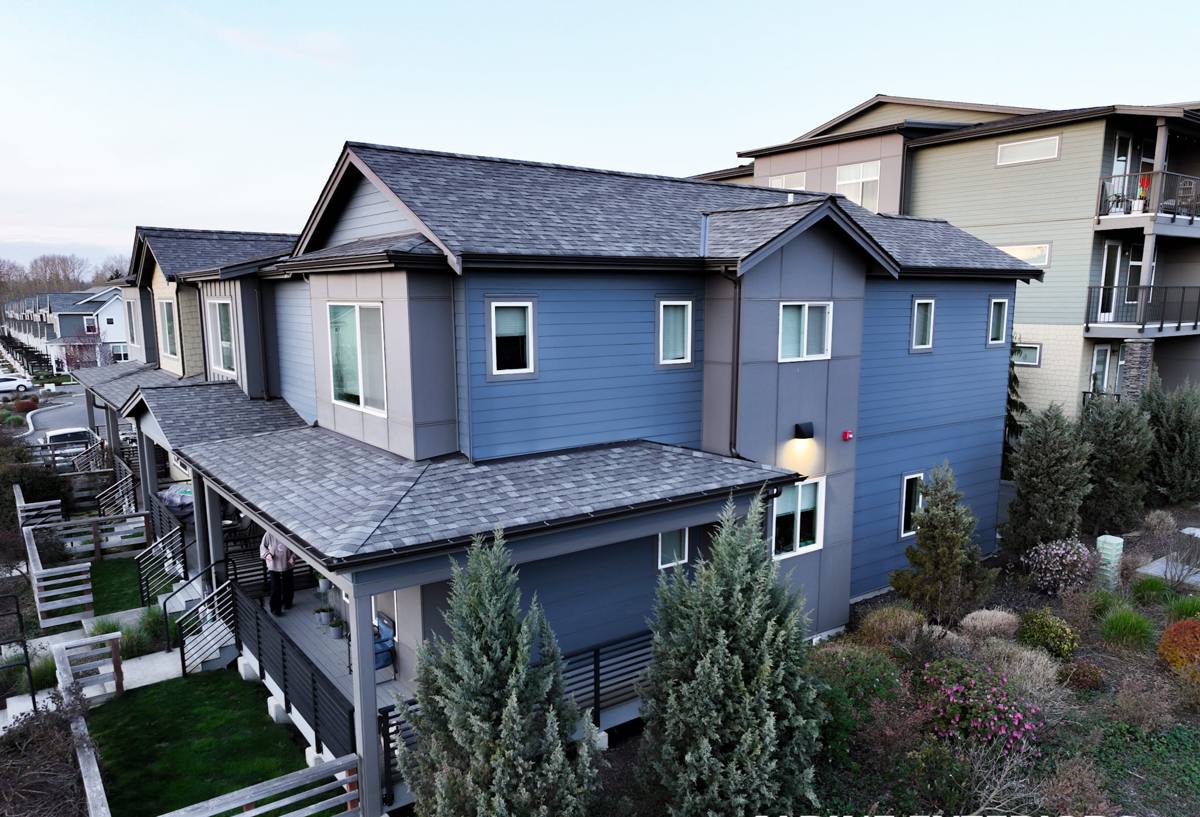
How Edison's Climate Actually Damages Siding
Salt Air and Corrosion
Homes closer to Samish Bay and the surrounding tidal flats get a steady, low-level dose of salt in the air. Over years, that salt accelerates corrosion on exposed fasteners, metal trim, and any hardware that isn't rated for coastal exposure. It also breaks down cheap paint finishes faster than an inland home would experience, which is why factory-applied, baked-on finishes hold up better here than field-applied paint.
Driving Rain
Storms coming off the Salish Sea don't just fall straight down here — wind-driven rain gets pushed sideways into wall assemblies, particularly on the west and southwest exposures. Siding that relies on caulk alone to keep water out, rather than a properly lapped and flashed drainage plane behind it, eventually lets that water in. Once water gets behind the siding, the framing and sheathing underneath are what actually rot — the siding is often just the first thing that shows the damage.
Moss and Sustained Moisture
The flat, low-lying land around Edison holds fog and damp air longer than higher ground does. Combined with tree cover and shaded north walls, that creates ideal conditions for moss and algae to establish on siding and stay there. Moss holds moisture against the surface, which is a slow but steady threat to any siding material that isn't dimensionally stable when wet.
Signs Your Edison Home Needs Siding Replacement
- Soft, spongy, or crumbling spots when you press on the siding, especially near the bottom of walls or below windows
- Paint that's peeling, bubbling, or needs repainting more often than every 7-8 years
- Visible warping, cupping, or boards that have pulled away from the wall
- Persistent moss or algae staining that comes back within a season or two of cleaning
- Rust streaks running down from fasteners or trim
- Rising energy bills alongside drafts near exterior walls
- Visible gaps at seams, corners, or around window and door trim
- Siding that's original to a home built more than 20-25 years ago, especially wood-based product
Why We Install Only James Hardie Fiber Cement
We standardized on James Hardie fiber cement siding for every job we do, including work in Edison, and we don't install vinyl, LP SmartSide, cedar, primed spruce, Cemplank, or Allura. That's not a marketing position — it's a decision based on what actually holds up in this specific climate over decades, not just years.
Vinyl siding can warp and become brittle with temperature swings, and it relies on gaps and laps rather than a sealed, engineered water-management system — a real liability with wind-driven rain. Wood-based products like cedar and primed spruce look good on day one, but they're organic material in a climate that stays damp for most of the year; even with excellent maintenance, they're vulnerable to moisture absorption, swelling, and eventual rot. LP SmartSide is an engineered wood product, which improves on solid wood in some ways, but it's still wood at its core and still depends on an intact factory coating to keep moisture out — any breach in that coating is a path for water into wood fiber.
James Hardie fiber cement is cement, sand, and cellulose fiber — it doesn't rot, it isn't attractive to insects, and it holds paint and factory finish far longer than wood-based alternatives because it doesn't expand and contract with moisture the way wood does. It's also non-combustible, which matters given Washington's wildfire seasons have been creeping earlier and lasting longer. Hardie's ColorPlus factory finish is baked on under controlled conditions, which produces a more even, longer-lasting result than field-applied paint — a real advantage against salt air and UV exposure. And Hardie's HZ5 product line is engineered specifically for the Pacific Northwest's freeze-thaw and moisture cycle, not a generic national spec.
We won't pretend fiber cement is the cheapest option on the shelf — it isn't. But for a home that has to survive Edison's salt air, driving rain, and moss season for the next 30-50 years, it's the material that actually does the job without repeated maintenance and premature replacement.
What a Correct Siding Replacement Actually Involves
Siding replacement isn't just removing old boards and nailing up new ones. In a climate like this, the parts you don't see matter as much as the finished look:
Tear-Off and Inspection
Full removal of the old siding lets us actually see the sheathing and framing underneath — which is often the only way to catch hidden rot or water damage from years of a failing water-management system before it's covered up again.
Weather-Resistive Barrier
A properly lapped weather-resistive barrier (WRB) goes over the sheathing before any siding goes up. This is the drainage plane that gives water a way out if it ever gets behind the siding — critical given how much wind-driven rain this area sees.
Flashing at Every Penetration
Windows, doors, vents, hose bibs, light fixtures — every penetration in the wall is a potential entry point for water. Correct flashing detail at each one is what actually keeps driving rain out, not caulk alone.
Fastening to Manufacturer Spec
James Hardie has specific fastener patterns, spacing, and clearance requirements, and following them is what keeps the warranty valid and the installation performing as engineered. Corrosion-resistant fasteners matter more here than in a drier, inland climate because of the salt air.
Proper Clearances
Siding needs clearance from grade, roof lines, and decks to avoid trapping moisture against the bottom edge — a detail that's easy to skip and expensive to ignore later.
Our Siding Replacement Process
- On-site assessment — we look at your current siding, the condition of the sheathing where visible, sun and wind exposure on each wall, and any moss or moisture patterns specific to your property.
- Written estimate — a clear scope of work and cost, with no pressure to sign on the spot.
- Material selection — choosing the right James Hardie product line and color for your home's exposure and your preferences.
- Tear-off and structural check — full removal of old siding and inspection of the wall assembly underneath.
- WRB and flashing installation — the water-management layer that does the real work over the life of the siding.
- Hardie installation to spec — correct fastening, spacing, and clearances throughout.
- Final walkthrough — reviewing the finished work with you before we consider the job done.
Cost Factors for Siding Replacement
Every home is different, but the same handful of factors drive most of the cost variation we see on jobs in and around Edison:
| Factor | Why It Matters |
|---|---|
| Home size and wall complexity | More square footage, more corners, gables, and dormers all mean more material and labor |
| Condition of existing sheathing | Hidden rot found during tear-off may need repair before new siding goes on |
| Siding profile and color | Hardie offers several plank widths, textures, and ColorPlus finishes at different price points |
| Trim and detail work | Window and door trim, corner boards, and fascia detail add labor time |
| Access and site conditions | Steep grades, tree cover, or tight lot lines can affect scaffolding and staging |
| Removal and disposal | Tear-off and haul-away of old siding is part of most full-replacement jobs |
We give straightforward written estimates based on what we actually find at your home — not a generic per-square-foot number that ignores your specific walls.
Why Hiring a Crew That Already Works in Edison Matters
Edison and the surrounding Samish Bay flats aren't identical to Anacortes proper, or to the drier parts of Skagit County further inland. A crew that regularly works this specific stretch already knows how much salt exposure to plan for on bay-facing walls, how aggressively moss establishes on shaded north sides here, and how wind-driven rain behaves on this flat, exposed terrain. That's the difference between a generic installation and one that's actually built for where your house sits.
It also means faster, more realistic scheduling around this area's weather patterns, and a contractor who isn't learning the local conditions on your project.
Maintaining Your New Siding in Edison's Climate
- Rinse siding annually to remove salt residue and prevent moss and algae buildup, especially on north and shaded walls
- Trim back trees and shrubs to improve airflow and sun exposure on affected walls
- Inspect caulking around windows, doors, and trim yearly and touch up as needed
- Watch for and address any moss regrowth early, before it holds moisture against the surface
- Keep gutters clear so water isn't overflowing onto siding below
James Hardie's factory ColorPlus finish reduces how often repainting is needed compared to field-painted wood siding, but no siding is entirely maintenance-free in this climate — a little attention each year goes a long way toward getting the full lifespan out of the material.
If you're seeing warning signs on your Edison home, or your siding is simply due for replacement, we're happy to take a look and give you a straightforward, no-pressure estimate — just fill out the form below.