 Anacortes Siding
 Decks Built for March Point's Marine Environment
March Point sits close enough to the water that every deck built here is, in effect, built into a marine environment. Salt-laden air moves through the area regularly, rain comes in sideways more often than most homeowners expect, and the shoulder seasons bring long stretches of damp, low-light weather that keeps every horizontal surface wet for days at a time. A deck that would hold up fine in a drier inland part of Skagit County can start showing problems here within a few seasons if it wasn't built with this specific exposure in mind.
That doesn't mean building here is complicated — it means the details that get skipped elsewhere can't get skipped here. Fastener choice, ledger flashing, gap spacing, and airflow underneath the structure all matter more in a spot like March Point than they would twenty miles inland. This page walks through what that actually looks like in practice.
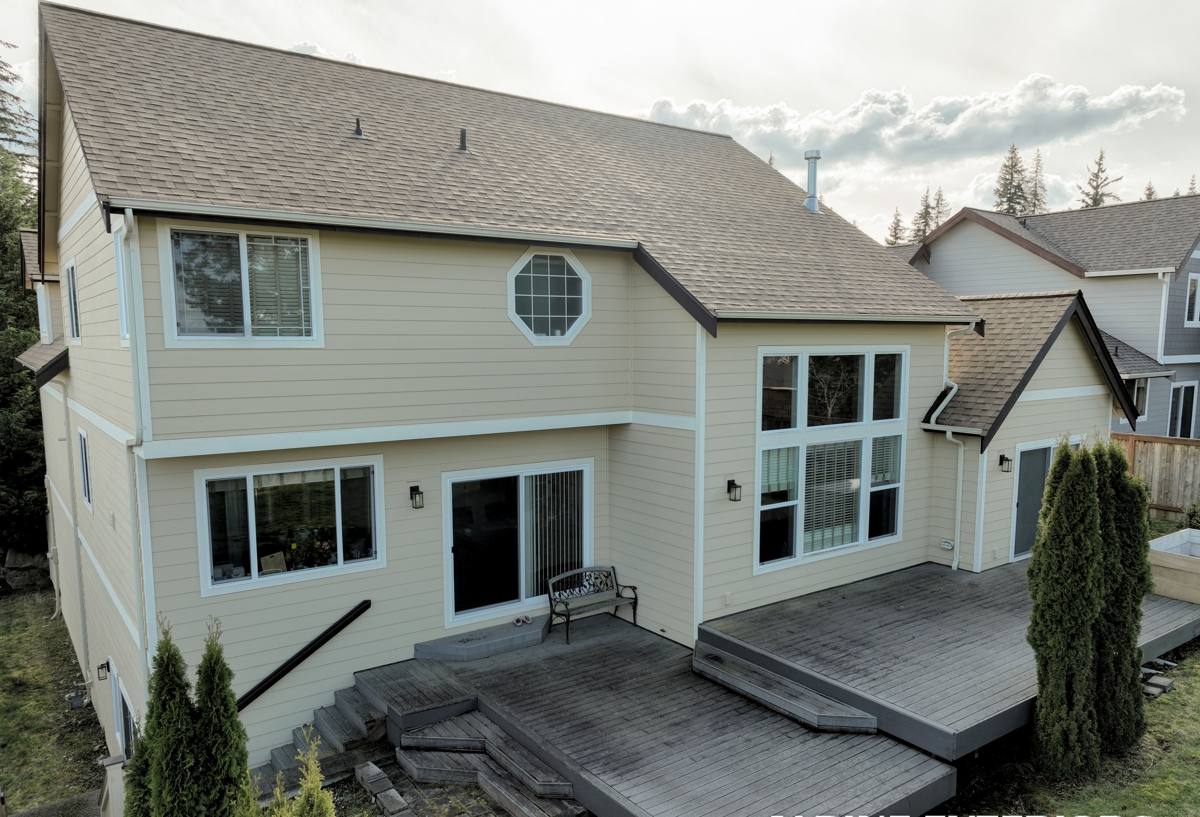
What Salt Air, Driving Rain, and Moss Season Do to a Deck
Each of these three conditions attacks a deck differently, and a correctly built deck has to answer all three at once.
Salt Air
Airborne salt accelerates corrosion on anything metal — fasteners, brackets, hidden fastener clips, and railing hardware. Standard galvanized screws and connectors that are rated for general outdoor use can start rusting from the inside out in a coastal-influenced setting well before a homeowner sees surface staining. Once a fastener corrodes, it loses holding strength long before it looks bad, which is exactly why this matters more than it seems like it should.
Driving Rain
Wind-driven rain doesn't just fall on a deck — it gets pushed sideways into ledger connections, under railing posts, and into any gap where flashing was skipped or installed loosely. On a flat or lightly sloped deck surface, that water needs somewhere to go. If drainage wasn't planned into the framing from the start, water finds its own path, and that path is usually through a seam that was never meant to shed water.
Moss Season
Anacortes and the rest of Skagit County get long stretches of mild, wet weather that are ideal for moss and algae growth. On a deck, moss doesn't just look bad — it holds moisture against the decking surface, keeps boards from drying out between rain events, and turns any shaded or low-airflow section of the deck into a standing damp zone. Over time that moisture retention is what actually causes rot, not the rain itself.
Choosing Decking Material for a Site Like This
There's no single "best" decking material — there's a best fit for the site, the budget, and how much upkeep a homeowner actually wants to do. For a March Point property, the comparison usually comes down to three realistic options.
| Material | How It Handles This Climate | Maintenance Burden |
|---|---|---|
| Pressure-treated wood | Affordable and strong, but needs sealing on a regular schedule to resist moisture and moss buildup in shaded areas | Highest — annual cleaning and periodic re-sealing |
| Composite decking | Resists rot and doesn't need sealing; some early-generation composite products held moisture at the surface and grew algae faster than expected, so board selection matters | Low — periodic cleaning, no sealing |
| PVC/capped decking | Fully sheds moisture at the surface, holds up well against salt exposure and driving rain, generally the most resistant to moss in shaded spots | Lowest — occasional washing |
We don't push one material on every job. A covered, shaded deck that never gets direct sun is a different situation than an open, south-facing deck, and the right material choice follows the site conditions, not the other way around.
Why We're Selective About Which Composite Products We Install
Not all composite decking behaves the same way in a wet, low-sun climate. Some products handle standing moisture and shaded conditions better than others, and installation details — gapping, ventilation underneath, and fastener spacing — affect how well any given board performs over time. Our standard is to install products with a track record in wet Pacific Northwest conditions specifically, and to install them the way the manufacturer's warranty actually requires, rather than the way that's fastest to build.
What a Correctly Built Deck Actually Involves
A deck that's going to hold up in this climate is built correctly below the surface, not just on top of it. The visible decking boards are the last five percent of the job.
Footings and Framing
Footings need to be sized and set below frost depth and on undisturbed, well-draining soil. Undersized or shallow footings are one of the most common corner-cuts we see on older or lower-budget builds, and they're also the hardest problem to fix later, since correcting them usually means partially rebuilding the structure.
Ledger Attachment and Flashing
Where a deck attaches to the house is the single most common failure point on any deck, anywhere — and in a driving-rain climate, it's even less forgiving. Proper flashing has to shed water away from the house structure, not just sit behind the ledger board. This is the detail that separates a deck that's dry inside the wall cavity ten years from now from one that's rotting the house's framing without anyone noticing until there's a soft spot in the floor.
Fasteners and Hardware
Every screw, bracket, and hanger should be rated for the environment it's going into — not just "exterior rated" in a general sense, but corrosion-resistant enough for a coastal-influenced setting. Stainless or heavily coated hardware costs more up front and is worth it here.
Gapping and Airflow
Board spacing needs to account for both drainage and the material's expansion behavior, and the structure underneath needs enough clearance and ventilation that air can actually move. A deck built low to the ground with poor underside airflow will hold moisture and grow moss faster than one that was framed with clearance in mind from the start.
Quick Reference: Signs an Existing Deck Needs Attention
- Soft or spongy spots anywhere in the decking, especially near the house
- Rust staining around fasteners or visible corrosion on brackets and hardware
- Persistent moss or algae in the same spot every year, even after cleaning
- Gaps or separation where the ledger board meets the house siding
- Railing posts that flex or feel loose when pushed
- Standing water that takes more than a day to fully dry after rain
How We Approach a March Point Deck Project
1. Site Assessment
We look at sun exposure, prevailing wind and rain direction, existing drainage, and how close the site is to open water or salt-influenced air, since that changes hardware and material recommendations.
2. Design and Material Selection
We walk through material trade-offs honestly — upfront cost against long-term maintenance — so the decision fits the homeowner's actual priorities, not just the lowest bid.
3. Permitting
Deck projects in Skagit County typically require permitting depending on size, height, and attachment to the structure. We handle that process as part of the job so it isn't left for the homeowner to figure out.
4. Construction
Footings, framing, flashing, and fastening are done to the standard described above — not the minimum standard, the correct one for this climate.
5. Final Walkthrough
We go over the finished deck with the homeowner, including basic care specific to the material installed, so there are no surprises in the first wet season.
Living With the Moss Season
Even a well-built deck in Anacortes and the surrounding parts of Skagit County needs some seasonal attention, because moss growth here is a function of climate, not workmanship. The goal of good construction is to make that upkeep minimal and predictable rather than eliminate it entirely — no deck material makes moss impossible in a shaded, wet Pacific Northwest yard.
- Sweep debris and organic matter off the deck surface regularly, especially in fall
- Keep gutters and downspouts near the deck clear so water isn't dumping directly onto it
- Trim back overhanging branches that keep sections of the deck shaded and damp longer than the rest
- Rinse or lightly clean shaded areas more often than sun-exposed ones
- Check railing hardware annually for corrosion, particularly on properties closer to open water
Why It Matters to Hire a Crew That Already Works in March Point
Deck-building fundamentals don't change from town to town, but the specific combination of salt exposure, storm direction, and moss pressure in a place like March Point is something a crew learns by working here repeatedly — not from a general contracting manual. We've built and repaired decks throughout Anacortes and Skagit County long enough to know which hardware actually holds up in this air, which decking products handle shaded, damp conditions well, and which framing shortcuts show up as callbacks two or three years later. That local pattern recognition is the difference between a deck that's built to pass inspection and one that's built to last through this specific climate.
If you're planning a new deck or dealing with an aging one in March Point, we're happy to take a look and talk through honest options — no pressure, no obligation. Use the form below to request a free estimate.